

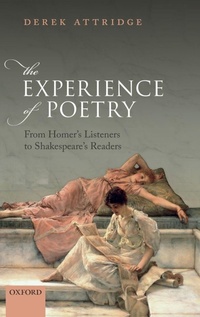
The Experience of Poetry
From Homer's Listeners to Shakespeare's Readers
Published on 5. March 2019
Book
Hardback
462 pages
978-0-19-883315-4 (ISBN)
Description
Was the experience of poetry--or a cultural practice we now call poetry--continuously available across the two-and-a-half millennia from the composition of the Homeric epics to the publication of Ben Jonson's Works and the death of Shakespeare in 1616? How did the pleasure afforded by the crafting of language into memorable and moving rhythmic forms play a part in the lives of hearers and readers in Ancient Greece and Rome, Europe during Late Antiquity and the Middle Ages, and Britain during the Renaissance?
In tackling these questions, this book first examines the evidence for the performance of the Iliad and the Odyssey and of Ancient Greek lyric poetry, the impact of the invention of writing on Alexandrian verse, the performances of poetry that characterized Ancient Rome, and the private and public venues for poetic experience in Late Antiquity. It moves on to deal with medieval verse, exploring the oral traditions that spread across Europe in the vernacular languages, the place of manuscript transmission, the shift from roll to codex and from papyrus to parchment, and the changing audiences for poetry. A final part investigates the experience of poetry in the English Renaissance, from the manuscript verse of Henry VIII's court to the anthologies and collections of the late Elizabethan era. Among the topics considered in this part are the importance of the printed page, the continuing significance of manuscript circulation, the performance of poetry in pageants and progresses, and the appearance of poets on the Elizabethan stage. In tracking both continuity and change across these many centuries, the book throws fresh light on the role and importance of poetry in western culture.
In tackling these questions, this book first examines the evidence for the performance of the Iliad and the Odyssey and of Ancient Greek lyric poetry, the impact of the invention of writing on Alexandrian verse, the performances of poetry that characterized Ancient Rome, and the private and public venues for poetic experience in Late Antiquity. It moves on to deal with medieval verse, exploring the oral traditions that spread across Europe in the vernacular languages, the place of manuscript transmission, the shift from roll to codex and from papyrus to parchment, and the changing audiences for poetry. A final part investigates the experience of poetry in the English Renaissance, from the manuscript verse of Henry VIII's court to the anthologies and collections of the late Elizabethan era. Among the topics considered in this part are the importance of the printed page, the continuing significance of manuscript circulation, the performance of poetry in pageants and progresses, and the appearance of poets on the Elizabethan stage. In tracking both continuity and change across these many centuries, the book throws fresh light on the role and importance of poetry in western culture.
Reviews / Votes
It is bracing to follow a prominent senior scholar in his exploration of so many centuries-millennia encountered not with any ex cathedra jadedness but with open enthusiasm that should immediately engage readers at every academic level. * Stephen Hinds, University of Washington, Modern Language Quarterly * Attridge's exploration is detailed and extensive as he considers how the demands of social norms and the changes in production technologies influenced the ways in which poetry might be experienced by readers and listeners. In turn, the volume will be of interest to those studying any of the time frames that it discusses as well as those interested in questions regarding the reception and transmission of literature. * John S. Garrison, Renaissance Studies * ...[the volume] is of significant value to classical scholarship, encouraging as it does a contextualising of ancient engagements with this literary form, and our own study of such engagements, within a much broader cultural history of poetry...this book offers an invaluable opportunity to consider the material with which we are most familiar as set within the wider evolution of poetry as a cultural phenomenon. But perhaps more significantly, we can become aware of how our perceptions of poetry by the ancient Greeks and Romans have likely been shaped by the different forms that poetry took in subsequent centuries... it should also encourage us to approach any poetry belonging to antiquity as part of a broader cultural activity than is often acknowledged. * Emily Patterson, Bryn Mawr Classical Review *More details
Language
English
Place of publication
Oxford
United Kingdom
Target group
Professional and scholarly
Illustrations
37 Illustrations
Dimensions
Height: 240 mm
Width: 161 mm
Thickness: 34 mm
Weight
1192 gr
ISBN-13
978-0-19-883315-4 (9780198833154)
Copyright in bibliographic data and cover images is held by Nielsen Book Services Limited or by the publishers or by their respective licensors: all rights reserved.
Schweitzer Classification
Other editions
Additional editions
E-Book
02/2019
1st Edition
OUP eBook
€22.99
Available for download
E-Book
01/2019
1st Edition
OUP eBook
€22.99
Available for download
Person
Derek Attridge obtained degrees from the Universities of Natal and Cambridge and he taught at Southampton, Strathclyde, and Rutgers Universities before moving to the University of York, where is he Emeritus Professor of English and Related Literature. He is the author or co-author of fifteen books on poetic form, literary theory, and South African and Irish literature, and has edited or co-edited eleven collections on similar topics. He has held fellowships or visiting professorships in the USA, South Africa, France, Italy, Egypt, and Australia and he is a Fellow of the British Academy.
Content
Preface
Introduction
PART ONE: Ancient Greece
1: Homeric Greece: Courts and Singers
2: Archaic to Classical Greece: Festivals and Rhapsodes
3: Classical Greece to Ptolemaic Alexandria: Writers and Readers
PART TWO: Ancient Rome and Late Antiquity
4: Ancient Rome: The Republic and the Augustan Age
5: Ancient Rome: The Empire after Augustus
6: Late Antiquity: Latin and Greek, Private, Public, Popular
PART THREE: The Middle Ages
7: Early Medieval Poetry: Vernacular Versifying
8: The Twelfth and Thirteenth Centuries: Performing Genres
9: Lyric, Romance, and Alliterative Verse in Fourteenth-Century England
10: Chaucer, Gower, and Fifteenth-Century Poetry in English
PART FOUR: The English Renaissance
11: Early Tudor Poetry: Courtliness and Print
12: Late Elizabethan and Early Jacobean Poetry: The Circulation of Verse
13: Late Elizabethan and Early Jacobean Poetry: The Idea of the Poet
Bibliography
Introduction
PART ONE: Ancient Greece
1: Homeric Greece: Courts and Singers
2: Archaic to Classical Greece: Festivals and Rhapsodes
3: Classical Greece to Ptolemaic Alexandria: Writers and Readers
PART TWO: Ancient Rome and Late Antiquity
4: Ancient Rome: The Republic and the Augustan Age
5: Ancient Rome: The Empire after Augustus
6: Late Antiquity: Latin and Greek, Private, Public, Popular
PART THREE: The Middle Ages
7: Early Medieval Poetry: Vernacular Versifying
8: The Twelfth and Thirteenth Centuries: Performing Genres
9: Lyric, Romance, and Alliterative Verse in Fourteenth-Century England
10: Chaucer, Gower, and Fifteenth-Century Poetry in English
PART FOUR: The English Renaissance
11: Early Tudor Poetry: Courtliness and Print
12: Late Elizabethan and Early Jacobean Poetry: The Circulation of Verse
13: Late Elizabethan and Early Jacobean Poetry: The Idea of the Poet
Bibliography