

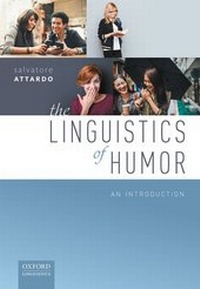
The Linguistics of Humor
An Introduction
Published on 25. June 2020
Book
Paperback/Softback
496 pages
978-0-19-879128-7 (ISBN)
Description
This book is the first comprehensive and systematic introduction to the linguistics of humor. Salvatore Attardo takes a broad approach to the topic, exploring not only theoretical linguistic analyses, but also pragmatic and semantic aspects, conversation and discourse analysis, ethnomethodology, and interactionist and variationist sociolinguistics. The volume begins with chapters that introduce the terminology and conceptual and methodological apparatus, as well as outlining the major theories in the field and examining incongruity and resolution and the semiotics of humor. The second part of the book explores humor competence, with chapters that cover semantic and pragmatic topics, the General Theory of Verbal Humor, and puns and their interpretation. The third part provides an in-depth discussion of the applied linguistics of humor, and examines social context, discourse and conversation analysis, and sociolinguistic aspects. In the final part of the book, the discussion is extended beyond the central field of linguistics, with chapters discussing humor in literature, in translation, and in the classroom.
The volume brings together the multiple strands of current knowledge about humor and linguistics, both theoretical and applied; it assumes no prior background in humor studies, and will be a valuable resource for students from advanced undergraduate level upwards, particularly those coming to linguistics from related disciplines.
The volume brings together the multiple strands of current knowledge about humor and linguistics, both theoretical and applied; it assumes no prior background in humor studies, and will be a valuable resource for students from advanced undergraduate level upwards, particularly those coming to linguistics from related disciplines.
Reviews / Votes
This elementary book is well structured and presented for readers without prior training in humor studies. Overall, it provides a clear foundation for understanding humor's embedding in linguistic practice, and its distinct (yet overlapping) cognitive, emotional, and physiological/embodied manifestations. As awkward as it can sometimes be to explain a joke, I enjoyed every aspect of this enlightening, eye-opening book. * Joseph Comer, Language in Society * The book-a must for linguists and humour scholarsalike -is intended to assess the current state of research and "set it out clearly in as comprehensive a framework as possible" (p. 384). * Wladyslaw Chlopicki, Jagiellonian University, Krakow, Poland, The European Journal of Humour Research * Indispensable, both as a text and for deep reading and reflection, giving comprehensive insight into how linguistics applies to humorous communications and the wider realms of humour theory and analysis. This book reflects a lifetime of reading and thinking on the complex and puzzling topic--what is the nature of humour and how do we research it? * Jessica Milner Davis, University of Sydney * It is often held to be a scientific ideal that we draw from multiple disciplinary perspectives in advancing our understanding of complex social phenomena such as humour, but we fall short of that ideal for the most part. Professor Attardo shows us how it should be done. In The Linguistics of Humor, he offers us a masterful and insightful overview that will help both those new to the field, as well as seasoned researchers, navigate the rapidly growing field of humour studies. Throughout the volume he integrates different theoretical and methodological perspectives, resulting in something that is much more than the simple sum of its parts. This is a must-read for anyone interested in humour studies. * Michael Haugh, University of Queensland * No doubt the most comprehensive treatment of the linguistic study of humor. Attardo succeeds, in particular, in showing how the phenomenon (or better, phenomena) of humor involve(s) the full complexity of what people do with language. * Jef Verschueren, University of Antwerp * Attardo successfully anticipates what target audiences want to know, what questions they may have, and what narrative style is optimal for them to understand the linguistics of humor. The target audience will surely benefit from this outstanding work...Reading this book while reflecting on one's own research, linguistic researchers studying humor can get insightful information. * Baiyao Zu, Brill *More details
Language
English
Place of publication
Oxford
United Kingdom
Target group
College/higher education
Dimensions
Height: 246 mm
Width: 171 mm
Thickness: 26 mm
Weight
862 gr
ISBN-13
978-0-19-879128-7 (9780198791287)
Copyright in bibliographic data and cover images is held by Nielsen Book Services Limited or by the publishers or by their respective licensors: all rights reserved.
Schweitzer Classification
Other editions
Additional editions
E-Book
06/2020
1st Edition
OUP eBook
€24.99
Available for download
Book
06/2020
Oxford University Press
€141.30
Shipment within 15-20 days
Person
Salvatore Attardo is Professor of Linguistics at Texas A&M University - Commerce. He works primarily on the linguistics of humor, and on issues relating to implicatures, irony, and rationality, and more generally on Neo-Gricean pragmatics. He was Editor-in-Chief of HUMOR: International Journal of Humor Research for ten years. His publications include Linguistic Theories of Humor (De Gruyter, 1994), Humorous Texts: A Semantic and Pragmatic Analysis (De Gruyter, 2001), and, as editor, The Encyclopedia of Humor Studies (Sage, 2014) and The Handbook of Language and Humor (Routledge, 2017).
Content
Preface
List of figures and tables
Part I: Humor Studies
1: Humor studies: A few definitions
2: Methodological preliminaries
3: Theories of humor and their levels
4: Incongruity and resolution
5: Semiotics of humor
Part II: Humor Competence
6: The semantics of humor
7: The General Theory of Verbal Humor
8: Pragmatics of humor
9: Verbal humor
Part III: Humor Performance
10: The performance of humor
11: Conversation analysis: Humor in conversation I
12: Discourse analysis: Humor in conversation II
13: Sociolinguistics of humor
Part IV: Applications
14: Humor in literature
15: Humor and translation
16: Humor in the classroom
17: Conclusion
Glossary
References
Index
List of figures and tables
Part I: Humor Studies
1: Humor studies: A few definitions
2: Methodological preliminaries
3: Theories of humor and their levels
4: Incongruity and resolution
5: Semiotics of humor
Part II: Humor Competence
6: The semantics of humor
7: The General Theory of Verbal Humor
8: Pragmatics of humor
9: Verbal humor
Part III: Humor Performance
10: The performance of humor
11: Conversation analysis: Humor in conversation I
12: Discourse analysis: Humor in conversation II
13: Sociolinguistics of humor
Part IV: Applications
14: Humor in literature
15: Humor and translation
16: Humor in the classroom
17: Conclusion
Glossary
References
Index