

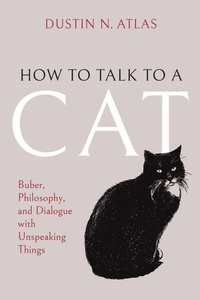
How to Talk to a Cat
Buber, Philosophy, and Dialogue with Unspeaking Things
Published on 31. March 2026
Book
Paperback/Softback
172 pages
978-0-253-07577-2 (ISBN)
Description
Guided by the philosophical insights of Jewish philosopher Martin Buber, How to Talk to a Cat explores the possibility of dialogue beyond the boundaries of spoken language. Original and effective in its interdisciplinary scope, this book ventures into the complexities of engaging in meaningful dialogue with creatures that do not use verbal communication, focusing on unspeaking beings we encounter in the domestic sphere: cats, babies, plants, and tools, among others.
Author Dustin N. Atlas distinguishes between talking to entities in a direct, second-person dialogue, talking about them in a third-person analytical mode, and focusing on how the former is possible in the absence of speech. While many discussions of Buber's philosophy have focused on the I-You relationship, How to Talk to a Cat emphasizes the dynamic processes of dialogue that take place over time where attention, rather than presence, is central. Raising questions about the nature of understanding, cohabitation, and the possibility of connection across different beings, Atlas encourages readers to look more closely at their present life, to reconsider the scope of dialogue and extend it beyond the human to include the silent relationships we share with the world around us.
Bringing Jewish thought into conversation with contemporary philosophy, ethology, animal studies, and critical theory, How to Talk to a Cat challenges prevailing assumptions about the limitations of dialogue and expands on the nature of understanding, cohabitation, and the possibility of connection across types of beings.
Author Dustin N. Atlas distinguishes between talking to entities in a direct, second-person dialogue, talking about them in a third-person analytical mode, and focusing on how the former is possible in the absence of speech. While many discussions of Buber's philosophy have focused on the I-You relationship, How to Talk to a Cat emphasizes the dynamic processes of dialogue that take place over time where attention, rather than presence, is central. Raising questions about the nature of understanding, cohabitation, and the possibility of connection across different beings, Atlas encourages readers to look more closely at their present life, to reconsider the scope of dialogue and extend it beyond the human to include the silent relationships we share with the world around us.
Bringing Jewish thought into conversation with contemporary philosophy, ethology, animal studies, and critical theory, How to Talk to a Cat challenges prevailing assumptions about the limitations of dialogue and expands on the nature of understanding, cohabitation, and the possibility of connection across types of beings.
Reviews / Votes
"With disarming candor and clarity, How to Talk to a Cat brings Martin Buber into our homes. Atlas uses Buber's concept of dialogue to make sense of what we are doing when we talk to our pets or wonder how we have upset our houseplants. These are neither encounters of equals, nor solely our human projections, Atlas argues. They are reciprocal. His analysis of these relations and these reciprocities is not only a compelling new reading of Buber but also a deeply moving account of what it means to relate to those around us."-Sarah Imhoff, author of Masculinity and the Making of American Judaism"What Atlas has succeeded doing in How to Talk to a Cat is to wed the issue of shelter to those who are sheltered, in all their imperfection, in order to give a phenomenological-esque account of how relationships between speaking beings and "unspeaking things" are actually encountered. It is a singular book on Buber written with a singular level of quality."-Jeffrey Bernstein, author of Leo Strauss on the Borders of Judaism, Philosophy and History
"Dustin Atlas's How to Talk to a Cat tackles one of the most important aspects of Buber's dialogical thinking, namely, how do human beings speak to beings that do not speak. . . . By focusing on the example of conversing with a cat, emblematic of the domestic dialogue, the reader is pulled into the dialogical situation through the gesture of indexing or pointing, identified as an essential feature of Buber's philosophical presentation. There is no question that How To Talk to a Cat is an important contribution that will be received well by Buber scholars and those interested more broadly in modern Jewish thought and its relationship to general philosophy in the twentieth century."-Elliot R. Wolfson, author of Apophasis and Envisioning the Invisible: Unveiling Veils of Infinity
More details
Series
Language
English
Place of publication
Bloomington, IN
United States
Target group
Professional and scholarly
Product notice
Paperback (trade)
Dimensions
Height: 225 mm
Width: 149 mm
Thickness: 11 mm
Weight
260 gr
ISBN-13
978-0-253-07577-2 (9780253075772)
Copyright in bibliographic data and cover images is held by Nielsen Book Services Limited or by the publishers or by their respective licensors: all rights reserved.
Schweitzer Classification
Other editions
Additional editions
E-Book
03/2026
Indiana University Press
€33.99
Available for download
Person
Dustin N. Atlas is Director of Jewish Studies and Associate Professor in the School of Religion at Queen's University. He specializes in contemporary Jewish thought and aesthetics, especially works that concern imperfection, gossip, and non-human creatures.
Content
Acknowledgments
Introduction: Dialogue and the Maintenance of Domestic Bubbles
1. Homes: Domesticity and Conflict
2. Animals: Communication and Language
3. Domestic Cats: Anxiety and Singularity
4. Plants: Dispersion and Surfaces
5. Babies: Noise and the Nursery
6. Sensuality: Tools, Crafts, Decoration
Conclusion: Death and Dialogue
Notes
Bibliography
Index
Introduction: Dialogue and the Maintenance of Domestic Bubbles
1. Homes: Domesticity and Conflict
2. Animals: Communication and Language
3. Domestic Cats: Anxiety and Singularity
4. Plants: Dispersion and Surfaces
5. Babies: Noise and the Nursery
6. Sensuality: Tools, Crafts, Decoration
Conclusion: Death and Dialogue
Notes
Bibliography
Index