

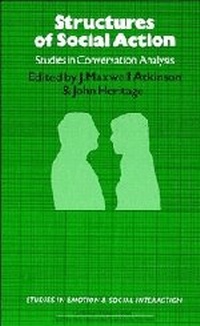
Structures of Social Action
Published on 4. April 1985
Book
Hardback
480 pages
978-0-521-24815-0 (ISBN)
Description
Bringing together thirteen original papers by leading American and British researchers, this volume reflects fresh developments in the increasingly influential field of conversation analysis. It begins by outlining the theoretical and methodological foundations of the field and goes on to develop some of the main themes that have emerged from topical empirical research. These include the organisation of preference, topic, non-vocal activities, and apparently spontaneous responses such as laughter and applause. The collection represents the most comprehensive statement yet to be published on this type of research.
More details
Series
Language
English
Place of publication
Cambridge
United Kingdom
Target group
College/higher education
Dimensions
Height: 228 mm
Width: 152 mm
Weight
738 gr
ISBN-13
978-0-521-24815-0 (9780521248150)
Copyright in bibliographic data and cover images is held by Nielsen Book Services Limited or by the publishers or by their respective licensors: all rights reserved.
Schweitzer Classification
Other editions
New editions
Book
04/1985
Cambridge University Press
€60.70
Shipment within 15-20 days
Additional editions

J. Maxwell Atkinson
Structures of Social Action
E-Book
04/2011
1st Edition
Cambridge University Press
€55.99
Available for download
Book
04/1985
Cambridge University Press
€60.70
Shipment within 15-20 days
Content
Preface; Transcript notation; 1. Introduction John Heritage and J. Maxwell Atkinson; Part I. Orientations: 2. Notes on methodology Harvey Sacks; 3. On some questions and ambiguities in conversation Emanuel A. Schegloff; Part II. Preference Organization: 4. Agreeing and disagreeing with assessments: some features of preferred/dispreferred turn shapes Anita Pomerantz; 5. Subsequent versions of invitations, offers, requests, and proposals, dealing with potential or actual rejection Judy Davidson; 6. Speakers' reportings in invitation sequences Paul Drew; 7. Pursuing a response Anita Pomerantz; Part III. Topic Organization: 8. Generating topic: the use of topic initial elicitors Graham Button and Neil Casey; 9. On stepwise transition from talk about a trouble to inappropriately next-positioned matters Gail Jefferson; Part IV. The Integration of Talk With Nonvocal Activities: 10. Notes on story structure and the organization of participation Charles Goodwin; 11. Talk and recipiency: sequential organization in speech and body movement Christian Health; 12. On some gestures' relation to talk Emanuel A. Schegloff; Part V. Aspects of Response: 13. A change-of-state token and aspects of its sequential placement John Heritage; 14. On the organization of laughter in talk about troubles Gail Jefferson; 15. Public speaking and audience responses: some techniques for inviting applause J. Maxwell Atkinson; Part VI. Everyday Activities as Sociological Phenomena: 16. On doing 'being ordinary' Harvey Sacks; References; Subject index; Index of names.