

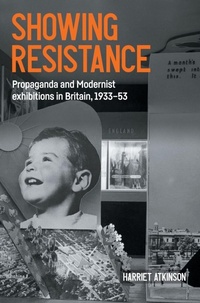
Showing Resistance
Propaganda and Modernist Exhibitions in Britain, 1933-53
Published on 23. July 2024
Book
Hardback
360 pages
978-1-5261-5741-6 (ISBN)
Description
How did exhibitions become a vital tool for public communication in early twentieth century Britain? Showing resistance reveals how exhibitions were taken up by activists and politicians from 1933 to 1953, becoming manifestos, weapons of war and a means of signalling political solidarities.
Drawing on dozens of examples mounted in empty shops, workers' canteens, station ticket halls and beyond, this richly illustrated book shows how this overlooked form was created by significant makers including artists Paul Nash, John Heartfield and Oskar Kokoschka, architect Erno Goldfinger and photographer Edith Tudor-Hart.
Showing resistance is the first study of exhibitions as communications in mid-twentieth century Britain.
An electronic edition of this book is freely available under a Creative Commons (CC BY) licence. -- .
Drawing on dozens of examples mounted in empty shops, workers' canteens, station ticket halls and beyond, this richly illustrated book shows how this overlooked form was created by significant makers including artists Paul Nash, John Heartfield and Oskar Kokoschka, architect Erno Goldfinger and photographer Edith Tudor-Hart.
Showing resistance is the first study of exhibitions as communications in mid-twentieth century Britain.
An electronic edition of this book is freely available under a Creative Commons (CC BY) licence. -- .
Reviews / Votes
"This is a book about a generation of designers (figures such as Erno Goldfinger, Otto Neurath and Laszlo Moholy-Nagy...) [and] more specifically a story about a generation of emigre - often Jewish - artists and designers, attempting to secure a professional foothold in 1930s Britain. 'Propaganda exhibitions' became an important vehicle (or not) for this larger process of social, political and cultural integration."Scott Anthony in Science Museum Group Journal
"Showing Resistance marks an intelligent bringing together of findings drawn from an impressively diverse range of primary resources... The range of primary and other sources identified and explored by Atkinson is impressive and illuminating, and her bibliography a rich resource in its own right."
Jonathan M. Woodham in Journal of Design History
"Atkinson deftly examines how exhibitions conveyed messages, influenced public opinion, and reflected political and social ideologies."
Elizabeth Resnick, Prof Emerita, Massachusetts College of Art and Design, Boston
"This first 'extended study' of 'persuasive exhibitions' in Britain is rich in historical detail and analysis."
Cheryl Buckley, Prof Emerita, Fashion and Design History, University of Brighton -- .
More details
Series
Language
English
Place of publication
Manchester
United Kingdom
Target group
College/higher education
Professional and scholarly
Illustrations
108 colour illustrations
Dimensions
Height: 250 mm
Width: 175 mm
Thickness: 28 mm
Weight
1109 gr
ISBN-13
978-1-5261-5741-6 (9781526157416)
Copyright in bibliographic data and cover images is held by Nielsen Book Services Limited or by the publishers or by their respective licensors: all rights reserved.
Schweitzer Classification
Person
Harriet Atkinson is AHRC Leadership Fellow and Senior Lecturer in History of Art and Design at University of Brighton -- .
Content
Introduction: exhibitions as 'propaganda in three dimensions'
1 Banishing 'chaos, vulgarity and mediocrity': training as an exhibition designer
2 Exhibitions as projection, promotion, policy and activism in three dimensions
3 Exhibitions as manifestos
4 Exhibitions as demonstrations
5 Counter-exhibitions
6 Exhibitions as solidarities
7 Exhibitions as weapons of war
8 Exhibitions as welfare
Conclusion
Index -- .
1 Banishing 'chaos, vulgarity and mediocrity': training as an exhibition designer
2 Exhibitions as projection, promotion, policy and activism in three dimensions
3 Exhibitions as manifestos
4 Exhibitions as demonstrations
5 Counter-exhibitions
6 Exhibitions as solidarities
7 Exhibitions as weapons of war
8 Exhibitions as welfare
Conclusion
Index -- .