

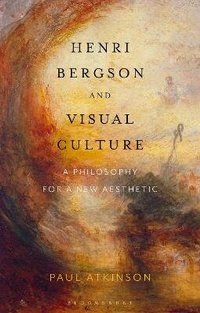
Henri Bergson and Visual Culture
A Philosophy for a New Aesthetic
Published on 15. October 2020
Book
Paperback/Softback
336 pages
978-1-350-16177-1 (ISBN)
Description
What does it mean to see time in the visual arts and how does art reveal the nature of time? Paul Atkinson investigates these questions through the work of the French philosopher Henri Bergson, whose theory of time as duration made him one of the most prominent thinkers of the fin de siecle. Although Bergson never enunciated an aesthetic theory and did not explicitly write on the visual arts, his philosophy gestures towards a play of sensual differences that is central to aesthetics. This book rethinks Bergson's philosophy in terms of aesthetics and provides a fascinating and original account of how Bergsonian ideas aid in understanding time and dynamism in the visual arts.
From an examination of Bergson's influence on the visual arts to a reconsideration of the relationship between aesthetics and metaphysics, Henri Bergson and Visual Culture explores what it means to reconceptualise the visual arts in terms of duration. Atkinson revisits four key themes in Bergson's work - duration; time and the continuous gesture; the ramification of life and durational difference - and reveals Bergsonian aesthetics of duration through the application of these themes to a number of 19th and 20th-century artworks.
This book introduces readers and art lovers to the work of Bergson and contributes to Bergsonian scholarship, as well as presenting a new of understanding the relationship between art and time.
From an examination of Bergson's influence on the visual arts to a reconsideration of the relationship between aesthetics and metaphysics, Henri Bergson and Visual Culture explores what it means to reconceptualise the visual arts in terms of duration. Atkinson revisits four key themes in Bergson's work - duration; time and the continuous gesture; the ramification of life and durational difference - and reveals Bergsonian aesthetics of duration through the application of these themes to a number of 19th and 20th-century artworks.
This book introduces readers and art lovers to the work of Bergson and contributes to Bergsonian scholarship, as well as presenting a new of understanding the relationship between art and time.
Reviews / Votes
Henri Bergson and Visual Culture is an immensely interesting book. It not only describes what Bergson's philosophy of art might have looked like, but it also shows how philosophy can be reoriented, enriched, and developed through its interaction with artworks. A tremendous achievement. * Leonard Lawlor, Sparks Professor of Philosophy, Penn State University, USA * 'Bergson' represents a movement in thought that calls on us to 'join' in that movement if we are to understand it. Atkinson not only joins Bergson's thought with supreme grace, he also creates a Bergsonian understanding of visual art that is quite remarkable. As adept in the history of art as it is impressive in its philosophical scholarship, this is the best book to appear on Bergson in years. * John O Maoilearca, Professor of Film, Kingston University, London, UK *More details
Language
English
Place of publication
London
United Kingdom
Publishing group
Bloomsbury Publishing PLC
Target group
College/higher education
Dimensions
Height: 214 mm
Width: 138 mm
Thickness: 20 mm
Weight
419 gr
ISBN-13
978-1-350-16177-1 (9781350161771)
Copyright in bibliographic data and cover images is held by Nielsen Book Services Limited or by the publishers or by their respective licensors: all rights reserved.
Schweitzer Classification
Other editions
Additional editions
E-Book
10/2020
1st Edition
Bloomsbury Academic
€29.99
Available for download
E-Book
10/2020
1st Edition
Bloomsbury Academic
€29.99
Available for download
Person
Content
List of Figures
Introduction
Chapter One: Duree
Chapter Two: Gesture
Chapter Three: Life
Chapter Four: Perception
Conclusion
Bibliography
Introduction
Chapter One: Duree
Chapter Two: Gesture
Chapter Three: Life
Chapter Four: Perception
Conclusion
Bibliography