

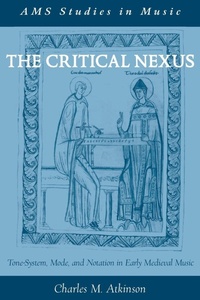
The Critical Nexus
Tone-System, Mode, and Notation in Early Medieval Music
Published on 7. January 2016
Book
Paperback/Softback
322 pages
978-0-19-027399-6 (ISBN)
Description
The Critical Nexus confronts an important and vexing enigma of early writings on music: why chant, which was understood to be divinely inspired, needed to be altered in order to work within the then-operative modal system. To unravel this mystery, Charles Atkinson creates a broad framework that moves from Greek harmonic theory to the various stages in the transmission of Roman chant, citing numerous music treatises from the sixth to the twelfth century. Out of this examination emerges the central point behind the problem: the tone-system advocated by writers coming from the Greek harmonic tradition was not suited to the notation of chant and that this basic incompatibility led to the creation of new theoretical constructs. By tracing the path of subsequent adaptation at the nexus of tone-system, mode, and notation, Atkinson promises new and far-reaching insights into what mode meant to the medieval musician and how the system responded to its inherent limitations.
Through a detailed examination of the major musical treatises from the sixth through the twelfth centuries, this text establishes a central dichotomy between classical harmonic theory and the practices of the Christian church. Atkinson builds the foundation for a broad and original reinterpretation of the modal system and how it relates to melody, grammar, and notation. This book will be of interest to all musicologists, music theorists working on mode, early music specialists, chant scholars, and medievalists interested in music.
Through a detailed examination of the major musical treatises from the sixth through the twelfth centuries, this text establishes a central dichotomy between classical harmonic theory and the practices of the Christian church. Atkinson builds the foundation for a broad and original reinterpretation of the modal system and how it relates to melody, grammar, and notation. This book will be of interest to all musicologists, music theorists working on mode, early music specialists, chant scholars, and medievalists interested in music.
Reviews / Votes
The Critical Nexus is a milestone in every respect, which appeals to specialists and novices alike. It deserves to be ranked among the classic studies on the subject and will be of lasting value to anybody interested in the formation of music thought in the Middle Ages. * Fontes Artis Musicae * The Critical Nexus will become required reading for musicologists, music theorists, and medievalists interested in the reception of ancient texts. * Speculum * A meticulously researched survey of early medieval theory and its application to plainsong, it will form the starting point for future research in the field. * James Grier, Professor of Music History, University of Western Ontario * A comprehensive study, fine-tuning our understanding of the challenges faced by medieval theorists as they adopted terminology and concepts from Antiquity to make sense of the music of their own time - the chant repertory of the Christian church. Professor Atkinson brings a unique perspective to this history of tone-system, mode, and notation through his command of Greek and Latin text sources, combined with his forage into the chant repertory itself. The scholarly community will prize this contribution for years to come. * Dolores Pesce, Professor of Music, Washington University in St. Louis * In this meticulous examination of the texts on music that were the most widely read from the ninth to the eleventh century, Charles Atkinson reveals how medieval theorist musicians reinterpreted the tone systems of ancient Greece and the writings of Latin grammarians to explain and notate the new practice of plainchant. His elegant and remarkably lucid argument is the crowning achievement of decades of scholarship: it not only explains early medieval tonality but resolves the longstanding problem of the derivation of the earliest Carolingian notations. It truly transforms our understanding of medieval music. Every musician and medievalist will benefit from reading it. * Barbara Haggh-Huglo, Professor of Music, University of Maryland, College Park * This important book is of a kind to stimulate one's thoughts about the inherent nature of medieval chant and to provoke discussions about contested issues; above all, however, it presents in al its wealth of detail the evidence for the remarkable story of the earliest developments in the history of Western art music. * Music & Letters * All readers, regardless of their level of specialization, will find their understanding both broadened and deepened. To be sure, this is a work that merits to become a classic, that deserves to be read and reread, studied and discussed among students and scholars time and again, and is therefore highly recommended to all musicologists and libraries. * Notes *More details
Series
Language
English
Place of publication
New York
United States
Target group
College/higher education
Professional and scholarly
Illustrations
20 halftones; 25 line illustrations
Dimensions
Height: 234 mm
Width: 156 mm
Thickness: 19 mm
Weight
550 gr
ISBN-13
978-0-19-027399-6 (9780190273996)
Copyright in bibliographic data and cover images is held by Nielsen Book Services Limited or by the publishers or by their respective licensors: all rights reserved.
Schweitzer Classification
Other editions
Additional editions
E-Book
12/2008
1st Edition
OUP eBook
€29.49
Available for download
E-Book
12/2008
1st Edition
OUP eBook
€22.99
Available for download
Person
Active as both clarinetist and musicologist, Charles M. Atkinson is a scholar whose work is devoted primarily to music within the intellectual history of Antiquity and the Middle Ages. His areas of research and publication range from ancient Greek conceptions of tonos to medieval liturgy and music to the early history of American jazz. He is Professor of Musicology at The Ohio State University and President of the American Musicological Society.
Content
Note on Abbreviations and Nomenclature for Ptich ; Prologue ; 1. The Heritage of Antiquity ; Part I. The Eighth and Ninth Centuries ; 2. The Reception of Ancient Texts in the Carolingian Era ; 3. The Heritage of the Church ; Part II. The Synthesis of Ancient Greek Theory and Medieval Practice ; 4. Hucbald of St. Amand and Regino of Prum ; 5. Alia musica ; 6 Pseudo-Bernelinus, Bern of Reichnau, Pseudo-Odo, and Guido d'Arezzo ; Epilogue ; Bibliography ; Index of Chants and Manuscripts ; General Index