

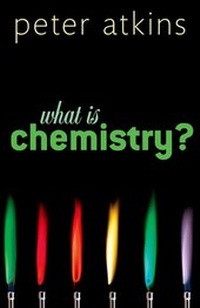
What is Chemistry?
A Very Short Introduction
Published on 22. August 2013
Book
Hardback
144 pages
978-0-19-968398-7 (ISBN)
Description
Most people remember chemistry from their schooldays as a subject that was largely incomprehensible, fact-rich but understanding-poor, smelly, and so far removed from the real world of events and pleasures that there seemed little point, except for the most introverted, in coming to terms with its grubby concepts, spells, recipes, and rules.
Peter Atkins wants to change all that. In What is Chemistry? he encourages us to look at chemistry anew, through a chemist's eyes, to understand its central concepts and to see how it contributes not only towards our material comfort, but also to human culture. Atkins shows how chemistry provides the infrastructure of our world, through the chemical industry, the fuels of heating, power generation, and transport, as well as the fabrics of our clothing and furnishings.
By considering the remarkable achievements that chemistry has made, and examining its place between both physics and biology, Atkins presents a fascinating, clear, and rigorous exploration of the world of chemistry - its structure, core concepts, and exciting contributions to new cutting-edge technologies.
Peter Atkins wants to change all that. In What is Chemistry? he encourages us to look at chemistry anew, through a chemist's eyes, to understand its central concepts and to see how it contributes not only towards our material comfort, but also to human culture. Atkins shows how chemistry provides the infrastructure of our world, through the chemical industry, the fuels of heating, power generation, and transport, as well as the fabrics of our clothing and furnishings.
By considering the remarkable achievements that chemistry has made, and examining its place between both physics and biology, Atkins presents a fascinating, clear, and rigorous exploration of the world of chemistry - its structure, core concepts, and exciting contributions to new cutting-edge technologies.
Reviews / Votes
Atkins wins his readers' attention simply through an elegant and lucid description of the subject he loves. * Nature * [T]he result is pretty much unimprovable. Recommending that every chemistry student in the world read a book by Peter Atkins feels a bit like recommending that everyone buy their books from Amazon. But what can you do? If this book had existed when I was an undergraduate, I'd have benefited tremendously. Now you can. * Philip Ball, Nature Chemistry * This is an excellent presentation, especially for laypeople and high school students or for a 'chemistry for poets' course. Highly recommended. * R. E. Buntrock, Choice, * It is an important supplementary book for undergraduate students in Chemistry, [and] integrates the main Chemistry concepts in an easy and fast reading. * Montserrat Gomez, University of Toulouse *More details
Series
Language
English
Place of publication
Oxford
United Kingdom
Target group
College/higher education
Professional and scholarly
An ideal introduction for all popular science readers interested in chemistry, as well as potential students of chemistry, and those who are familiar with Peter Atkins's work.
Illustrations
None
Dimensions
Height: 204 mm
Width: 135 mm
Thickness: 17 mm
Weight
252 gr
ISBN-13
978-0-19-968398-7 (9780199683987)
Copyright in bibliographic data and cover images is held by Nielsen Book Services Limited or by the publishers or by their respective licensors: all rights reserved.
Schweitzer Classification
Other editions
New editions
Book
02/2015
Oxford University Press
€13.00
Shipment within 15-20 days
Additional editions
E-Book
08/2013
1st Edition
OUP eBook
€9.49
Available for download
E-Book
08/2013
1st Edition
OUP eBook
€9.49
Available for download
Person
Peter Atkins is the author of about 70 books, including the world-renowned and widely used Physical Chemistry, now in its 10th edition. He won the Grady-Stack award for science journalism in 2016. After graduating from the University of Leicester and a post-doctoral year in the University of California, Los Angeles, he returned to Oxford in 1965 as Fellow of Lincoln College and University Lecturer (later Professor) in physical chemistry. He retired in 2007, but continues to write and lecture worldwide.
Content
Preface ; 1. Its origins, scope, and organization ; 2. Its principles: atoms and molecules ; 3. Its principles: energy and entropy ; 4. Its reactions ; 5. Its techniques ; 6. Its achievements ; 7. Its future ; Glossary ; Index