

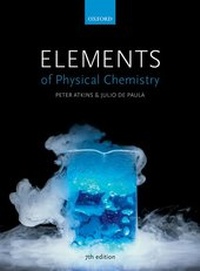
Elements of Physical Chemistry
7th Edition
Published on 15. December 2016
Book
Paperback/Softback
656 pages
978-0-19-872787-3 (ISBN)
Description
The ideal course companion, Elements of Physical Chemistry is written specifically with the needs of undergraduate students in mind, and provides extensive mathematical and pedagogical support while remaining concise and accessible.
For the seventh edition of this much-loved text, the material has been reorganized into short Topics, which are grouped into thematic Focus sections to make the text more digestible for students, and more flexible for lecturers to teach from. At the beginning of each topic, three questions are posed, emphasizing why it is important, what the key idea is, and what the student should already know.
Throughout the text, equations are clearly labeled and annotated, and detailed 'justification' boxes are provided to help students understand the crucial mathematics which underpins physical chemistry. Furthermore, Chemist's Toolkits provide succinct reminders of key mathematical techniques exactly where they are needed in the text. Frequent worked examples, in addition to self-test questions and end-of-focus exercises, help students to gain confidence and experience in solving problems. This diverse suite of pedagogical features, alongside an appealing design and layout, make Elements of Physical Chemistry the ideal course text for those studying this core branch of chemistry for the first time.
Online Resource Centre:
For registered adopters of the book:
? Figures and tables of data from the book, ready to download.
? A test bank of additional multiple-choice questions, linked to relevant sections of the book
For students:
?Multiple choice questions to support self-directed learning
For the seventh edition of this much-loved text, the material has been reorganized into short Topics, which are grouped into thematic Focus sections to make the text more digestible for students, and more flexible for lecturers to teach from. At the beginning of each topic, three questions are posed, emphasizing why it is important, what the key idea is, and what the student should already know.
Throughout the text, equations are clearly labeled and annotated, and detailed 'justification' boxes are provided to help students understand the crucial mathematics which underpins physical chemistry. Furthermore, Chemist's Toolkits provide succinct reminders of key mathematical techniques exactly where they are needed in the text. Frequent worked examples, in addition to self-test questions and end-of-focus exercises, help students to gain confidence and experience in solving problems. This diverse suite of pedagogical features, alongside an appealing design and layout, make Elements of Physical Chemistry the ideal course text for those studying this core branch of chemistry for the first time.
Online Resource Centre:
For registered adopters of the book:
? Figures and tables of data from the book, ready to download.
? A test bank of additional multiple-choice questions, linked to relevant sections of the book
For students:
?Multiple choice questions to support self-directed learning
Reviews / Votes
The breaking down of chapters into topics is great, particularly when the book is used for quick reference * Tom Martin, chemistry student at Loughborough University * The style of writing makes the material readily accessible to undergraduates of all levels of chemistry capability. Physical Chemistry is notoriously mathematical in nature and as such any good text on this subject must carry readers of varying ability in mathematics. * Dr Subrayal M Reddy, University of Surrey * There are no other textbooks that serve the purposes of my physical chemistry courses so well. * Dr Peter B Karadakov, University of York * As always the writing style is clear and elegant and the numerical examples are pertinent and helpful. * Dr Mike Lyons, Trinity College Dublin *More details
Edition
7th Revised edition
Language
English
Place of publication
Oxford
United Kingdom
Target group
College/higher education
Edition type
Revised edition
Illustrations
Over 650 colour line illustrations
Dimensions
Height: 265 mm
Width: 192 mm
Thickness: 27 mm
Weight
1378 gr
ISBN-13
978-0-19-872787-3 (9780198727873)
Copyright in bibliographic data and cover images is held by Nielsen Book Services Limited or by the publishers or by their respective licensors: all rights reserved.
Schweitzer Classification
Other editions
Additional editions
Julio de Paula | Peter Atkins
US Edition Elements of Physical Chemistry
Book
approx. 11/2016
7th Edition
Oxford University Press
€92.85
Not yet published
Persons
Peter Atkins is a fellow of Lincoln College in the University of Oxford and the author of more than sixty books for students and a general audience. His texts are market leaders around the globe. A frequent lecturer in the United States and throughout the world, he has held visiting professorships in France, Israel, Japan, China, and New Zealand. He was the founding chairman of the Committee on Chemistry Education of the International Union of Pure and Applied Chemistry and was a member of IUPAC's Physical and Biophysical Chemistry Division. Peter was the 2016 recipient of the American Chemical Society's Grady-Stack Award for science journalism.
Julio de Paula is Professor of Chemistry and Dean of the College of Arts & Sciences at Lewis & Clark College. A native of Brazil, Professor de Paula received a B.A. degree in chemistry from Rutgers, The State University of New Jersey, and a Ph.D. in biophysical chemistry from Yale University. His research activities encompass the areas of molecular spectroscopy, biophysical chemistry, and nanoscience. He has taught courses in general chemistry, physical chemistry, biophysical chemistry, instrumental analysis, and writing.
Julio de Paula is Professor of Chemistry and Dean of the College of Arts & Sciences at Lewis & Clark College. A native of Brazil, Professor de Paula received a B.A. degree in chemistry from Rutgers, The State University of New Jersey, and a Ph.D. in biophysical chemistry from Yale University. His research activities encompass the areas of molecular spectroscopy, biophysical chemistry, and nanoscience. He has taught courses in general chemistry, physical chemistry, biophysical chemistry, instrumental analysis, and writing.
Content
FOCUS 1: THE PROPERTIES OF GASES; FOCUS 2: THE FIRST LAW OF THERMODYNAMICS; FOCUS 3: THE SECOND LAW OF THERMODYNAMICS; FOCUS 4: PHYSICAL TRANSFORMATIONS; FOCUS 5: CHEMICAL CHANGE; FOCUS 6: CHEMICAL KINETICS; FOCUS 7: QUANTUM THEORY; FOCUS 8: ATOMIC STRUCTURE; FOCUS 9: THE CHEMICAL BOND; FOCUS 10: MOLECULAR INTERACTIONS; FOCUS 11: MOLECULAR SPECTROSCOPY; FOCUS 12: STATISTICAL THERMODYNAMICS; FOCUS 13: MAGNETIC RESONANCE; FOCUS 14: MACROMOLECULES AND AGGREGATES; FOCUS 15: SOLIDS