

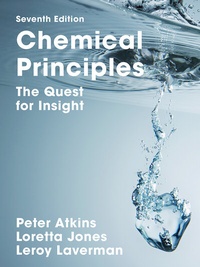
Chemical Principles
The Quest for Insight
7th Edition
Published on 1. March 2016
Book
Hardback
978-1-319-15419-6 (ISBN)
Description
Written for calculus-inclusive general chemistry courses, Chemical Principles helps students develop chemical insight by showing the connections between fundamental chemical ideas and their applications. Beginning with a detailed picture of the atom, Chemical Principles builds toward chemistry's frontier, continually demonstrating how to solve problems, think about nature and matter, and visualize chemical concepts as working chemists do. It also offers an exceptional level of support to help students develop their mathematical and problem-solving skills.
Chemical Principles is now supported in Achieve, Macmillan's new online learning platform, Achieve is the culmination of years of development work put toward creating the most powerful online learning tool for chemistry students. Achieve includes an interactive e-Book as well as our renowned assessments.More details
Edition
7th ed. 2016
Language
English
Place of publication
New York
United Kingdom
Publishing group
Macmillan Learning
Target group
Professional and scholarly
Edition type
Revised edition
Illustrations
Approx. 125 p.
Dimensions
Height: 23.5 cm
Width: 15.5 cm
ISBN-13
978-1-319-15419-6 (9781319154196)
Schweitzer Classification
Other editions
New editions
Book
04/2023
8th Edition
W.H.Freeman & Co Ltd
€93.00
Available immediately
Additional editions
Book
01/2016
7th Edition
W.H.Freeman & Co Ltd
€85.59
Article exhausted; check for reprint
Persons
Peter Atkins is a fellow of Lincoln College in the University of Oxford and the author of about 70 books for students and a general audience. His texts are market leaders around the globe. A frequent lecturer in the United States and throughout the world, he has held visiting professorships in France, Israel, Japan, China, and New Zealand. He was the founding chairman of the Committee on Chemistry Education of the International Union of Pure and Applied Chemistry and was a member of IUPAC's Physical and Biophysical Chemistry Division.
Loretta L. Jones is Emeritus Professor of Chemistry at the University of Northern Colorado. She taught general chemistry there for 16 years and at the University of Illinois at Urbana-Champaign for 13 years. She earned a BS in honors chemistry from Loyola University, an MS in organic chemistry from the University of Chicago, and a Ph.D. in physical chemistry as well as a D.A. in chemical education from the University of Illinois at Chicago. Her physical chemistry research used electron paramagnetic resonance to investigate motion in liquids.
Leroy Laverman is a senior lecturer in the Department of Chemistry and Biochemistry at the University of California, Santa Barbara. He earned a B.S. in Chemistry from Washington State University and received his Ph.D. from U.C. Santa Barbara where he worked on ligand exchange reaction mechanisms in metalloporphyrins. He has been teaching chemistry at UCSB since 2000 and continues to instruct students in general chemistry and honors level courses.
Loretta L. Jones is Emeritus Professor of Chemistry at the University of Northern Colorado. She taught general chemistry there for 16 years and at the University of Illinois at Urbana-Champaign for 13 years. She earned a BS in honors chemistry from Loyola University, an MS in organic chemistry from the University of Chicago, and a Ph.D. in physical chemistry as well as a D.A. in chemical education from the University of Illinois at Chicago. Her physical chemistry research used electron paramagnetic resonance to investigate motion in liquids.
Leroy Laverman is a senior lecturer in the Department of Chemistry and Biochemistry at the University of California, Santa Barbara. He earned a B.S. in Chemistry from Washington State University and received his Ph.D. from U.C. Santa Barbara where he worked on ligand exchange reaction mechanisms in metalloporphyrins. He has been teaching chemistry at UCSB since 2000 and continues to instruct students in general chemistry and honors level courses.
Content
Fundamentals.- Focus 1: Atoms.- Focus 2: Molecules.- Focus 3: Bulk matter.- Focus 4: Thermodynamics.- Focus 5: Equilibrium.- Focus 6: Reactions.- Focus 7: Kinetics.- Focus 8: Main-group elements.- Focus 9: The d-block.- Focus 10: Nuclear Chemistry.- Focus 11: Organic Chemistry.- Major Techniques (Online Only)