

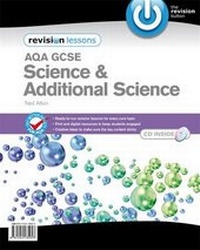
AQA GCSE Science and Additional Science Revision Lessons
Published on 26. August 2011
Book
Spiral bound
114 pages
978-1-4441-3505-3 (ISBN)
Description
This photocopiable pack and CD provides you with ready made, interactive revision lessons and materials to help your students revise effectively for their exams. The pack includes lesson plans, teacher notes and engaging activities on all the key specification topics, plus a 'revision journey' so students can track their progress. An accompanying VLE-compatible CD-ROM contains all the content in the pack in pdf and Word format PLUS extra content including visual topic summaries, PowerPoints and MP3 podcasts.
Reviews / Votes
I would use these resources for booster sessions very close to an exam date. The content is accessible and gives the range from C-A* students. I would use the key words as an activity or to stick into class books. Mindmaps are always good and these provide a start to make sure that pupils have all the info on a topic in one place. Lots of our pupils would like to download the podcasts to their ipods to revise on the bus. These would make VERY good, quick pre-made resources for new teachers as it has the full range of the spec, with no gaps in content. Paul Allen, GCSE Science Coordinator, Coombe Dean School, PlymouthMore details
Language
English
Place of publication
United Kingdom
Publishing group
Hachette Learning
Target group
Primary & secondary/elementary & high school
Illustrations
Black and white illustrations
Dimensions
Height: 316 mm
Width: 238 mm
Thickness: 46 mm
Weight
1344 gr
ISBN-13
978-1-4441-3505-3 (9781444135053)
Copyright in bibliographic data and cover images is held by Nielsen Book Services Limited or by the publishers or by their respective licensors: all rights reserved.
Schweitzer Classification
Person
Neil Atkin is an experienced author and teacher.
Content
B1 Keeping healthy B2 Nerves and hormones B3 The use and abuse of drugs B4 Interdependence and adaptation B5 Energy and biomass in food chains B6 Waste materials from plants and animals B7 Genetic variation and its control B8 Evolution B9 Cells and simple cell transport B10 Tissues, organs and organ systems B11 Photosynthesis B12 Organisms and their environment B13 Proteins - their functions and uses B14 Aerobic and anaerobic respiration B15 Cell division and inheritance B16 Speciation B17 Movement of molecules in and out of cells B18 Transport systems in plants and animals B19 Homeostasis B20 Humans and their environment C1 The fundamental ideas in chemistry C2 Limestone and building materials C3 Metals and their uses C4 Crude oil and fuels C5 Other useful substances from crude oil C6 Plant oils and their uses C7 Changes in the Earth and its atmosphere C8 Structure and bonding C9 How structure influences the properties and uses of substances C10 Atomic structure, analysis and quantitative chemistry C11 Rates of reaction C12 Exothermic and endothermic reactions C13 Acids, bases and salts C14 Electrolysis C15 The periodic table C16 Water C17 Calculating and explaining energy changes C18 Further analysis and quantitative chemistry C19 The production of ammonia C20 Alcohols, carboxylic acids and esters P1 The transfer of energy by heating processes and the factors that affect the rate at which that energy is transferred P2 Energy and efficiency P3 The usefulness of electrical appliances P4 Methods we use to generate electricity P5 The use of waves for communication and to provide evidence that the universe is expanding P6 Forces and their effects P7 The kinetic energy of objects speeding up or slowing down P8 Currents in electrical circuits P9 Using mains electricity safely and the power of electrical appliances P10 What happens when radioactive substances decay, and the uses and dangers of their emissions P11Nuclear fission and nuclear fusion P12 Medical applications of physics P13 Using physics to make things work P14 Keeping things moving