

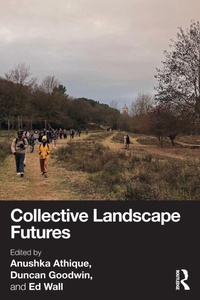
Collective Landscape Futures
1st Edition
Will be published approx. on 22. December 2025
Book
Paperback/Softback
236 pages
978-1-032-85472-4 (ISBN)
Description
This book critically reflects on dominant landscape techniques, discusses landscapes that are marginalised through globalising market forces, and focuses on the collective nature of landscapes-from planetary climates to intimate private spaces. Whether in views from above or the mirror and mirage that landscapes can create, landscape practices too often foreground hegemony and embolden individuals with power, while simultaneously concealing the actions from which they are produced. Chapters show how landscapes are only possible through the collective contribution of humans and non-humans, interacting, sharing between, providing for, and making with. Collective Landscape Futures investigates the common, shared, and public endeavours that produce landscapes. Chapters address varied concerns across diverse geographies, from wilding practices to extractive landscapes and from decolonizing approaches to tools for co-creation. This volume will appeal to scholars and activists working in environmental humanities, landscape studies, and landscape architecture, and the many disciplines which converge around these topics, including design, geography, anthropology, philosophy, and politics.
Reviews / Votes
"Drawing from really wide and diverse thoughts that affect our universe, Collective Landscape Futures reimagines our relation with self and our world, making a compelling and pragmatic reading which has the power to pivot the profession into a new, relevant and exciting journey."Aniket Bhagwat, Principal Partner at M/S. Prabhakar B. Bhagwat, India
"Collective Landscape Futures is a vital contribution to the evolving discourse of landscape architecture and design. It challenges the dominance of individualistic, extractive frameworks and instead highlights the necessity of cooperation, shared motivations, and collective action. By centering multiple voices, more-than-human relationships, and alternative practices of place-making, this book charts a crucial path forward for more just, interconnected, and resilient landscapes."
Julia Watson, Author, Lo-TEK Design By Radical Indigenism and Lo-TEK Water, A Field Guide for TEKnologists; Principal, Julia Watson Studio; and Co-founder, Lo-TEK Institute
More details
Language
English
Place of publication
London
United Kingdom
Publishing group
Taylor & Francis Ltd
Target group
College/higher education
Postgraduate and Undergraduate Advanced
Illustrations
1 s/w Zeichnung, 66 s/w Photographien bzw. Rasterbilder, 67 s/w Abbildungen
1 Line drawings, black and white; 66 Halftones, black and white; 67 Illustrations, black and white
Dimensions
Height: 234 mm
Width: 156 mm
Thickness: 13 mm
Weight
360 gr
ISBN-13
978-1-032-85472-4 (9781032854724)
Copyright in bibliographic data and cover images is held by Nielsen Book Services Limited or by the publishers or by their respective licensors: all rights reserved.
Schweitzer Classification
Other editions
Additional editions
Anushka Athique | Duncan Goodwin | Ed Wall
Collective Landscape Futures
E-Book
12/2025
1st Edition
Routledge
€55.49
Available for download
Anushka Athique | Duncan Goodwin | Ed Wall
Collective Landscape Futures
E-Book
12/2025
1st Edition
Routledge
€55.49
Available for download
Anushka Athique | Duncan Goodwin | Ed Wall
Collective Landscape Futures
Book
approx. 12/2025
1st Edition
Routledge
€207.60
Not yet published
Persons
Anushka Athique is a landscape architect, researcher, educator, artist and mother. Her practice draws influence from post-human feminist phenomenologies. This involves researching and articulating landscapes using the embodied practices of walking, dialogue and crafting. She leads the postgraduate Landscape Architecture programmes at University of Greenwich where she is undertaking a PhD.
Duncan Goodwin leads the Landscape Architecture and Urbanism Portfolio at the University of Greenwich, where he teaches on both undergraduate and master's programmes. He previously worked in practice, managing landscape architecture teams and delivering large, multidisciplinary infrastructure projects. His book, The Urban Tree, was published in 2017 by Routledge.
Ed Wall explores practices of public space and processes of landscapes through concerns for spatial justice. He is Professor of Cities and Landscapes at the University of Greenwich where he leads the Spatial and Digital Ecologies research centre. He has a PhD from the London School of Economics and has been a Visiting Professor at Politecnico di Milano, Harvard University, and TU Wien.
Duncan Goodwin leads the Landscape Architecture and Urbanism Portfolio at the University of Greenwich, where he teaches on both undergraduate and master's programmes. He previously worked in practice, managing landscape architecture teams and delivering large, multidisciplinary infrastructure projects. His book, The Urban Tree, was published in 2017 by Routledge.
Ed Wall explores practices of public space and processes of landscapes through concerns for spatial justice. He is Professor of Cities and Landscapes at the University of Greenwich where he leads the Spatial and Digital Ecologies research centre. He has a PhD from the London School of Economics and has been a Visiting Professor at Politecnico di Milano, Harvard University, and TU Wien.
Content
Introduction: Being Collective 1. Landscapes of Discomfort, Or, How to Love a Coot 2. Tumbleweed Rodeo 3.The Ontopolity of Feral Landscapes: An Anthropology of Tools Negotiating Relationships between Other-Than-Human and Human Collectives 4. Reflections on a Bioblitz: Notes Toward an Ecologised Technics 5. A Proposal for a Site-Body 6. Somatic Activism: Wastelands and Bodies 7. Ground Pedagogies 8. Landscape Collective Entanglements and the Landscapes-to-Come in Aotearoa, New Zealand 9. Mapping the Jaguar Corridor: A Snapshot of Urbanisation across the Americas 10. Capital-to-Nature in Te Whanganui-a-Tara: Challenges of Collective Participation in Wellington's Town Belt 11. Redefining Collective Spaces in the Technological Axial Age 12. Ephemeral Island as Process: Sympoiesis and the Making of Collective Worlds in the Mediterranean 13. Counter-Cartography of Copper: Mapping the Collective Landscapes of Krivelj, Serbia 14. Beyond the Operational Landscape 15. A Post-Landscape Handbook