

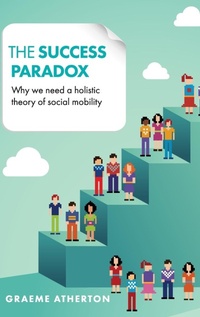
The Success Paradox
Why We Need a Holistic Theory of Social Mobility
1st Edition
Published on 27. January 2016
Book
Hardback
220 pages
978-1-4473-1633-6 (ISBN)
Description
Social mobility needs a re-boot. The narrow, economistic way of measuring it favoured by politicians and academics is unsustainable and is contributing to rising inequality.
This timely book provides an alternative, original vision of social mobility and a route-map to achieving it. It examines how the term 'social mobility' structures what success means and the impact that has on society. Providing a new holistic approach that encompasses education, the economy and politics, Atherton recasts the relationship with employers, embracing radical opportunities provided by technology and rethinking what higher education means. He also goes beyond employment to incorporate progress in non-work areas of life.
Based on the need to improve well-being, not just income or occupation, the book addresses one of the key issues facing 21st century society in a new way and provides valuable insights for policymakers and academics.
This timely book provides an alternative, original vision of social mobility and a route-map to achieving it. It examines how the term 'social mobility' structures what success means and the impact that has on society. Providing a new holistic approach that encompasses education, the economy and politics, Atherton recasts the relationship with employers, embracing radical opportunities provided by technology and rethinking what higher education means. He also goes beyond employment to incorporate progress in non-work areas of life.
Based on the need to improve well-being, not just income or occupation, the book addresses one of the key issues facing 21st century society in a new way and provides valuable insights for policymakers and academics.
Reviews / Votes
"A useful and thought-provoking contribution to current debates on the notion of success that is engaging and accessible." Sheila Riddell, University of EdinburghMore details
Edition
First Edition
Language
English
Place of publication
Bristol
United Kingdom
Publishing group
Bristol University Press
Target group
Professional and scholarly
Illustrations
9 s/w Abbildungen, 2 s/w Tabellen
2 Tables, black and white; 9 Illustrations, black and white
Dimensions
Height: 240 mm
Width: 161 mm
Thickness: 17 mm
Weight
499 gr
ISBN-13
978-1-4473-1633-6 (9781447316336)
Copyright in bibliographic data and cover images is held by Nielsen Book Services Limited or by the publishers or by their respective licensors: all rights reserved.
Schweitzer Classification
Other editions
Additional editions

Book
07/2017
1st Edition
Policy Press
€42.50
Shipment within 15-20 days

E-Book
01/2016
1st Edition
Policy Press
€49.49
Available for download
Person
Graeme Atherton has been working in access to higher education and social mobility for nearly 20 years. He has led regional, national and international initiatives to increase opportunity in higher education. He is a frequent commentator on social mobility and education in the UK and internationally. As Chair of the World Congress on Access to Post-Secondary Education he is leading a global movement to open up opportunity to benefit from education for learners over the life course across the world.
Content
Introduction;
Why we need a new theory of social mobility;
Rising, Falling or staying the same? The academic discourse on social mobility;
Unpicking the political consensus on social mobility;
Breaking the Attainment Addiction;
Unbundling, diversification and ecological: New models for Higher Education;
Hourglass, molecule or pyramid? Social mobility and the labour market;
Social Mobility, well-being and class;
A new politics for social mobility;
Conclusions: Re-framing social mobility.
Why we need a new theory of social mobility;
Rising, Falling or staying the same? The academic discourse on social mobility;
Unpicking the political consensus on social mobility;
Breaking the Attainment Addiction;
Unbundling, diversification and ecological: New models for Higher Education;
Hourglass, molecule or pyramid? Social mobility and the labour market;
Social Mobility, well-being and class;
A new politics for social mobility;
Conclusions: Re-framing social mobility.