

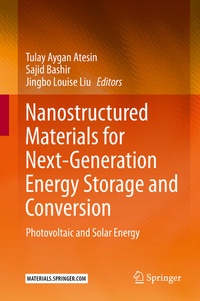
Nanostructured Materials for Next-Generation Energy Storage and Conversion
Description
Nanostructured Materials for Next-Generation Energy Storage and Conversion: Photovoltaic and Solar Energy , is volume 4 of a 4-volume series on sustainable energy. Photovoltaic and Solar Energy while being a comprehensive reference work, is written with minimal jargon related to various aspects of solar energy and energy policies. It is authored by leading experts in the field, and lays out theory, practice, and simulation studies related to solar energy and allied applications including policy, economic and technological challenges. Topics covered include: introduction to solar energy, fundamentals of solar radiation, heat transfer, thermal collection and conversion, solar economy, heating, cooling, dehumidification systems, power and process heat, solar power conversion, policy and applications pertinent to solar energy as viable alternatives to fossil fuels.
The aim of the book is to present all the information necessary for the design and analysisof solar energy systems for engineers, material scientists, economics, policy analysts, graduate students, senior undergraduates, solar energy practitioner, as well as policy or lawmakers in the field of energy policy, international energy trade, and libraries which house technical handbooks related to energy, energy policy and applications.
More details
Other editions
Additional editions
Persons
Prof. Sajid Bashir received his Ph.D. in Analytical Chemistry from the University of Warwick, England, 2001. He was a postgraduate research associate at Cornell University to conduct research in the field of plant genetics. Currently, he is a Full Professor at Texas A&M University-Kingsville (TAMUK) and a Faculty Fellow at the US Air Force. He has directed and participated in more than 20 projects supported by the Welch Foundation, TAMUK, Texas Workforce Commission, and US National Institute of Health. He has co-authored > 80 book chapters and peer-reviewed journal articles. He is a fellow of the Royal Society of Chemistry, and Chartered Chemist & Chartered Scientists of Science Council. More recently, he has collaborated with local law enforcement as a consultant.
Jingbo (Louise) Liu received her Ph.D. in Materials Science and Engineering from the University of Science and Technology Beijing in 2001. She is a full Professor at Texas A&M University-Kingsville (TAMUK) and focused on materials preparation, characterization, andapplications. She is the Fellow of Royal Society of Chemistry and DEBI faculty fellow at the US Air Force Research Laboratory. She has authored and co-authored, books, book chapters, and peer-reviewed journal articles (>100). During her 12.5-year services in TAMUK, she taught > 8,700 students and trained about 150 students and scholars to conduct leading-edge research. She directed and/or participated in the projects (>40) supported by the NSF (US and China), NSERC (CANADA), ACS Petroleum Research Funds, and Department of Education as PI, Co-PI and senior personnel. She was recently elected as the Division Chair-Elect of Energy and Fuels, American Chemical Society.Content
Solar Energy: Potential and Toxicology.- First Principles Simulations for CuInGaSe 2 (CIGS) Solar Cells.- Design of Photovoltaics Based Manufacturing System Using Computer-Aided Design.- Solar Energy Harvesting by Perfect Absorbers Made of Natural Hyperbolic Material.- Strategies for Improving Solar Energy Conversion: Nanostructured Materials and Processing Techniques.- The Recent Research and Growth in Energy Efficiency in Cu 2 ZnSnS 4 (CZTS) Solar Cells.- Counter Electrode Materials for Organic-Inorganic Perovskite Solar Cells.- Impact of Electron Transport Layers (ETLs) and Hole Transport Layer (HTLs) on Perovskite Solar Cells Performance.- Thermal Management Techniques for Concentrating Photovoltaic Modules.- Thermal Energy Storage Systems Based on Metal Hydride Materials.- Advanced Coupling of Energy Storage and Photovoltaics.- Design, Engineering, and Evaluation of Porphyrins for Dye-Sensitized Solar Cells.- Insights into the Application of Metal-Organic Frameworks for Molecular Photovoltaics.- Industry-Specific Utilization of Solar Industrial Process Heat (SHIP).- Comparative Analysis of Water Quality of Different Types of Feed Water in Solar Energy Based Desalting System.- Postface: China in the New Policies Scenario.