

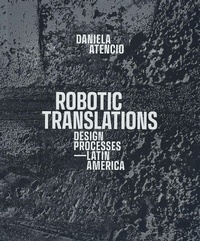
Robotic Translations
Design Processes. Latin America
Published on 31. March 2025
Book
Paperback/Softback
256 pages
978-1-63840-113-1 (ISBN)
Description
This book develops findings and methodological work process of approaches and explorations through a 6-axis robotic arm, hybrid representations, and material conceptualizations in Latin America in the research-creation project: Programmed Materialism. This research-creation provides examples of a better understanding of history, architecture, and landscapes by creating architectural artifacts in a journey between the physical and the digital, as the agencies involved in these explorations provide lessons for students of architecture and trigger pedagogical and didactical reflections.
This publication focuses on two issues associated with a technological approach and its relationship with research in the architectural discipline. First, the investigation concerns specific technological tools (software and hardware) based on interactions with a 6-axis robotic arm and deepens the scholarly exploration of design strategies that can amplify creative pedagogies for undergraduate architecture students in Latin America. Second, advanced prototyping in a research and creation process allows questioning disciplinary issues through speculative and narrative techniques or conceptualizations of architectural objects (artifacts). In this case, the research-creation objectives become pedagogical objects, examining a disciplinary reinterpretation, or reintegration, with the digital world; likewise, opening contemplation on how learning from specific stylistic or conceptual issues can generate new perspectives and promote new inflections and representations for the design process. At its most ambitious, the discussion is about the past and future of architecture and its encounter with technology, addressing with a sense of urgency the actual local conditions where it operates. This work constitutes a history of the relationships between styles and technology, between objects and artifacts, or in this specific case, hyper-artifacts, by unlocking the material capacities of the objects, establishing new qualities, arrangements, and above all, new responsibilities and interpretations of the cases studied. This research-creation points to new conceptual conclusions.
This publication focuses on two issues associated with a technological approach and its relationship with research in the architectural discipline. First, the investigation concerns specific technological tools (software and hardware) based on interactions with a 6-axis robotic arm and deepens the scholarly exploration of design strategies that can amplify creative pedagogies for undergraduate architecture students in Latin America. Second, advanced prototyping in a research and creation process allows questioning disciplinary issues through speculative and narrative techniques or conceptualizations of architectural objects (artifacts). In this case, the research-creation objectives become pedagogical objects, examining a disciplinary reinterpretation, or reintegration, with the digital world; likewise, opening contemplation on how learning from specific stylistic or conceptual issues can generate new perspectives and promote new inflections and representations for the design process. At its most ambitious, the discussion is about the past and future of architecture and its encounter with technology, addressing with a sense of urgency the actual local conditions where it operates. This work constitutes a history of the relationships between styles and technology, between objects and artifacts, or in this specific case, hyper-artifacts, by unlocking the material capacities of the objects, establishing new qualities, arrangements, and above all, new responsibilities and interpretations of the cases studied. This research-creation points to new conceptual conclusions.
More details
Language
English
Place of publication
New York
United States
Product notice
Paperback (trade)
Dimensions
Height: 231 mm
Width: 196 mm
Thickness: 23 mm
Weight
821 gr
ISBN-13
978-1-63840-113-1 (9781638401131)
Copyright in bibliographic data and cover images is held by Nielsen Book Services Limited or by the publishers or by their respective licensors: all rights reserved.
Schweitzer Classification
Persons
Daniela Atencio is a Venezuelan architect (Summa Cum Laude). She completed her postgraduate degree (Master of Design Research in Emerging Systems, Technologies and Media) at SCI_Arc in the United States (graduated with Distinction). Professor and researcher at Universidad de Los Andes (Bogotá, Colombia), where she coordinates computational design and robotics courses. She is currently developing research projects called Programmed Materialism (translations between images, objects, robots, and pedagogies), Hyper_Artifacts, Hyper_Anomalies, and Bio_lent architecture. Member of Dislocal, a research platform associated with the World Bank, Global Research Program on Inequity, United Nations, Development Bank of Latin America, and Inter-American Development Bank, among other institutions. Co-founder of the Videogames & Robots research group at Universidad de Los Andes.
Her work covers topics of advanced technologies in architecture, representation, computational design, robotic manufacturing (computer-controlled), published and exhibited by platforms, editorials and associations, such as the International Association for Robots in Architecture ROB | ARCH, Association for Computer Aided Design in Architecture (ACADIA): REALIGNMENTS Toward Critical Computation, PA Parametric Architecture CDNEXT 7.0, 17th Venice Architecture Biennale Italian Pavilion Sezione del Padiglione Italia, DigitalFutures (Robotics and Digital Fabrication in Latin America), Sociedad Iberoamericana de Gráfica Digital (Sigradi): Appropriation of Digital Fabrication from Latin America XXVI, XII Ibero-American Biennial of Architecture and Urbanism and Routledge. In 2021, with Prof. Claudio Rossi, she started the first robotics course in undergraduate architecture in Latin America called Robot_Lab.
She previously taught in the United States at UCLA and SCI-Arc (Assistant Teaching) in graduate and undergraduate courses and in Venezuela in undergraduate courses. She has been a jury member at SCI_Arc, UCLA, University of Melbourne, Pontificia Universidad Católica de Chile, Kent State University, Texas A&M, and Universidad del Rosario (Argentina). Former Senior Associate Architect at PATTERNS (USA), where she led a wide range of projects in America, Europe, and Asia.