

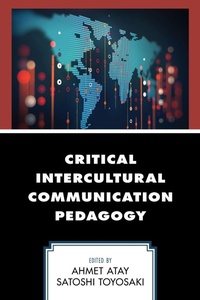
Critical Intercultural Communication Pedagogy
Published on 15. June 2020
Book
Paperback/Softback
286 pages
978-1-4985-3122-1 (ISBN)
Description
Critical Intercultural Communication Pedagogy constructs a theoretical frame through which critical intercultural communication pedagogy can be dreamed, envisioned, and realized as praxis. Its chapters provide answers to questions surrounding the relationship of intercultural communication pedagogy to critical race theory, queer theory, critical ethnography, and narrative methodology, among others. Utilizing a diverse array of theoretical and methodological approaches within critical intercultural communication research, this collection is creatively engaging, theoretically innovating, and pedagogically encouraging.
Reviews / Votes
This is a rich and essential collection of essays by leading scholar-educators of critical intercultural communication. Rooted in lived experiences across identities and standpoints, it incorporatespowerful narrative autoethnography, performance, embodied practice, critical love, and other approaches within a variety of contexts. It addresses practical, ethical, and emotional elements of teaching, and offers deep and valuable insights for seasoned and novice critical educators who strive to decolonize our teaching through dialogue and self-reflexivity. Merging insights of intercultural communication scholarship with those of critical pedagogy, the book constitutes an important contribution to the turn toward social justice within communication studies. -- Sara DeTurk, University of Texas at San Antonio Critical Intercultural Communication Pedagogy is a powerful and resonant collection of insights into the nuances of culture, power, and pedagogy. Because the authors open dialogic explorations into teaching, learning, and embodying feminist, mediated, postcolonial, queer, and other critical theories, these writings will be of great interest and value to communication scholars in/of/beyond the classroom. Atay and Toyosaki have assembled established scholars who are committed to modeling reflexivity in illuminating and interrogating structures of power and privilege that affect us all. These readings command us to compassionately and critically investigate our own roles in naming, perpetuating, and challenging these structures in our classrooms and in our scholarship; its value to the discipline is considerable. -- Deanna L. Fassett, San Jose State UniversityMore details
Language
English
Place of publication
United States
Publishing group
Bloomsbury Publishing Plc
Target group
Professional and scholarly
Illustrations
1 b/w photos;
Dimensions
Height: 229 mm
Width: 152 mm
Thickness: 17 mm
Weight
459 gr
ISBN-13
978-1-4985-3122-1 (9781498531221)
Copyright in bibliographic data and cover images is held by Nielsen Book Services Limited or by the publishers or by their respective licensors: all rights reserved.
Schweitzer Classification
Other editions
Additional editions
E-Book
12/2017
1st Edition
Lexington Books
€40.49
Available for download
Persons
Ahmet Atay is associate professor of communication at the College of Wooster.
Satoshi Toyosaki is associate professor of communication studies at Southern Illinois University.
Satoshi Toyosaki is associate professor of communication studies at Southern Illinois University.
Content
Contents
Introduction
Chapter One: Demarcating the "Critical" in Critical Intercultural Communication Studies
Rona Tamiko Halualani
Chapter Two: Making a Place: A Framework for Educators Working with Critical Intercultural Communication and Critical Communication Pedagogy
Jennifer Sandoval and Keith Nainby
Chapter Three: Intercultural Communication, Ethics and Activism Pedagogy
Leda Cooks
Chapter Four: (Critical) Love is a Battlefield: Implications for a Critical Intercultural Pedagogical Approach
Bernadette Marie Calafell and Robert Gutierrez-Perez
Chapter Five: Engaging Historical Trauma in the Classroom: Ethnoautobiography as Decolonizing Practice
S. Lily Mendoza
Chapter Six: Pedagogies of Failure: Queer Communication Pedagogy as Anti-Normative
Benny LeMaster
Chapter Seven: Pedagogy of the Taboo: Theorizing Transformative Teaching-Learning Experiences that Speak Truth(s) to Power
Mark P. Orbe
Chapter Eight: Obstructing the Process of Becoming: Basal Whiteness and the Challenge to Critical
Introduction
Chapter One: Demarcating the "Critical" in Critical Intercultural Communication Studies
Rona Tamiko Halualani
Chapter Two: Making a Place: A Framework for Educators Working with Critical Intercultural Communication and Critical Communication Pedagogy
Jennifer Sandoval and Keith Nainby
Chapter Three: Intercultural Communication, Ethics and Activism Pedagogy
Leda Cooks
Chapter Four: (Critical) Love is a Battlefield: Implications for a Critical Intercultural Pedagogical Approach
Bernadette Marie Calafell and Robert Gutierrez-Perez
Chapter Five: Engaging Historical Trauma in the Classroom: Ethnoautobiography as Decolonizing Practice
S. Lily Mendoza
Chapter Six: Pedagogies of Failure: Queer Communication Pedagogy as Anti-Normative
Benny LeMaster
Chapter Seven: Pedagogy of the Taboo: Theorizing Transformative Teaching-Learning Experiences that Speak Truth(s) to Power
Mark P. Orbe
Chapter Eight: Obstructing the Process of Becoming: Basal Whiteness and the Challenge to Critical