

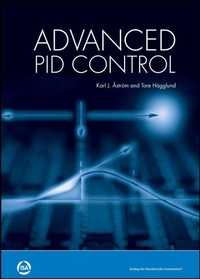
Advanced PID Control
Description
The authors of the best-selling book PID Controllers: Theory, Design, and Tuning once again draw on their extensive expertise in the PID field to provide an in-depth look at PID control.
Advanced PID Control builds on the fundamentals learned in PID Controllers by incorporating more advanced control techniques. The design of PID controllers has become crucial to control system design, addressing criteria such as load disturbances, noise measurement, robustness to process variations and maintaining set points. This approach enables a seamless transition from basic PID control to more advanced, model-based controllers. It also helps gain insight into fundamental limitations and recognize the necessary information to design effective controllers.
This book provides a solid foundation for understanding, operating and implementing the more advanced features of PID controllers, including auto-tuning, gain scheduling and adaptation. It pays particular attention to specific challenges like reset windup, long process dead times and oscillatory systems. Additionally, it covers modeling methods, implementation details and problem-solving techniques.
More details
Other editions
Additional editions
Persons
Content
1 Introduction 1
1.1 Introduction 1
1.2 Feedback 2
1.3 Simple Forms of Feedback 3
1.4 How the PID Controller Developed 5
1.5 Technology Changes and Knowledge Transfer 7
1.6 Outline of the Contents of the Book 8
1.7 Summary 10
1.8 Notes and References 10
2 Process Models 12
2.1 Introduction 12
2.2 Static Models 13
2.3 Dynamic Models 14
2.4 Feature-Based Models 23
2.5 Typical Process Models 28
2.6 Models for Disturbances 44
2.7 How to Obtain the Models 47
2.8 Model Reduction 56
2.9 Summary 61
2.10 Notes and References 62
3 PID Control 64
3.1 Introduction 64
3.2 The PID Controller 64
3.3 Filtering the Derivative 73
3.4 Set-Point Weighting 74
3.5 Integrator Windup 76
3.6 When Can PID Control Be Used? 87
3.7 Summary 92
3.8 Notes and References 93
4 Controller Design 95
4.1 Introduction 95
4.2 A Rich Variety of Control Problems 96
4.3 Feedback Fundamentals 96
4.4 Stability 102
4.5 Closed-Loop Poles and Zeros 109
4.6 The Sensitivity Functions 111
4.7 Robustness to Process Variations 118
4.8 Quantifying the Requirements 122
4.9 Classical Specifications 128
4.10 Summary 136
4.11 Notes and References 137
5 Feed forward Design 139
5.1 Introduction 139
5.2 Improved Set-Point Response 139
5.3 Set-Point Weighting 145
5.4 Neutral Feed forward 146
5.5 Fast Set-Point Response 150
5.6 Disturbance Attenuation 154
5.7 Summary 156
5.8 Notes and References 157
6 PID Design 158
6.1 Introduction 158
6.2 Ziegler-Nichols and Related Methods 159
6.3 Rule-Based Empirical Tuning 169
6.4 Pole Placement 174
6.5 Lambda Tuning 186
6.6 Algebraic Design 189
6.7 Optimization Methods 196
6.8 Robust Loop Shaping 206
6.9 Summary 221
6.10 Notes and References 222
7 A Ziegler-Nichols Replacement 225
7.1 Introduction 225
7.2 The Test Batch 226
7.3 PI Control 228
7.4 PID Control 230
7.5 Frequency Response Methods 238
7.6 PID Control Based on Second-Order Model 242
7.7 Comparison of the Methods 247
7.8 Measurement Noise and Filtering 251
7.9 Detuning 253
7.10 Summary 262
7.11 Notes and References 265
8 Predictive Control 266
8.1 Introduction 266
8.2 The Smith Predictor 267
8.3 Analysis of Smith Predictor Control 271
8.4 The PPI Controller 279
8.5 Predictors for Integrating Processes 283
8.6 Model Predictive Control 285
8.7 Summary 291
8.8 Notes and References 292
9 Automatic Tuning and Adaptation 293
9.1 Introduction 293
9.2 Process Knowledge 294
9.3 Adaptive Techniques 295
9.4 Model-Based Methods 298
9.5 Rule-Based Methods 302
9.6 Supervision of Adaptive Controllers 304
9.7 Iterative Feedback Tuning 313
9.8 Commercial Products 316
9.9 Summary 327
9.10 Notes and References 327
10 Loop and Performance Assessment 329
10.1 Introduction 329
10.2 Valves 329
10.3 Loop Assessment 334
10.4 Performance Assessment 336
10.5 Integrated Tuning and Diagnosis 344
10.6 Summary 345
10.7 Notes and References 346
11 Interaction 347
11.1 Introduction 347
11.2 Interaction of Simple Loops 347
11.3 Decoupling 354
11.4 Parallel Systems 360
11.5 Summary 364
11.6 Notes and References 365
12 Control Paradigms 366
12.1 Introduction 366
12.2 Bottom-Up and Top-Down Approaches 367
12.3 Repetitive Control 368
12.4 Cascade Control 373
12.5 Mid-Range and Split-Range Control 378
12.6 Nonlinear Elements 381
12.7 Neural Network Control 389
12.8 Fuzzy Control 392
12.9 System Structuring 398
12.10 Summary 404
12.11 Notes and References 406
13 Implementation 407
13.1 Introduction 407
13.2 Analog Implementations 408
13.3 Computer Implementations 412
13.4 Velocity Algorithms 420
13.5 Operational Aspects 423
13.6 Controller Outputs 427
13.7 Summary 431
13.8 Notes and References 432
Bibliography 433
Index 456