

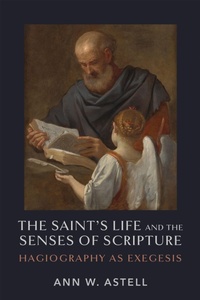
The Saint's Life and the Senses of Scripture
Hagiography As Exegesis
Will be published approx. on 15. August 2026
Book
Paperback/Softback
400 pages
978-0-268-20812-7 (ISBN)
Description
Through close examination of ancient, medieval, and modern Lives of the saints, Ann W. Astell demonstrates how the historical transformation of hagiography as a genre correlates with similar changes in biblical studies.
Christian hagiography flourished from the fourth to the fifteenth centuries, illuminating the gospel through the overlapping forms of exempla and vita. Originally, the Lives of the saints were understood as hermeneutical extensions of the Bible-God authors the saint, just as God authors the divinely inspired scriptures. During the medieval period, a sense of dual authorship between God and the cooperating saint developed, paralleling the Scholastic impulse to assign greater agency to the human writers of scripture. Then, in the sixteenth century, powerful new anxieties about historical truth pushed hagiography aside for biography, its successor.
Drawing on her expertise in the history of Christianity and biblical exegesis, Astell convincingly shows how this radical shift in hagiography's status-the loss of the literal, allegorical, tropological, and anagogical senses of the Lives-serves as a bellwether for modern biblical reception.
Christian hagiography flourished from the fourth to the fifteenth centuries, illuminating the gospel through the overlapping forms of exempla and vita. Originally, the Lives of the saints were understood as hermeneutical extensions of the Bible-God authors the saint, just as God authors the divinely inspired scriptures. During the medieval period, a sense of dual authorship between God and the cooperating saint developed, paralleling the Scholastic impulse to assign greater agency to the human writers of scripture. Then, in the sixteenth century, powerful new anxieties about historical truth pushed hagiography aside for biography, its successor.
Drawing on her expertise in the history of Christianity and biblical exegesis, Astell convincingly shows how this radical shift in hagiography's status-the loss of the literal, allegorical, tropological, and anagogical senses of the Lives-serves as a bellwether for modern biblical reception.
Reviews / Votes
"Astell seeks to frame hagiography as a form of biblical exegesis, shifting debate about the genre into new territory. . . . [T]he shift will be enriching for both hagiography's detractors and its defenders." -First Things"Though Astell's focus is hagiography, her aspirations extend to biblical interpretation. . . . This wide-ranging and well-documented work provides valuable resources in support of achieving that goal." -Theological Studies
"Astell's book further emphasises the importance of analysing hagiography for more than just the 'historical sense' and demonstrates the potential rewards for scholars from a range of disciplines of taking the Scriptural dimension of saints' Lives seriously." -Irish Theological Quarterly
"Astell reads skillfully, writes lucidly, and is on top of her material." -Barbara Newman, author of The Permeable Self
"An original contribution to the field of medieval studies, in particular, but also religious history." -Ian Christopher Levy, author of Introducing Medieval Biblical Interpretation
More details
Language
English
Place of publication
Notre Dame IN
United States
Target group
Professional and scholarly
Product notice
Paperback (trade)
Illustrations
11 illustrations - 11 illustrations - 7 Illustrations, color - 4 Tables, black and white
Dimensions
Height: 229 mm
Width: 152 mm
Thickness: 21 mm
ISBN-13
978-0-268-20812-7 (9780268208127)
Copyright in bibliographic data and cover images is held by Nielsen Book Services Limited or by the publishers or by their respective licensors: all rights reserved.
Schweitzer Classification
Other editions
Additional editions
E-Book
07/2024
1st Edition
University of Notre Dame Press
from
€134.99
Available for download
Person
Ann W. Astell is the John Cardinal O'Hara Professor of Theology at the University of Notre Dame. She is the author of many books, including Eating Beauty: The Eucharist and the Spiritual Arts of the Middle Ages, and the editor of Saving Fear in Christian Spirituality.
Content
Acknowledgments
Illustrations
Abbreviations
Introduction: Brief Candle: The Saint's Life as Biblical Illumination
Part 1. The Saint's Life in the Age of Monasticism
1. Psalm Use, Prayer, and Prophecy in the Lives of Saint Guthlac
2. Hexaemeral Miracles in Saint AElred of Rievaulx's Life of Ninian
3. The Song of Songs and Saint Bernard of Clairvaux's Life of Saint Malachy
4. Eadmer's Parabolic Life and History of Saint Anselm of Canterbury: A Twice-Told Tale.
Part 2. The Saint's Life in the Scholastic Age
5. Saint Francis of Assisi as "New Evangelist" in Thomas of Celano's Vita Prima and Bonaventure's Legenda Maior
6. Heroic Virtue in Blessed Raymond of Capua's Life of Catherine of Siena
7. Mary Magdalene and the Eucharist: Reading Jacobus de Voragine's Legenda Aurea with Catherine of Siena, Raymond of Capua, and Osbern Bokenham
Part 3. The Saint's Life in Modernity
8. The Ends of Hagiography: Erasmus's Jerome, Harpsfield's Life, and More's Epitaph
9. Modern Literary Experiments in Biblical Hagiography
Conclusion: Historical Truth, Biblical Criticism, and Hagiography
Illustrations
Abbreviations
Introduction: Brief Candle: The Saint's Life as Biblical Illumination
Part 1. The Saint's Life in the Age of Monasticism
1. Psalm Use, Prayer, and Prophecy in the Lives of Saint Guthlac
2. Hexaemeral Miracles in Saint AElred of Rievaulx's Life of Ninian
3. The Song of Songs and Saint Bernard of Clairvaux's Life of Saint Malachy
4. Eadmer's Parabolic Life and History of Saint Anselm of Canterbury: A Twice-Told Tale.
Part 2. The Saint's Life in the Scholastic Age
5. Saint Francis of Assisi as "New Evangelist" in Thomas of Celano's Vita Prima and Bonaventure's Legenda Maior
6. Heroic Virtue in Blessed Raymond of Capua's Life of Catherine of Siena
7. Mary Magdalene and the Eucharist: Reading Jacobus de Voragine's Legenda Aurea with Catherine of Siena, Raymond of Capua, and Osbern Bokenham
Part 3. The Saint's Life in Modernity
8. The Ends of Hagiography: Erasmus's Jerome, Harpsfield's Life, and More's Epitaph
9. Modern Literary Experiments in Biblical Hagiography
Conclusion: Historical Truth, Biblical Criticism, and Hagiography