

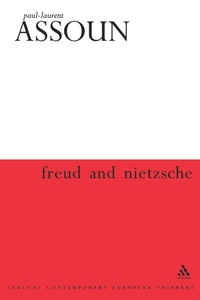
Freud and Nietzsche
Published on 1. January 2003
Book
Paperback/Softback
288 pages
978-0-8264-6316-6 (ISBN)
Description
Many of the leading Freudian analysts, including in the early days Jung, Adler, Reich and Rank, attempted to link the writings of Nietzsche with the clinical work of Freud. But what was Nietzsche to Freud - an intuitive anticipation, a precursor, a rival psychologist? Assoun moves beyond the seduction of these attractive analogues to a deeper analysis of the relation between these two figures. Assoun reconstructs Freud's encounter with Nietzsche, his personal interpretations and the contribution of Nietzsche's champions. He also examines the thematic similarities that appear on the surface to reveal close affinities between the theorists. His argument is that these "analogies" are really the symptom of an open, ongoing dialogue between Freud and Nietzsche (and Marx) which remains vital to critical theory today
Reviews / Votes
"A lucid, incisive analysis of the interrelationship between Nietzsche's unsystematic, but acute, psychological observations and significant elements in Freudian psychoanalysis."--George J. StackMore details
Series
Language
English
Place of publication
London
United Kingdom
Publishing group
Bloomsbury Publishing PLC
Target group
College/higher education
Professional and scholarly
Dimensions
Height: 229 mm
Width: 152 mm
Thickness: 17 mm
Weight
471 gr
ISBN-13
978-0-8264-6316-6 (9780826463166)
Copyright in bibliographic data and cover images is held by Nielsen Book Services Limited or by the publishers or by their respective licensors: all rights reserved.
Schweitzer Classification
Person
Professor Assoun is an active historian of philosophy and has published widely on Freud, Marx and psychoanalysis.
Content
Part One Freud and Nietzsche: The Genesis of an Encounter; Nietzsche in Freudian Discourse. Part Two Nietzsche and Freud: The Foundations - Instinct and Drive, Nietzschean Psychology, Freudian Psychoanalysis, Principles of the Drive; The Themes - Love and Sexuality, The Unconscious and Consciousness, Dreams and Symbolism; The Stakes - Neurosis and Morality, Culture and Civilization, Therapeutics.