

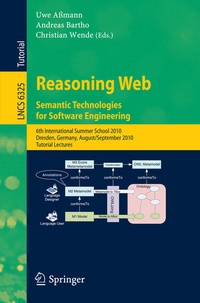
Reasoning Web. Semantic Technologies for Software Engineering
6th International Summer School 2010, Dresden, Germany, August 30 - September 3, 2010. Tutorial Lectures
1st Edition
Published on 25. August 2010
Book
Paperback/Softback
IX, 183 pages
978-3-642-15542-0 (ISBN)
Description
Welcome to the proceedings of Reasoning Web 2010 which was held in Dresden. Reasoning Web is a summer school series on theoretical foundations,contemporary approaches, and practical solutions for reasoning in a Web of Semantics. It has est- lished itself as a meeting point for experts from research institutes and industry, as well as students undertakingtheir PhDs in related ?elds. This volume contains tutorial notes of the sixth school in the series, held from August 30 to September 3, 2010. This year, the school focused on applications of semantic technologies in software engineeringandthereasoningtechnologiesappropriateforsuchanendeavor. Asit turns out, semantic technologies in software engineering are not so easily applied, and s- eral issues mustbe resolvedbeforesoftware modelingcanbene?t fromreasoning. First, reasoning has to be fast and scalable, since models and programscan be quite large and voluminous. SincemanyreasoninglanguagesareexponentialorNP-complete,appro- mation, incrementalization,and other optimizationtechniques are extremelyimportant. Second, software engineering needs to model software systems, in contrast to mod- ing domains of the world.
Thus, the modeling techniques are prescriptive rather than descriptive [1], which in?uences the way models are reasoned about. When a software system is modeled, its behavior is prescribed by the model, that is, "the truth is in the model"[2]; when a domainof the world is described,its behaviorcannotbe prescribed, only described by the model ("the truth is in the world"). Therefore, reasoning has to distinguish between prescriptiveness and descriptiveness, leading to different assu- tions about the closeness or openness of the world (closed-world assumption, CWA vs. open-world assumption, OWA).
Thus, the modeling techniques are prescriptive rather than descriptive [1], which in?uences the way models are reasoned about. When a software system is modeled, its behavior is prescribed by the model, that is, "the truth is in the model"[2]; when a domainof the world is described,its behaviorcannotbe prescribed, only described by the model ("the truth is in the world"). Therefore, reasoning has to distinguish between prescriptiveness and descriptiveness, leading to different assu- tions about the closeness or openness of the world (closed-world assumption, CWA vs. open-world assumption, OWA).
More details
Series
Language
English
Place of publication
Berlin
Germany
Publishing group
Springer Berlin
Target group
Professional and scholarly
Research
Illustrations
52 s/w Abbildungen
IX, 183 p. 52 illus.
Dimensions
Height: 0 mm
Width: 0 mm
Weight
305 gr
ISBN-13
978-3-642-15542-0 (9783642155420)
DOI
10.1007/978-3-642-15543-7
Schweitzer Classification
Other editions
Additional editions
Uwe Aßmann | Andreas Bartho | Christian Wende
Reasoning Web. Semantic Technologies for Software Engineering
6th International Summer School 2010, Dresden, Germany, August 30 - September 3, 2010. Tutorial Lectures
E-Book
08/2010
Springer
€53.49
Available for download
Content
Reasoning and Explanation in and in Expressive Description Logics.- Hybrid Reasoning with Non-monotonic Rules.- Model Driven Engineering with Ontology Technologies.- Combining Ontologies with Domain Specific Languages: A Case Study from Network Configuration Software.- Bridging Query Languages in Semantic and Graph Technologies.- Semantic Business Process Engineering.