

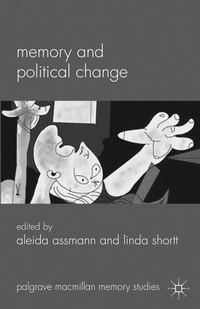
Memory and Political Change
Published on 8. November 2011
Book
Hardback
XVIII, 223 pages
978-0-230-30199-3 (ISBN)
Description
Examining the role of memory in the transition from totalitarian to democratic systems, this book makes an important contribution to memory studies. It explores memory as a medium of and impediment to change, looking at memory's biological, cultural, narrative and socio-psychological dimensions.
More details
Series
Edition
2012 edition
Language
English
Place of publication
London
United Kingdom
Target group
Professional and scholarly
Product notice
sewn/stitched
Cloth over boards
With dust jacket
Illustrations
XVIII, 223 p.
Dimensions
Height: 218 mm
Width: 142 mm
Thickness: 20 mm
Weight
408 gr
ISBN-13
978-0-230-30199-3 (9780230301993)
DOI
10.1057/9780230354241
Schweitzer Classification
Other editions
Additional editions
A. Assmann | L. Shortt
Memory and Political Change
Book
11/2011
Palgrave Macmillan
€53.49
Shipment within 15-20 days
A. Assmann | L. Shortt
Memory and Political Change
E-Book
11/2011
1st Edition
Palgrave Macmillan
€53.49
Available for download
Persons
NUTSA BATIASHVILI Ph.D. Candidate in Cultural Anthropology at Washington University, St Louis, USA GUDRUN BROCKHAUS Social-Psychologist in Munich, Germany SUSANNE BUCKLEY-ZISTEL Professor for Peace and Conflict Studies at the University of Marburg, Germany ANGELA GUTCHESS Assistant Professor of Psychology at Brandeis University, USA MONIKA REIF-HUELSER Held Guest Professorships in Guelph, Canada, Toronto, Canada, and Shanghai, China, and has acted as Associate Professor in Iasi, Romania GABRIELE SCHWAB Chancellor's Professor of English and Comparative Literature at the University of California at Irvine, USA ANJA SCHWARZ Junior Professor for British Cultural Studies at the University of Potsdam, Germany MAYA SIEGEL Ph.D. Graduate from the Psychology Department at Brandeis University, USA BRIGITTE WEIFFEN Lecturer and Research Fellow at the Department of Politics and Management, University of Konstanz, Germany JAMES V. WERTSCH Marshall S. Snow Professor in Arts and Sciences and Professor at Washington University, St. Louis, USA JAY WINTER Charles J. Stille Professor of History at Yale University, USA.
Content
Notes on the Contributors Acknowledgements Foreword: Remembrance as a Human Right; J.Winter Introduction; A.Assmann & L.Shortt PART I: TRANSGENERATIONAL TRANSMISSION Replacement Children: The Transgenerational Transmission of Traumatic Loss; G.Schwab The Emotional Legacy of the Nazi Past in Post-War Germany; G.Brockhaus PART II: INSTRUMENTS OF CHANGE To Remember or to Forget: Which Way out of a Shared History of Violence? A.Assmann Between Pragmatism, Coercion and Fear: Chosen Amnesia after the Rwandan Genocide; S.Buckley-Zistel From Domestic to International Instruments for Dealing with a Violent Past: Causes, Concomitants and Consequences for Democratic Transitions; B.Weiffen PART III: RE-IMAGINING THE PAST FOR THE FUTURE Re-Imagining East Germany in the Berlin Republic: Jana Hensel, GDR Memory and the Transitional Generation; L.Shortt South African Transition in the Literary Imagination: Nadine Gordimer, J.M. Coetzee, Malika Lueen Ndlovu; M.Reif-Huelser 'That's Not a Story I Could Tell': Commemorating the Other Side of the Colonial Frontier in Australian Literature of Reconciliation; A.Schwarz PART IV: RESISTANCE TO CHANGE Deep Memory and Narrative Templates: Conservative Forces in Collective Memory; J.V.Wertsch The 'Myth' of the Self: The Georgian National Narrative and Quest for 'Georgianness'; N.Batiashvili Memory across Cultures; A.H.Gutchess & M.Siegel Index