

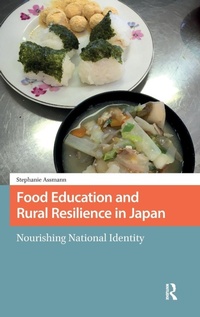
Food Education and Rural Resilience in Japan
Nourishing National Identity
Published on 5. August 2025
Book
Hardback
202 pages
978-94-6298-524-7 (ISBN)
Description
Food education initiatives exist worldwide, but Japan remains unique with its food education law known as shokuiku. The country's impressive health metrics - high life expectancies, low obesity, and affordable health care - often lead observers to praise this approach. This book presents a more nuanced analysis. First, it challenges the assumption that food education is wholly a "good thing" by exposing underlying power mechanisms. Through food diagrams, food fairs, and school lunch programs, government ministries promote both nationalism and traditional gender roles. Second, it explores how food education operates in Japan's rural regions, where educators champion resilience and food self-sufficiency to alleviate depopulation and economic decline. This emphasis on local food persisted even in the aftermath of the 2011 Fukushima nuclear disaster. Using Foucault's concept of governmentality, historical contextualization, and extensive fieldwork in rural Japan, this study reveals the complex political agenda driving food education in a non-Western society.
Reviews / Votes
"Assmann demonstrates how Japan's 'food education' (shokuiku) campaigns do more than promote healthy eating but respond to manifold problems including the country's low food self-sufficiency rate, the decline of rural communities, and natural disasters. Her book is essential reading for understanding the connections between food and politics in modern Japan."- Eric C. Rath, University of Kansas
"Stephanie Assmann's meticulous research sheds new light on the ways in which food education in Japan has been a powerful force in shaping national identity and revitalizing rural communities. This groundbreaking study provides essential insights for all those with an interest in Japanese food studies, cultural politics, and rural sociology."
- Jon Morris, Daito Bunka University
More details
Series
Language
English
Place of publication
Oxford
Netherlands
Target group
Professional and scholarly
College/higher education
Academic
Illustrations
6 s/w Abbildungen
6 Illustrations, black and white
Dimensions
Height: 240 mm
Width: 161 mm
Thickness: 16 mm
Weight
476 gr
ISBN-13
978-94-6298-524-7 (9789462985247)
Copyright in bibliographic data and cover images is held by Nielsen Book Services Limited or by the publishers or by their respective licensors: all rights reserved.
Schweitzer Classification
Other editions
Additional editions
E-Book
10/2025
Routledge
€60.49
Available for download
E-Book
10/2025
Routledge
€60.49
Available for download
Person
Stephanie Assmann's research interests are foodways and culinary politics, life in rural Japan, employment and diversity. She is co-editor of Japanese Foodways, Past and Present (with Eric C. Rath, 2010, University of Illinois Press) and editor of Sustainability in Contemporary Rural Japan: Challenges and Opportunities (2016, Routledge).
Content
Introduction
Chapter One - Food Education: A Theoretical Framework
Chapter Two - The Historical Trajectories of Food Education
Chapter Three - The Shokuiku Campaign: Food Governmentality in Present Japan
Chapter Four - Shokuiku Policies in Rural Areas
Chapter Five - Food Education and Sustainability in Times of Crisis
Moving Forward: Embracing Sustainability
References
Chapter One - Food Education: A Theoretical Framework
Chapter Two - The Historical Trajectories of Food Education
Chapter Three - The Shokuiku Campaign: Food Governmentality in Present Japan
Chapter Four - Shokuiku Policies in Rural Areas
Chapter Five - Food Education and Sustainability in Times of Crisis
Moving Forward: Embracing Sustainability
References