

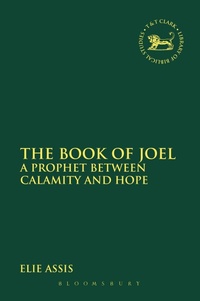
The Book of Joel
A Prophet between Calamity and Hope
Published on 25. September 2014
Book
Paperback/Softback
304 pages
978-0-567-65718-3 (ISBN)
Description
Prophetic sayings are generally a reaction to immediate realities, and therefore attempts to understand prophetic literature without the benefit of the prophet's historical milieu are limited or inaccurate. Contrary to the prevailing opinion that Joel is post-exilic, the book is located within the exilic period, recognising the lack of any rebuke consistent with a people experiencing deep despair. The Book of Joel places great emphasis on the motif of the divine presence residing in the midst of Israel, and it is asserted that the prophet's main purpose was to bring the people to renew their connection with the Lord after the destruction of the Temple, which, though physically ruined, had not lost its religious significance. A literary and rhetorical analysis demonstrates how the prophet sought to influence his audience. Literary devices and rhetorical tools are investigated, and their relevance and contribution to the book's meanings are explored. One central feature of the book is its focus on a detailed discussion of the position and purpose of the locust plague, employing recent literary approaches.
Reviews / Votes
Assis' analysis of Joel is positive and erudite. First, his connection between Joel and Lamentations is innovative and suggestive. This connection is worthy of further study. Second, Assis' discussion of compositional and literary techniques is enlightening. His assertion that, in places, the author of Joel is intentionally ambiguous is interesting and his careful attention to the minute details of the Hebrew texts is helpful. Third, his structural analysis of the entire book and each individual text segment aids in organizing such a complex book. Fourth, Assis' largely synchronic approach allows him to focus on the interpretive issues that are pertinent to his theological reading... Assis' volume exemplifies a careful synchronic reading of Joel. His interaction with major commentators makes his study an excellent companion to commentary literature. For those interested in composition and structural analysis of prophetic literature or those working with the book of Joel directly, I recommend this volume. -- Garrick Vernon Allen, University of St Andrews * Reviews in Religion and Theology * Elie Assis has written extensively on the biblical material which he regards as having emerged from that vital period in Israel's history-the sixth and fifth centuries BCE. Fourteen previously published books and articles are listed in the bibliography, and three of the chapters in the present volume are substantially reprints of some of that earlier work. What is here offered is therefore not a commentary, though the whole Hebrew text of Joel, along with an English translation, is included; and any dangerthat the inclusion of previously published material would break the flow of the final work has been skilfully avoided. Assis has been consistent in his view of the historical situation and the way that it has shaped the response to it as it is enshrined in the Hebrew Bible. -- Richard Coggins * Journal of Theological Studies (Vol. 64.2) * This book represents a large amount of careful research through a large block of material in the Hebrew Bible, and so C. is to be congratulated on this work. It will prove to be an additional resource for those interested in the subject of prophecy in general and the intricacies of fulfillment of predictive prophecy and lack thereof in particular. The book is written in very readable prose, and ample footnotes throughout provide the reader with a solid research paper trail [...] C's book will prove to be a strong contribution to the field and a must read for scholar's and student interested in biblical prophecy and the theology of the Deuteronomistic history. -- Jason Bember * Catholic Biblical Quarterly *
More details
Series
Language
English
Place of publication
Edinburgh
United Kingdom
Publishing group
Bloomsbury Publishing PLC
Target group
College/higher education
Dimensions
Height: 234 mm
Width: 156 mm
Thickness: 16 mm
Weight
465 gr
ISBN-13
978-0-567-65718-3 (9780567657183)
Copyright in bibliographic data and cover images is held by Nielsen Book Services Limited or by the publishers or by their respective licensors: all rights reserved.
Schweitzer Classification
Other editions
Additional editions
E-Book
04/2013
1st Edition
T.& T.Clark Ltd
€42.99
Available for download
Person
Elie Assis is the head of the Department of Bible Studies at Bar Ilan University. Among his scholarly work are his books From Moses to Joshua and from the Miraculous to the Ordinary: A Literary Analysis of the Conquest Narrative in the Book of Joshua, Jerusalem: 2005 (Hebrew), and Self-Interest or Communal Interest? An Ideology of Leadership in the Gideon, Abimelech and Jephthah Narratives (Judg. 6-12) (Supplements to Vetus Testamentum, 106), 2005.
Content
Introduction
The Date and Meaning of the Book of Joel
Part I: Description of the locusts, call to the people to turn to God, priests' prayer (1:2-2-17)
The First Pericope about the Locusts (1:2-12)
The Second Pericope about the Locusts (1:13-20)
The Third Pericope about the Locusts (2:1-14)
The Fourth Pericope about the Locusts, and the Priests' Prayer (2:15-17)
Part II
Divine Response to the Priests' Prayer (2:18-4:17)
The first Divine reply - Salvation from the Locust Plague, 2:18-27
The second Divine reply - Salvation for the People from National Distress 3:1-4:17
Outpouring of God's Spirit ans Cosmic Omens for of the Day of the Lord (3:1-5)
Judgement of the Nations (4:1-17)
The Book's Ending (4:18-21)
Salvation of the agriculture (4:18)
National Salvation (4:19-21)
Conclusions
Bibliography
Index
The Date and Meaning of the Book of Joel
Part I: Description of the locusts, call to the people to turn to God, priests' prayer (1:2-2-17)
The First Pericope about the Locusts (1:2-12)
The Second Pericope about the Locusts (1:13-20)
The Third Pericope about the Locusts (2:1-14)
The Fourth Pericope about the Locusts, and the Priests' Prayer (2:15-17)
Part II
Divine Response to the Priests' Prayer (2:18-4:17)
The first Divine reply - Salvation from the Locust Plague, 2:18-27
The second Divine reply - Salvation for the People from National Distress 3:1-4:17
Outpouring of God's Spirit ans Cosmic Omens for of the Day of the Lord (3:1-5)
Judgement of the Nations (4:1-17)
The Book's Ending (4:18-21)
Salvation of the agriculture (4:18)
National Salvation (4:19-21)
Conclusions
Bibliography
Index