

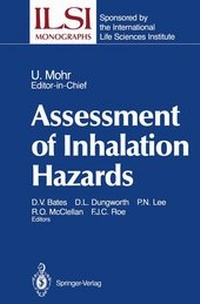
Assessment of Inhalation Hazards
Integration and Extrapolation Using Diverse Data
Springer (Publisher)
1st Edition
Published on 28. December 1989
Book
Hardback
XVI, 382 pages
978-3-540-50952-3 (ISBN)
Description
The International Life Sciences Institute (ILSI), a nonprofit, public foundation, was established in 1978 to advance the sciences of nutrition, toxicology, and food safety. ILSI promotes the resolution of health and safety issues in these areas by sponsoring research, conferences, publications, and educational programs. Through ILSI's programs, scientists from government, academia, and industry unite their efforts to resolve issues of critical importance to the public. As part of its commitment to understanding and resolving health and safety issues, ILSI is pleased to sponsor this series of monographs that consolidates new scientific knowledge, defines research needs, and provides a background for the effective application of scientific advances in toxicology and food safety. Alex Malaspina President International Life Sciences Institute Contents Series Foreword . . . . . . . . . . . . . . . . . . . . . . . . . . . . . . . . . . . . . . . . . . . . . . v Contributors . . . . . . . . . . . . . . . . . . . . . . . . . . . . . . . .. . . . xiii . . . . . . . . . . . . . Part I. Integrative Approach to Assessing Human Health Risk: Two Contemporary Problems Chapter 1. Integrating Diverse Data Sets to Assess the Risks of Airborne Pollutants . . . . . . . . . . . . . . . . . . . . . . . . . . . . . . . 3 R.o. McClellan, R.G. Cuddihy, w.e. Griffith, and J. L. Mauderly Chapter 2. Risk Assessment for Radon Inhalation Based on Animal Exposure Data and Human Epidemiology . . . . . . . 23 . F. Steinhausler Part II. Types of Evidence: General Strengths and Weaknesses Section 1. Epidemiological Chapter 3. Inhalation Hazards: The Interpretation of Epidemiologic Evidence. . . . . . . . . . . . . . . . . . . . 39 . . . . . . . J.e. Bailar Chapter 4. Problems in Interpreting Epidemiological Data 49 P.N. Lee Section 2. Animal Chapter 5. Rodent Carcinogenicity Studies: Their Value and Limitations. . . . . . . . . . . . . . . . . . . . . . . . . . 61 . . . . . . . . . .
More details
Series
Language
English
Place of publication
Heidelberg
Germany
Publishing group
Springer Berlin
Target group
College/higher education
Professional and scholarly
Research
Illustrations
illustrations
Dimensions
Height: 240 mm
Weight
690 gr
ISBN-13
978-3-540-50952-3 (9783540509523)
DOI
10.1007/978-3-642-74606-2
Schweitzer Classification
Other editions
Additional editions
Assessment of Inhalation Hazards
Integration and Extrapolation Using Diverse Data
E-Book
12/2012
Springer
€96.29
Available for download
Assessment of Inhalation Hazards
Integration and Extrapolation Using Diverse Data
Book
01/2012
Springer
€106.99
Shipment within 7-9 days
Persons
Content
I. Integrative Approach to Assessing Human Health Risk: Two Contemporary Problems.- 1. Integrating Diverse Data Sets to Assess the Risks of Airborne Pollutants.- 2. Risk Assessment for Radon Inhalation Based on Animal Exposure Data and Human Epidemiology.- II. Types of Evidence: General Strengths and Weaknesses.- Section 1. Epidemiological.- 3. Inhalation Hazards: The Interpretation of Epidemiologic Evidence.- 4. Problems in Interpreting Epidemiological Data.- Section 2. Animal.- 5. Rodent Carcinogenicity Studies: Their Value and Limitations.- 6. The Quality and Relevance of Data from Studies in Laboratory Rodents.- Section 3. Dosimetric.- 7. Identification of the Effective Dose of Inhaled Toxicants: General and Specific Problems.- 8. Molecular Dosimetry of Chemical Carcinogens: Implications for Epidemiology and Risk Assessment.- Section 4. Mechanistic.- 9. Pathobiological Effects of Fibers and Tobacco-Related Chemicals in Human Lung Cells in Vitro.- 10. A Mechanistic Approach to Assess the Inhalation Toxicity and Hazard of Methylisocyanate and Related Aliphatic Monoisocyanates.- III. Case Studies.- Section 1. Formaldehyde.- 11. Inhalation Toxicity and Carcinogenicity of Formaldehyde in Animals: Significance for Assessment of Human Health Risk.- 12. Formaldehyde: Evidence of the Carcinogenic Potential from Epidemiological Data.- 13. Covalent Binding of Formaldehyde to DNA: Characterization of Reaction Products and Quantitation Following Inhalation Exposure.- Section 2. Arsenic.- 14. Environmental and Occupational Exposure to Arsenic.- 15. Is Inhaled Arsenic Carcinogenic for Sites Other Than the Lung?.- Section 3. Butadiene.- 16. Toxicology and Carcinogenicity of 1,3-Butadiene.- 17. Species Differences in Pharmacokinetics, Metabolism, and DNA Binding of Inhaled 1,3-Butadiene.- 18. Epidemiologic Data Related to Health Effects of 1,3-Butadiene.- Section 4. Benzene.- 19. A Review of the Toxicokinetics of Benzene.- 20. Benzene Haematotoxicity and Leukaemia.- Section 5. Mineral Fibers.- 21. Man-Made Mineral Fiber Exposure: Assessment and a Note on Nonoccupational Exposure to Asbestos in Air.- 22. Carcinogenicity of Fibers in Experimental Animals-Data and Evaluation.- 23. The Health Effects of Man-Made Mineral Fibers.- Section 6. Environmental Tobacco Smoke.- 24. Environmental Tobacco Smoke: Adverse Effects on Respiratory Infection, Respiratory Symptoms, and Lung Function.- 25. Environmental Tobacco Smoke and Cancer.- 26. Risk Assessment for Inhomogeneous Subgroups.- Section 7. Automotive Exhaust Emissions and Polycyclic Aromatic Hydrocarbons.- 27. Epidemiologic Studies of Populations Exposed to Motor Vehicle Exhausts and Polycyclic Aromatic Hydrocarbons.- 28. Exhaust-Specific Carcinogenic Effects of Polycyclic Aromatic Hydrocarbons and Their Significance for the Estimation of the Exhaust Exposure-Related Lung Cancer Risk.- 29. Molecular Dosimetry of Inhaled Diesel Exhaust.- IV. Interfaces Between Scientific Judgement and Prudent Environmental Health Policy.- 30. Risk Assessment as an Instrument of Environmental Policy.- 31. The Perils of Prudence.- 32. Science, Ethics and Public Policy.- 33. Recent Progress and Problems in Setting and Applying Occupational Exposure Standards.- Some Reflections on the Symposium.