

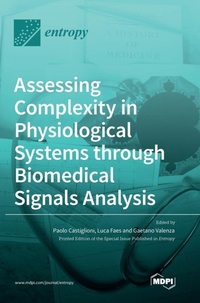
Assessing Complexity in Physiological Systems through Biomedical Signals Analysis
MDPI AG (Publisher)
Published on 2. March 2021
Book
Hardback
296 pages
978-3-03943-368-1 (ISBN)
Description
Complexity is a ubiquitous phenomenon in physiology that allows living systems to adapt to external perturbations. Fractal structures, self-organization, nonlinearity, interactions at di¿erent scales, and interconnections among systems through anatomical and functional networks, may originate complexity. Biomedical signals from physiological systems may carry information about the system complexity useful to identify physiological states, monitor health, and predict pathological events. Therefore, complexity analysis of biomedical signals is a rapidly evolving field aimed at extracting information on the physiological systems. This book consists of 16 contributions from authors with a strong scientific background in biomedical signals analysis. It includes reviews on the state-of-the-art of complexity studies in specific medical applications, new methods to improve complexity quantifiers, and novel complexity analyses in physiological or clinical scenarios. It presents a wide spectrum of methods investigating the entropic properties, multifractal structure, self-organized criticality, and information dynamics of biomedical signals touching upon three physiological areas: the cardiovascular system, the central nervous system, the heart-brain interactions. The book is aimed at experienced researchers in signal analysis and presents the latest trends in the complexity methods in physiology and medicine with the hope of inspiring future works advancing this fascinating area of research.
More details
Language
English
Product notice
sewn/stitched
Cloth over boards
Dimensions
Height: 250 mm
Width: 175 mm
Thickness: 24 mm
Weight
940 gr
ISBN-13
978-3-03943-368-1 (9783039433681)
Copyright in bibliographic data and cover images is held by Nielsen Book Services Limited or by the publishers or by their respective licensors: all rights reserved.
Schweitzer Classification