

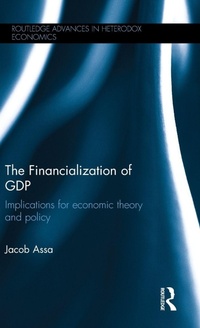
The Financialization of GDP
Implications for economic theory and policy
1st Edition
Published on 30. August 2016
Book
Hardback
136 pages
978-1-138-99983-1 (ISBN)
Description
Gross Domestic Product (GDP) and other statistics based on national income accounting are ubiquitous but rarely understood today. GDP has been criticized for many reasons, including not reflecting well-being, leaving out the costs of environmental pollution, and not counting unpaid work, but on purely economic terms it has been mostly accepted as an indicator of economic performance. In recent decades, however, GDP has diverged dramatically from economic trends such as employment and median income. This book argues that GDP is flawed even as a narrow economic indicator, and traces the problem to the way financial services are measured.
The first part of the book is a political history of the practice of national accounting from its beginning in the mid-17th century to present day, and explores how such income estimates were constructed for political reasons. The Financialization of GDP presents the practice of estimating national income as a historically and political contingent craft - driven by power and not only theory - culminating in the rise of the financial sector and the concomitant inclusion of financial services in GDP in 1993.. The second part of the book focuses on the treatment of financial services in national accounting and develops an adjusted measure of output (Final Domestic Product or FDP) - which treats financial revenues as intermediate inputs (or costs) to the economy as a whole. The final part of the book explores the empirical and policy implications of treating finance as an overall cost to the economy.
This volume shows that the Great Moderation of volatility was a statistical artefact; Okun's Law (relating changes in output and unemployment) never died, and even provides early signs for the Great Recession which analysts using standard GDP did not see. This book is of great interest to those who study political economy and macroeconomics.
The first part of the book is a political history of the practice of national accounting from its beginning in the mid-17th century to present day, and explores how such income estimates were constructed for political reasons. The Financialization of GDP presents the practice of estimating national income as a historically and political contingent craft - driven by power and not only theory - culminating in the rise of the financial sector and the concomitant inclusion of financial services in GDP in 1993.. The second part of the book focuses on the treatment of financial services in national accounting and develops an adjusted measure of output (Final Domestic Product or FDP) - which treats financial revenues as intermediate inputs (or costs) to the economy as a whole. The final part of the book explores the empirical and policy implications of treating finance as an overall cost to the economy.
This volume shows that the Great Moderation of volatility was a statistical artefact; Okun's Law (relating changes in output and unemployment) never died, and even provides early signs for the Great Recession which analysts using standard GDP did not see. This book is of great interest to those who study political economy and macroeconomics.
More details
Series
Language
English
Place of publication
London
United Kingdom
Publishing group
Taylor & Francis Ltd
Target group
College/higher education
Illustrations
23 s/w Abbildungen, 23 s/w Zeichnungen, 25 s/w Tabellen
25 Tables, black and white; 23 Line drawings, black and white; 23 Illustrations, black and white
Dimensions
Height: 222 mm
Width: 145 mm
Thickness: 11 mm
Weight
314 gr
ISBN-13
978-1-138-99983-1 (9781138999831)
Copyright in bibliographic data and cover images is held by Nielsen Book Services Limited or by the publishers or by their respective licensors: all rights reserved.
Schweitzer Classification
Other editions
Additional editions
Book
12/2019
1st Edition
Routledge
€55.74
Shipment within 15-20 days
E-Book
08/2016
Routledge
€59.49
Available for download
E-Book
08/2016
Routledge
€59.49
Available for download
Person
Jacob Assa is Economic Affairs Officer at the United Nations, New York. Born and raised in Israel, Jacob attended Hunter College in New York, and has been working at the United Nations since 1999. He received his master's and PhD degrees in economics at the New School for Social Research.
Content
Acknowledgements
Preface
Introduction: The Economic Problem with GDP
Chapter 1. The Ubiquity, Importance and Uniqueness of National Accounting
Chapter 2. National Accounting as a Historically and Politically Contingent Art
Chapter 3. Policy-Based Evidence: A Political History of National Accounts
Chapter 4. The Financialization of GDP
Chapter 5. GDP on FIRE: Financialization, Stagnation and Leakages from Aggregate Demand
Chapter 6. The Distributional Impacts of FGDP
Conclusion
Preface
Introduction: The Economic Problem with GDP
Chapter 1. The Ubiquity, Importance and Uniqueness of National Accounting
Chapter 2. National Accounting as a Historically and Politically Contingent Art
Chapter 3. Policy-Based Evidence: A Political History of National Accounts
Chapter 4. The Financialization of GDP
Chapter 5. GDP on FIRE: Financialization, Stagnation and Leakages from Aggregate Demand
Chapter 6. The Distributional Impacts of FGDP
Conclusion