

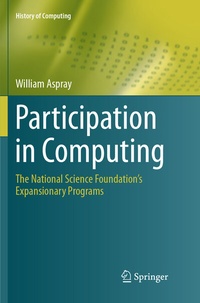
Participation in Computing
The National Science Foundation's Expansionary Programs
Published on 9. September 2018
Book
Paperback/Softback
X, 200 pages
978-3-319-79685-7 (ISBN)
Description
This book provides a history of the efforts of the US National Science Foundation to broaden participation in computing. The book briefly discusses the early history of the NSF's involvement with education and workforce issues. It then turns to two programs outside the computing directorate (the ADVANCE program and the Program on Women and Girls) that set the stage for three programs in the NSF computing directorate on broadening participation: the IT Workforce Program, the Broadening Participation in Computing program, and the Computing Education for the 21st Century program. The work looks at NSF-funded research and NSF-funded interventions both to increase the number of women, underrepresented minorities (African Americans, Hispanics, and American Indians) and people with disabilities, and to increase the number of public schools offering rigorous instruction in computing. Other organizations such as the ACM, the Computer Science Teachers Association, and Code.org are also covered.The years covered are primarily 1980 to the present.
More details
Series
Edition
Softcover reprint of the original 1st ed. 2016
Language
English
Place of publication
Cham
Switzerland
Publishing group
Springer International Publishing
Target group
Professional and scholarly
Illustrations
1 farbige Abbildung
X, 200 p. 1 illus. in color.
Dimensions
Height: 235 mm
Width: 155 mm
Thickness: 12 mm
Weight
330 gr
ISBN-13
978-3-319-79685-7 (9783319796857)
DOI
10.1007/978-3-319-24832-5
Schweitzer Classification
Other editions
Additional editions
Book
03/2016
Springer
€74.89
Article exhausted; check different version
Person
William Aspray is a full professor in the Department of Information Science at the University of Colorado Boulder. He has also taught at the University of Texas Austin, Indiana University Bloomington, Virginia Tech, University of Pennsylvania, and Harvard University, among others. He holds a Ph.D. in the history of science from the University of Wisconsin-Madison. He has served as the Director of the IEEE Center for the History of Electrical Engineering, Associate Director of the Charles Babbage Institute for the History of Information Processing at the University of Minnesota, and Executive Director at the Computing Research Association. He is the author or editor of over two dozen books dealing with the history of computing, mathematics, and information. He has published more than 100 articles in the key information history journals and served on their editorial boards, including Information Research, The Information Society, IEEE Annals of the History of Computing, Information & Culture: A Journal of History, and Communications of the ACM.
James W. Cortada is a Senior Research Fellow at the Charles Babbage Institute at the University of Minnesota. He holds a Ph.D. in modern history and worked at IBM in various sales, consulting, management, and executive positions for 38 years, including in IBM's management research institute, The IBM Institute for Business Value (IBV). There, he led and participated in over three dozen global studies on the use of information and business managerial practices. He is also the author of over a dozen books on the management of business, information technologies, and management. He also authored nearly two dozen books on the history of information technology, its business practices and industry, and about knowledge management. His articles on the history of information have appeared in many of the "journals of record" for each topic he has studied, including Information and Culture, Library and Information History, Business History Review, IEEE Annals of the History of Computing, Enterprise and Society, and Technology and Culture, among others. He serves on the editorial boards of Information and Culture, Library and Information History, and IEEE Annals of the History of Computing.
Content
Introduction.- Opening Computing Careers to Underrepresented Groups.- The Broadening Participation in Computing Alliances.- Recent Efforts to Broaden Formal Computer Science Education at the K-12 Level.- Recent Efforts to Broaden Informal Computer Science Education.- Conclusions.- Appendix: CISE-Supported Projects Targeted at Women in IT.