

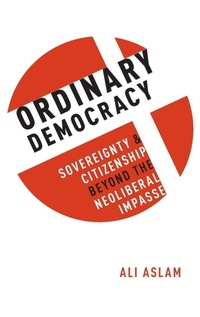
Ordinary Democracy
Sovereignty and Citizenship Beyond the Neoliberal Impasse
Published on 5. January 2017
Book
Hardback
224 pages
978-0-19-060181-2 (ISBN)
Description
While various democratic theorists have looked at particular instances of recent social movements (Occupy or the Arab Spring, for example), none have yet attempted a more general theoretical take on what it is that relates all of these movements and what that running thread can tell us about democratic theory.
Ordinary Democracy argues that there is a commonality to these movements as well as a striking lesson about the nature of democracy, sovereignty, agency and solidarity today: in that these movements all highlight the ordinariness of neoliberal regimes and the ways in which citizens find solidarity and a sense of freedom in the marketplace. Aslam contends that neoliberalism is more than a set of policies, ideological principles, or a distinct phase of capitalism -- rather it constitutes the ways in which citizens think about their everyday lives. Conceived as common sense, it also governs what is permitted or forbidden in public discourse (for example, rendering issues of private debt a personal responsibility). Mass movements call attention to the effects of neoliberalism, providing a way to contest its acceptability; in doing so they help to contextualize the impasse that marks a language of civil empowerment and inclusion on one hand, and feelings of powerlessness, diminished agency and impassivity on the other.
In Aslam's view, democratic theorists who view participatory agency as offering the most authentic opportunity to satisfy the need for solidarity and freedom minimize the degree to which capitalism satisfies most citizens, as well as the depth of most people's affective attachment to neoliberalism. Looking in particular at Idle No More, Occupy Wall Street, Occupy Sandy, the Egyptian Revolution, and Strike Debt, Aslam takes what may be a more sobering, but still hopeful, view toward the potential of mass movements: to resist the normalization of conceptions of solidarity and citizenship under neoliberalism.
Ordinary Democracy argues that there is a commonality to these movements as well as a striking lesson about the nature of democracy, sovereignty, agency and solidarity today: in that these movements all highlight the ordinariness of neoliberal regimes and the ways in which citizens find solidarity and a sense of freedom in the marketplace. Aslam contends that neoliberalism is more than a set of policies, ideological principles, or a distinct phase of capitalism -- rather it constitutes the ways in which citizens think about their everyday lives. Conceived as common sense, it also governs what is permitted or forbidden in public discourse (for example, rendering issues of private debt a personal responsibility). Mass movements call attention to the effects of neoliberalism, providing a way to contest its acceptability; in doing so they help to contextualize the impasse that marks a language of civil empowerment and inclusion on one hand, and feelings of powerlessness, diminished agency and impassivity on the other.
In Aslam's view, democratic theorists who view participatory agency as offering the most authentic opportunity to satisfy the need for solidarity and freedom minimize the degree to which capitalism satisfies most citizens, as well as the depth of most people's affective attachment to neoliberalism. Looking in particular at Idle No More, Occupy Wall Street, Occupy Sandy, the Egyptian Revolution, and Strike Debt, Aslam takes what may be a more sobering, but still hopeful, view toward the potential of mass movements: to resist the normalization of conceptions of solidarity and citizenship under neoliberalism.
Reviews / Votes
"In an era of widespread political passivity and skepticism of the value of collective action, how can the structures of state and capital be made more democratic and more accountable to the people they impact? Through innovative readings of recent and ongoing grassroots activism-from Occupy Wall Street to Occupy Sandy, from Idle No More to Tahrir Square to Strike Debt-Ali Aslam gleans examples of how to rewire attachment to passivity and inaction throughmicropractices that generate new attachments to solidarity, sustainability, and democracy. Ordinary Democracy is essential reading for anyone concerned with revitalizing radical democracy in a neoliberal
age."-Michaele L. Ferguson, author of Sharing Democracy
"In Ordinary Democracy, political theorist Ali Aslam invites readers to appreciate ordinary citizens' capacity to exercise political power. Analyzing a broad array of social movements ranging from Occupy Wall Street to the Tahrir Square protests in Egypt to indigenous activism in Canada, Aslam offers us a global vision of democracy in which activists seek to both claim and critique state power. Revealing the democratic possibilities of Native American
Round Dancing, Islamic congregational prayer, flash mobs, poetry, documentary film, and amateur media, Ordinary Democracy shows us how democratic imaginaries are created and enacted. An erudite, inspiring, and
thought-provoking book."-Cristina Beltran, author of The Trouble with Unity: Latino Politics and the Creation of Identity
More details
Language
English
Place of publication
New York
United States
Target group
College/higher education
Professional and scholarly
Dimensions
Height: 240 mm
Width: 161 mm
Thickness: 17 mm
Weight
505 gr
ISBN-13
978-0-19-060181-2 (9780190601812)
Copyright in bibliographic data and cover images is held by Nielsen Book Services Limited or by the publishers or by their respective licensors: all rights reserved.
Schweitzer Classification
Other editions
Additional editions
E-Book
11/2016
1st Edition
OUP eBook
€53.49
Available for download
E-Book
11/2016
1st Edition
OUP eBook
€41.49
Available for download
Person
Ali Aslam is Visiting Lecturer in Politics at Mount Holyoke College.
Content
Acknowledgments
Introduction
Chapter 1: Idleness is the Problem
Chapter 2: Out of the Ordinary
Chapter 3: Inspiring Solidarity
Chapter 4: Democracy and the State
Chapter 5: Debt and Sacrifice
Conclusion
Notes
Works Cited
Index
Introduction
Chapter 1: Idleness is the Problem
Chapter 2: Out of the Ordinary
Chapter 3: Inspiring Solidarity
Chapter 4: Democracy and the State
Chapter 5: Debt and Sacrifice
Conclusion
Notes
Works Cited
Index