

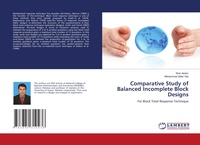
Comparative Study of Balanced Incomplete Block Designs
For Block Total Response Technique
Published on 15. May 2011
Book
Paperback/Softback
92 pages
978-3-8443-1043-6 (ISBN)
Description
Randomized response technique has decades old history. Warner (1965) is the founder of this technique. Block total response technique is one of these methods that were initially proposed by Smith et al. (1974). Raghavarao and Federer (1979) used the theory of balanced incomplete block designs to determine the structure of the questionnaires in their block total response technique (symmetric designs). Smith and Street (2003) determined the best designs in terms of minimum variance; used to estimate the proportions of 3 to 6 sensitive questions using the block total response procedure given a maximum total number of 13 questions. In this study, some new designs are explored for 3 to 6 sensitive questions given a maximum total number of 13 questions while extending the work of Smith and Street (2003) to estimate the proportion of population for 3 to 10 sensitive questions given a maximum total number of 25 questions. The proposed design for six sensitive questions has smaller variance than variance obtained from the un-matched count technique of Dalton et al. (1994).
More details
Language
English
Place of publication
Germany
Product notice
Paperback (trade)
Unsewn / adhesive bound
Dimensions
Height: 220 mm
Width: 150 mm
Thickness: 6 mm
Weight
155 gr
ISBN-13
978-3-8443-1043-6 (9783844310436)
Copyright in bibliographic data and cover images is held by Nielsen Book Services Limited or by the publishers or by their respective licensors: all rights reserved.
Schweitzer Classification
Persons
The authors are PhD scholar at National College of Business Administration and Economics (NCBA&E), Lahore, Pakistan and professor of statistics at the University of Gujrat, Pakistan respectively. Their area of research is design and analysis of experiment.