

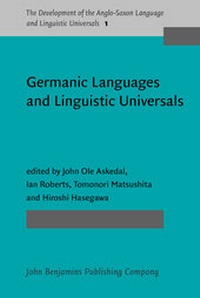
Germanic Languages and Linguistic Universals
Published on 4. February 2009
Book
Hardback
213 pages
978-90-272-1068-5 (ISBN)
Description
For sale in all countries except Japan. For customers in Japan: please contact Yushodo Co.
The Senshu University Project The Development of the Anglo-Saxon Language and Linguistic Universals has as its general aim the investigation of structural characteristics common to the Germanic languages, such as English, German, Norwegian, and Icelandic, all of which are descended from the so-called Proto-Germanic language, and their clarification with regard to linguistic universals provided by the theoretical framework of Generative Grammar. In order to fulfill this aim, the project has to be responsive to theoretical advances in a variety of linguistic domains and approaches, such as language acquisition, pragmatics and corpus linguistics as well as philological and historical contributions on Germanic languages in various stages of their development.
The present book seeks to advance these goals in ten chapters exemplifying work on a wide range of Germanic languages and linguistic universals. It is divided into three parts: Part 1. Old English and Germanic languages; Part 2. Generative Grammar; and Part 3. Pragmatics and Corpus Linguistics. Germanic Languages and Linguistic Universals will be of general interest to linguists who seek to understand the nature of the Germanic languages and the relationships obtaining between them.
The Senshu University Project The Development of the Anglo-Saxon Language and Linguistic Universals has as its general aim the investigation of structural characteristics common to the Germanic languages, such as English, German, Norwegian, and Icelandic, all of which are descended from the so-called Proto-Germanic language, and their clarification with regard to linguistic universals provided by the theoretical framework of Generative Grammar. In order to fulfill this aim, the project has to be responsive to theoretical advances in a variety of linguistic domains and approaches, such as language acquisition, pragmatics and corpus linguistics as well as philological and historical contributions on Germanic languages in various stages of their development.
The present book seeks to advance these goals in ten chapters exemplifying work on a wide range of Germanic languages and linguistic universals. It is divided into three parts: Part 1. Old English and Germanic languages; Part 2. Generative Grammar; and Part 3. Pragmatics and Corpus Linguistics. Germanic Languages and Linguistic Universals will be of general interest to linguists who seek to understand the nature of the Germanic languages and the relationships obtaining between them.
More details
Series
Language
English
Place of publication
Amsterdam
Netherlands
Target group
Professional and scholarly
Dimensions
Height: 245 mm
Width: 164 mm
Weight
555 gr
ISBN-13
978-90-272-1068-5 (9789027210685)
Copyright in bibliographic data and cover images is held by Nielsen Book Services Limited or by the publishers or by their respective licensors: all rights reserved.
Schweitzer Classification
Other editions
Additional editions
John Ole Askedal | Ian Roberts | Tomonori Matsushita
Germanic Languages and Linguistic Universals
E-Book
02/2009
1st Edition
John Benjamins Publishing Company
€118.99
Available for download
Persons
Content
1. Preface (by Askedal, John Ole); 2. 1. Old English and Germanic Languages; 3. Some General Evolutionary and Typological Characteristics of the Germanic Languages (by Askedal, John Ole); 4. Characteristics of Germanic Languages (by Shimomiya, Tadao); 5. Old English Pronouns for Possession (by Fujiwara, Yasuaki); 6. 2. Generative Grammar; 7. Reflexive Binding as Agreement and its Locality Conditions within the Phase System (by Hasegawa, Hiroshi); 8. Movement in the Passive Nominal: A Morphological Analysis (by Hamamatsu, Junji); 9. On Tritransitive Verbs (by Mita, Ryohei); 10. 3. Pragmatics and Corpus Linguistics; 11. On the Cognitive Dependence Phenomena Observed in English Expressions (by Takeda, Shuichi); 12. On Pronoun Referents in English (by Azuma, Hiromi); 13. Relative and Interrogative who/whom in Contemporary Professional American English (by Iyeiri, Yoko); 14. New Functions of FrameSQL for Multilingual FrameNets (by Sato, Hiroaki); 15. Index of Names; 16. Index of Subjects; 17. Editors & Contributors