

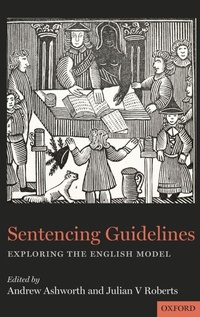
Sentencing Guidelines
Exploring the English Model
Published on 18. July 2013
Book
Hardback
308 pages
978-0-19-968457-1 (ISBN)
Description
The politics of criminal sentencing has recently crystallised around the issue of whether and how a system of structured sentencing should inform judicial approaches to punishing criminals. Increasingly, structured sentencing guidelines are being introduce to frame judicial discretion. This volume is the first to examine the experience in England and Wales in the light of international developments.
This collection of essays begins with a clear and concise history of the guidelines as well as a description of how they function. Topics addressed include the effect of guidelines on judicial practice, the role of public opinion in developing sentencing guidelines, the role of the crime victim in sentencing guidelines, and the use of guidelines by practicing barristers. In addition, the international dimension offers a comparative perspective: the English guidelines are explored by leading academics from the United States and New Zealand.
Although there is a vast literature on sentencing guidelines across the United States, the English guidelines have attracted almost no attention from scholars. As other jurisdictions look to introduce more structure to sentencing, the English scheme offers a real alternative to current US schemes. Contributors include practicing lawyers, legal and socio-legal academics, and also scholars from several other countries including New Zealand and the United States, providing a multidisciplinary and cross-jurisdictional approach to sentencing. This book will be of interest to academics from law, sociology and criminology, legal practitioners, and indeed anyone else with an interest in sentencing, around the world.
This collection of essays begins with a clear and concise history of the guidelines as well as a description of how they function. Topics addressed include the effect of guidelines on judicial practice, the role of public opinion in developing sentencing guidelines, the role of the crime victim in sentencing guidelines, and the use of guidelines by practicing barristers. In addition, the international dimension offers a comparative perspective: the English guidelines are explored by leading academics from the United States and New Zealand.
Although there is a vast literature on sentencing guidelines across the United States, the English guidelines have attracted almost no attention from scholars. As other jurisdictions look to introduce more structure to sentencing, the English scheme offers a real alternative to current US schemes. Contributors include practicing lawyers, legal and socio-legal academics, and also scholars from several other countries including New Zealand and the United States, providing a multidisciplinary and cross-jurisdictional approach to sentencing. This book will be of interest to academics from law, sociology and criminology, legal practitioners, and indeed anyone else with an interest in sentencing, around the world.
Reviews / Votes
Sentencing may not be one of the most glamorous parts of the criminal justice system, however this collection highlights its varied nature and dynamic operation. The volume draws together fascinating insights into sentencing, and is, as the cover suggests, of interest to academics from law, sociology and criminology, legal practitioners and indeed anyone else with an interest in sentencing, around the world. * James Roffee, Monash University, Australian & New Zealand Journal of Criminology *More details
Language
English
Place of publication
Oxford
United Kingdom
Target group
College/higher education
Professional and scholarly
Dimensions
Height: 240 mm
Width: 161 mm
Thickness: 21 mm
Weight
628 gr
ISBN-13
978-0-19-968457-1 (9780199684571)
Copyright in bibliographic data and cover images is held by Nielsen Book Services Limited or by the publishers or by their respective licensors: all rights reserved.
Schweitzer Classification
Other editions
Additional editions
E-Book
07/2013
1st Edition
OUP eBook
€63.49
Available for download
E-Book
07/2013
1st Edition
OUP eBook
€76.49
Available for download
Persons
Andrew Ashworth, Q.C., is Vinerian Professor of English Law, University of Oxford and a Fellow of All Souls College. He is the author of Sentencing and Criminal Justice (5th edn.,, Cambridge University Press). Other recent volumes include Principled Sentencing (3rd edn., with A. von Hirsch and J.V. Roberts) and Proportionate Sentencing (Oxford University Press, with A. von Hirsch). He teaches sentencing courses at the University of Oxford.
Julian V. Roberts is a Professor of Criminology in the Faculty of Law, University of Oxford. Sentencing has been his principal area of research and teaching since 1984. Recent books include: Mitigation and Aggravation at Sentencing (Cambridge University Press, 2011); The Role of Previous Convictions at Sentencing (Oxford: Hart Publishing, with A. von Hirsch); Punishing Persistent Offenders (2008, Oxford University Press); Principled Sentencing (with A. von Hirsch et al., 2009; Oxford: Hart). Roberts teaches sentencing courses at the University of Oxford.
Julian V. Roberts is a Professor of Criminology in the Faculty of Law, University of Oxford. Sentencing has been his principal area of research and teaching since 1984. Recent books include: Mitigation and Aggravation at Sentencing (Cambridge University Press, 2011); The Role of Previous Convictions at Sentencing (Oxford: Hart Publishing, with A. von Hirsch); Punishing Persistent Offenders (2008, Oxford University Press); Principled Sentencing (with A. von Hirsch et al., 2009; Oxford: Hart). Roberts teaches sentencing courses at the University of Oxford.
Content
1. The Origins and Structure of Sentencing Guidelines in England and Wales ; 2. The Struggle for Supremacy in Sentencing ; 3. Exploring the Success of Sentencing Guidelines ; 4. Sentencing Guidelines for Murder: From Political Schedule to Principled Guidelines ; 5. Victims, Sentencing Guidelines and the Sentencing Council ; 6. The Definitive Guideline on Assault Offences: The Performance of Justice ; 7. Sentencing Guidelines: New Findings from the Crown Court Survey ; 8. Remorse and Sentencing: An Analysis of the Sentencing Guidelines and Sentencing Practice ; 9. The Role of Public Opinion in Formulating Sentencing Guidelines ; 10. Nothing Personal: The Impact of Personal Mitigation at Sentencing since Creation of the Council ; 11. A 'Decision Science' Perspective on the Old and New Format Guidelines ; 12. Comparing Sentencing Guidelines: Do the US Systems have anything Worthwhile to offer England and Wales? ; 13. The Origins and Evolution of Sentencing Guidelines: A Comparison of England and Wales and New Zealand ; 14. Living without Guidelines ; 15. The Struggle for Sentencing Reform: Will the English Guidelines Spread? ; 16. Sentencing Guidelines and EU Law