

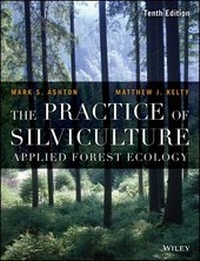
The Practice of Silviculture
Applied Forest Ecology
10th Edition
Will be published approx. on 2. March 2018
Book
Paperback/Softback
792 pages
978-1-119-27095-9 (ISBN)
Description
The most up-to-date, comprehensive resource on silviculture that covers the range of topics and issues facing today's foresters and resource professionals
The tenth edition of the classic work, The Practice of Silviculture: Applied Forest Ecology, includes the most current information and the results of research on the many issues that are relevant to forests and forestry. The text covers such timely topics as biofuels and intensive timber production, ecosystem and landscape scale management of public lands, ecosystem services, surface drinking water supplies, urban and community greenspace, forest carbon, fire and climate, and much more.
In recent years, silvicultural systems have become more sophisticated and complex in application, particularly with a focus on multi-aged silviculture. There have been paradigm shifts toward managing for more complex structures and age-classes for integrated and complementary values including wildlife, water and open space recreation. Extensively revised and updated, this new edition covers a wide range of topics and challenges relevant to the forester or resource professional today. This full-color text offers the most expansive book on silviculture and:
* Includes a revised and expanded text with clear language and explanations
* Covers the many cutting-edge resource issues that are relevant to forests and forestry
* Contains boxes within each chapter to provide greater detail on particular silvicultural treatments and examples of their use
* Features a completely updated bibliography plus new photographs, tables and figures
The Practice of Silviculture: Applied Forest Ecology, Tenth Edition is an invaluable resource for students and professionals in forestry and natural resource management.
More details
Other editions
Additional editions
E-Book
01/2018
10th Edition
Wiley
€120.99
Available for download
E-Book
12/2017
10th Edition
Wiley
€120.99
Available for download
Previous edition
David M. Smith | Bruce C. Larson | Matthew J. Kelty
The Practice of Silviculture
Applied Forest Ecology
Book
11/1996
9th Edition
Wiley
€272.34
Article exhausted; check for reprint
Persons
Mark S. Ashton, Morris K. Jesup Professor of Silviculture and Forest Ecology and Director of School Forests, Yale School of Forestry & Environmental Studies, New Haven, CT, USA.
Matthew J. Kelty, Professor Emeritus, University of Massachusetts, Amherst, MA, USA.
Content
Preface
PART ONE: INTRODUCTION TO SILVICULTURE
CHAPTER 1 THE HISTORY AND PHILOSOPHY OF SILVICULTURE
Introduction
Silviculture, Its Origin and Development as an Applied Ecology
The Philosophies of Silviculture as a Practice
Silviculture as a Body of Knowledge
CHAPTER 2 SILVICULTURE AND ITS PLACE IN MANAGING CURRENT FORESTS AND WOODLANDS
Introduction
The Purpose of Silviculture Today
Scope and Terminology of Silvicultural Practice
The Silvicultural Framework for Managing a Forest
PART TWO: ECOLOGICAL FOUNDATIONS OF SILVICULTURE
CHAPTER 3 ECOLOGICAL SITE CLASSIFICATION, STANDS AS MANAGEMENT UNITS, AND LANDSCAPE-SCALE PLANNING
Introduction
Ecological Methods of Identifying and Classifying Sites
Stands as Management Units
New Developments in Landscape-Level Ecological Planning
CHAPTER 4 STAND DYNAMICS: THE ECOLOGY OF FOREST SUCCESSION
Introduction
Initiating disturbances and sources of regeneration
Stages of stand development
Defining cohorts and age-classes
Defining canopy stratification by age-class
Relationship of stand dynamics to other interpretations of vegetational development
Choice of development patterns
CHAPTER 5 ECOLOGY OF REGENERATION
Introduction
ECOLOGICAL ROLE OF NATURAL DISTURBANCE
Kinds of natural regenerative disturbances
Disturbance and the environment of the microsite
THE REGENERATION PROCESS
Mechanisms of essential stages of natural regeneration
Provisions for initiating natural regeneration
DISTURBANCE, CLIMATE, AND REGIONAL PATTERNS IN FLORISTICS OF FOREST REGENERATION
Fire, wind and water
REGENERATION METHODS AS ANALOGS TO NATURAL DISTURBANCE
PART THREE: METHODS OF REGENERATION
CHAPTER 6 DEVELOPMENT OF SILVICULTUREAL SYSTEMS AND METHODS OF REGENERATION
Introduction
Conceptual Formation of Silvicultural Systems: The Science of Place
Classification of natural methods of regeneration
Classification of plantations and artificial seeding
CHAPTER 7 SITE TREATMENTS
Introduction
Disposal of logging slash
Treatment of the forest floor and competing vegetation
PART 3A: NATURAL REGENERATION METHODS
CHAPTER 8 NATURAL REGENERATION: THE CLEARCUTTING METHOD
Introduction
The protocol
Regeneration of pure stands from natural seeding
Applications of true clearcutting: case studies from North America
CHAPTER 9 NATURAL REGENERATION: THE SEED-TREE METHOD
Introduction
The protocol
Variations in spatial patterns of stand structure
Application of seed-tree methods
CHAPTER 10 NATURAL REGENERATION: THE SHELTERWOOD METHOD
Introduction
The protocol for the uniform shelterwood
Protocols for alternative arrangements
Application of shelterwood methods
CHAPTER 11 NATURAL REGENERATION: MULTI-AGED SYSTEMS (IRREGULAR SEED-TREE AND SHELTERWOOD METHODS)
Introduction
Development of two- or three-aged stands
Regeneration methods including reserve trees within irregular seed-tree and shelterwood systems
Application of two- or three-aged systems
CHAPTER 12 NATURAL REGENERATION: THE COPPICE METHOD
Introduction
Vegetative regeneration and the nature of disturbance
The physiology and morphology of sprouting
Types of vegetative regeneration
Simple coppice systems
Coppice systems with irregular structures and age classes
The role of coppice stands in the past, present, and future
Conversion of coppice stands to high forests
CHAPTER 13 NATURAL REGENERATION: SELECTION METHOD
Introduction
The protocol
The selection regeneration method and its variation
Managing for balanced all-aged stands
Managing for unbalanced all-aged stands
PART 3B: METHODS BASED ON ARTIFICIAL REGENERATION
CHAPTER 14 SPECIES SELECTION AND GENETIC IMPROVEMENT
Introduction
Selection of species and provenances
Genetic improvement
CHAPTER 15 NURSERY, PLANTING, AND SEEDING TECHNIQUES
Introduction
Part one: Propagation
Part two: Planting and seeding
CHAPTER 16 THE ARRANGEMENT, COMPOSITION AND METHODS OF PLANTING
Introduction
The role of planting
Density of plantings
Spatial arrangement of plantings
High forest plantations
Single-species, single-aged plantations
Mixed-species, single-aged plantations
Mixed-species with all-aged or multiple-aged (two- or three-aged) systems
Enrichment planting and underplanting in native forests
Low forest plantations
Single-aged, single-species plantations
Single-aged, mixed-species plantations
Protection of new plantations
PART FOUR: POST-ESTABLISHMENT (INTERMEDIATE) TREATMENTS
CHAPTER 17 TREE AND STAND GROWTH
Introduction
Growth within individual trees
Stand scale patterns of production
The effect of thinning on stand production
The effect of thinning on the economic yield of stands
CHAPTER 18 POST-ESTABLISHMENT TOOLS IN SILVICULTURE
Introduction
Cutting and girdling
Use of herbicides
Methods of applying herbicides
Use of insecticides
Prescribed burning
Use of fertilizer
Irrigation
CHAPTER 19 PRUNING METHODS AND APPLICATIONS
Introduction
The ecology of natural pruning processes
Pruning trees to improve timber quality in forests
Techniques of pruning open-grown trees within urban and agricultural lands
Training and pruning fruit and shade trees in orchards and agroforestry systems
CHAPTER 20 RELEASE OPERATIONS IN SEEDLING AND SAPLING STANDS
Introduction
Competing vegetation
Concept of free-to-grow
Early use of release treatments
Vegetation control methods
Timing and extent of release treatments
Ecological impact of release treatments on plant communities
Liberation treatments
Release treatments that control invasives
CHAPTER 21 METHODS OF THINNING
Introduction
The different approaches to thinning
Low thinning
Crown thinning
Dominant thinning
Free-form thinning
Variable density thinning
Geometric thinning
Application of thinnings
CHAPTER 22 QUANTITATIVE GUIDELINES FOR STAND DENSITY MANAGEMENT
PART FIVE: SILVICULTURAL CONSIDERATIONS FOR MANAGING ALL FORESTS
CHAPTER 23 CONSERVATION MANAGEMENT PRACTICES
Introduction
Management practices
CHAPTER 24 SILVICULTURE FOR WILDLIFE HABITAT
Introduction
Habitat elements within stands
Landscape elements across stands
Examples of application
CHAPTER 25 SILVICULTURAL APPLICATIONS TO FOREST RETORATION: REHABILITATION AND RECLAMATION
Introduction
Degradation and restoration processed of forests
CATEGORIES OF FOREST DEGRADATION AND THEIR RESTORATION TREATMENTS
Least severity degradation: Rehabilitation through assisted natural regeneration and enrichment planting
Medium severity degradation: Rehabilitation through natural regeneration, direct seeding, or planting
High severity degradation: Forest reclamation
Synthesis
CHAPTER 26 approaches AND treatmentS TO MAINTAINING HEALTHY FOREST ECOSYSTEMS
The Concept of Forest Ecosystem Health within Stand Dynamics
Protection against Biotic Agencies: Insects and Disease
Protection against Abiotic Agencies
Using Silviculture to Control Damage
CHAPTER 27 MANAGING FOREST CARBON IN CHANGING CLIMATES
Introduction
The Ecology of Forest Carbon
Avoiding deforestation and increasing reforestation
Carbon management in existing forests
The use of wood as biomass energy or in wood products for carbon storage
PART SIX: SILVICULTURAL APPLICATIONS FOR DIFFERENT LAND USES
CHAPTER 28 ECOSYSTEM MANAGEMENT: MANAGING PUBLIC NATURAL FORESTS FOR MULTIPLE VALUES
Introduction
Regional and global differences in public land ownership
MANAGING COMPLEX LARGE-SCALE FORESTS
The ecosystem management paradigm
REGIONAL EXAMPLES OF ECOSYSTEM MANAGEMENT
Sustainable forest management in the Canadian Boreal, Quebec
Managing for complexity in the longleaf pine ecosystem, Southeastern United States
Managing ponderosa pine for a Pre-European landscape in the U. S. Southwest
CHAPTER 29 APPLICATION OF SILVICULTURE TO WATERSHED MANAGEMENT
Introduction
Baseline watershed conditions
Paired watershed studies: impacts of land clearance and forest disturbance
Managing forests for water quality: examples from the U.S.
Managing forest for water yield: examples form the U.S.
Summary
CHAPTER 30 INDUSTRIAL TIMBER MANAGEMENT
Introduction
PRINCIPLES OF REGULATING TIMBER MANAGEMENT HARVESTS
Considerations for timber production in forests
GLOBAL AND NATIONAL TRENDS IN PLANTATION FORESTRY
Industrial plantation forestry
CHAPTER 31 APPLICATION OF SILVICULTURE TO AGROFORESTRY
Introduction
Stages of stand development and agroforestry
Successional agrisilvicultural practices
Permanent agrisilvicultural practices
Selection of tree species for agroforestry
CHAPTER 32 APPLICATION OF SILVICULTURE TO URAN ECOSYSTEMS AND THE URBAN-RURAL INTERFACE
Introduction
Aesthetics and landscape design of urban forests
Mitigating urban meso- and micro-environments
The application of silviculture to urban watersheds
CHAPTER 33 SYNTHESIS
Glossary
Index