

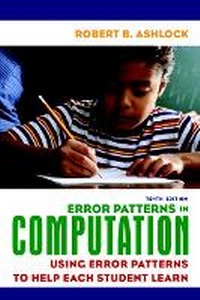
Error Patterns in Computation
Using Error Patterns to Help Each Student Learn
10th Edition
Published on 13. May 2010
Book
Paperback/Softback
288 pages
978-0-13-500910-9 (ISBN)
Description
"Students must learn mathematics with understanding, actively building new knowledge from experience and prior knowledge." From the Principles for School Mathematics of NCTM standards, copyright NCTM 2000-2004.
Yet sometimes when students are learning mathematics, they learn misconceptions and adopt erroneous procedures despite the best efforts of their teacher. This book was written to help teachers to detect the systematic errors many students make-whether using paper and pencil, or calculators or computers. Emphasizing concepts and skills, in accordance with the NCTM standards, this readable and engaging supplementary text will help all teachers of math methods to become more proficient at diagnosing and correcting computational procedures. Teachers will gain skills by actually looking for error patterns, making decisions, and planning instruction.
The book is organized into two parts with appendices. The first part is mainly devoted to instructional issues and considers the place of computation in today's world of technology and then focuses on various aspects of assessment and instruction for both concepts and skills. Part Two presents sample student papers within topical chapters. These papers provide opportunities to identify patterns of error and to reflect on the best course of corrective instruction. Readers can then compare their responses with those of the author. The appendices provide additional papers for even more practice in identifying error patterns.
New To This Edition:
NEW! Gives greater emphasis on diagnosis as a part of formative assessment.
NEW! Includes more material on understanding the meanings of operations to help teachers and students understand the operations of arithmetic so they will know when to use each operation when solving problems.
NEW! Enables teachers to plan varied instruction that involves connections with other mathematics and varied applications.
Yet sometimes when students are learning mathematics, they learn misconceptions and adopt erroneous procedures despite the best efforts of their teacher. This book was written to help teachers to detect the systematic errors many students make-whether using paper and pencil, or calculators or computers. Emphasizing concepts and skills, in accordance with the NCTM standards, this readable and engaging supplementary text will help all teachers of math methods to become more proficient at diagnosing and correcting computational procedures. Teachers will gain skills by actually looking for error patterns, making decisions, and planning instruction.
The book is organized into two parts with appendices. The first part is mainly devoted to instructional issues and considers the place of computation in today's world of technology and then focuses on various aspects of assessment and instruction for both concepts and skills. Part Two presents sample student papers within topical chapters. These papers provide opportunities to identify patterns of error and to reflect on the best course of corrective instruction. Readers can then compare their responses with those of the author. The appendices provide additional papers for even more practice in identifying error patterns.
New To This Edition:
NEW! Gives greater emphasis on diagnosis as a part of formative assessment.
NEW! Includes more material on understanding the meanings of operations to help teachers and students understand the operations of arithmetic so they will know when to use each operation when solving problems.
NEW! Enables teachers to plan varied instruction that involves connections with other mathematics and varied applications.
More details
Other editions
Previous edition
Book
07/2005
9th Edition
Pearson
€29.70
Article exhausted; check for reprint
Person
Robert Ashlock began his career in 1957 as a fourth and fifth grade teacher with a bachelor's degree in elementary education. He later received a master's degree in elementary school administration from Butler University and a doctorate in elementary education from Indiana University. He became a graduate assistant and teaching associate at Indiana University in 1964 and went on to teach at several institutions including the University of Maryland, Reformed Theological Seminary, Belhaven College, and finally, Covenant College in Lookout Mountain, Georgia. Ashlock came to Covenant in 1988 to fill the need for a specialist in elementary education who could also teach on the graduate level. He directed the Master of Education Program, taught both undergraduate and graduate education courses, and coordinated the process necessary for the teacher education program to be approved by the Georgia Professional Standards Commission.
He is one of only two professors ever to receive the title Professor Emeritus at Covenant. He is known throughout the education community for his book, Error Patterns in Computation: Using Error Patterns to Improve Instruction, which is currently in its tenth edition. Although retired, Ashlock continues to teach a few classes.
He is one of only two professors ever to receive the title Professor Emeritus at Covenant. He is known throughout the education community for his book, Error Patterns in Computation: Using Error Patterns to Improve Instruction, which is currently in its tenth edition. Although retired, Ashlock continues to teach a few classes.
Content
Part I: Misconceptions and Error Patterns
1. Computation, Misconceptions, and Error Patterns
2. Error Patterns: Addition and Subtraction with Whole Numbers
3. Error Patterns: Multiplication and Division with Whole Numbers
4. Misconceptions and Error Patterns: Concepts and Equivalents with Fractions and Decimals
5. Error Patterns: Addition and Subtraction with Fractions and Decimals
6. Error Patterns: Multiplication and Division with Fractions and Decimals
7. Introduction to Misconceptions and Error Patterns: Geometry and Measurement
8. Introduction to Misconceptions and Error Patterns: Percent, Proportion, Integers, and Algebra
Part II: Diagnosis and Instruction
9. Diagnosing Misconception and Error Patters in Computation and in Other Mathematical Topics
10. Providing Data-Driven Instruction in Computation
11. Enriching Instruction in Computation and Other Mathematical Topics
Glossary
Key for Additional Practice
Selected Resources
Appendices
1. Computation, Misconceptions, and Error Patterns
2. Error Patterns: Addition and Subtraction with Whole Numbers
3. Error Patterns: Multiplication and Division with Whole Numbers
4. Misconceptions and Error Patterns: Concepts and Equivalents with Fractions and Decimals
5. Error Patterns: Addition and Subtraction with Fractions and Decimals
6. Error Patterns: Multiplication and Division with Fractions and Decimals
7. Introduction to Misconceptions and Error Patterns: Geometry and Measurement
8. Introduction to Misconceptions and Error Patterns: Percent, Proportion, Integers, and Algebra
Part II: Diagnosis and Instruction
9. Diagnosing Misconception and Error Patters in Computation and in Other Mathematical Topics
10. Providing Data-Driven Instruction in Computation
11. Enriching Instruction in Computation and Other Mathematical Topics
Glossary
Key for Additional Practice
Selected Resources
Appendices