

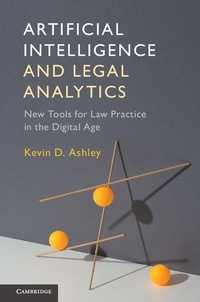
Artificial Intelligence and Legal Analytics
New Tools for Law Practice in the Digital Age
Published on 10. July 2017
Book
Hardback
446 pages
978-1-107-17150-3 (ISBN)
Description
The field of artificial intelligence (AI) and the law is on the cusp of a revolution that began with text analytic programs like IBM's Watson and Debater and the open-source information management architectures on which they are based. Today, new legal applications are beginning to appear and this book - designed to explain computational processes to non-programmers - describes how they will change the practice of law, specifically by connecting computational models of legal reasoning directly with legal text, generating arguments for and against particular outcomes, predicting outcomes and explaining these predictions with reasons that legal professionals will be able to evaluate for themselves. These legal applications will support conceptual legal information retrieval and allow cognitive computing, enabling a collaboration between humans and computers in which each does what it can do best. Anyone interested in how AI is changing the practice of law should read this illuminating work.
Reviews / Votes
'In relation to the composition of this book, it provides a comprehensive and user-friendly description of this interdisciplinary area, focusing on the suitability of developing legal devices based on artificial intelligence. The structure of the work allows users to analyse how representation of legal logic knowledge occurs, and its suitability for computational implementations ... On this matter, the author provides relevant and understandable illustrations that facilitate the linkage between theory and the development of the techno legal implementations. ... Artificial Intelligence and Legal Analytics: New Tools for Law Practice in the Digital Age is a fundamental work for those of us who are interested in the intersection between intelligent technology and the legal field, and its promising future.' Jesus Manuel Niebla Zatarain, SCRIPTedMore details
Language
English
Place of publication
Cambridge
United Kingdom
Target group
College/higher education
Illustrations
26 Halftones, black and white; 85 Line drawings, black and white
Dimensions
Height: 235 mm
Width: 157 mm
Thickness: 29 mm
Weight
801 gr
ISBN-13
978-1-107-17150-3 (9781107171503)
Copyright in bibliographic data and cover images is held by Nielsen Book Services Limited or by the publishers or by their respective licensors: all rights reserved.
Schweitzer Classification
Other editions
Additional editions
Kevin D. Ashley
Artificial Intelligence and Legal Analytics
New Tools for Law Practice in the Digital Age
E-Book
07/2017
Cambridge University Press
€42.99
Available for download
Kevin D. Ashley
Artificial Intelligence and Legal Analytics
New Tools for Law Practice in the Digital Age
E-Book
07/2017
Cambridge University Press
€36.99
Available for download
Kevin D. Ashley
Artificial Intelligence and Legal Analytics
New Tools for Law Practice in the Digital Age
Book
07/2017
Cambridge University Press
€65.20
Shipment within 15-20 days
Person
Kevin Ashley is a Professor of Law and Intelligent Systems at the University of Pittsburgh, Senior Scientist, Learning Research and Development Center, and Adjunct Professor of Computer Science. He received a B.A. from Princeton University, New Jersey, a J.D. from Harvard Law School, Massachusetts and a Ph.D. in computer science from the University of Massachusetts. A visiting scientist at the IBM Thomas J. Watson Research Center, New York, NSF Presidential Young Investigator and Fellow of the American Association for Artificial Intelligence, he is co-Editor-in-Chief of Artificial Intelligence and Law and teaches in the University of Bologna Erasmus Mundus doctoral program in Law, Science and Technology.
Content
Part I. Computational Models of Legal Reasoning: 1. Introducing AI and Law and its role in future legal practice; 2. Modeling statutory reasoning; 3. Modeling case-based legal reasoning; 4. Models for predicting legal outcomes; 5. Computational models of legal argument; Part II. Legal Text Analytics: 6. Representing legal concepts in ontologies and type systems; 7. Making legal informational retrieval smarter; 8. Machine learning with legal texts; 9. Extracting information from statutory and regulatory texts; 10. Extracting argument-related information from legal case texts; Part III. Connecting Computational Reasoning Models and Legal Texts: 11. Conceptual legal information retrieval for cognitive computing; 12. Cognitive computing legal apps.