

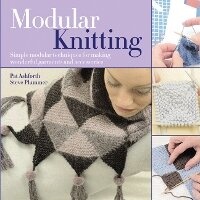
Modular Knitting
Simple Modular Techniques for Making Wonderful Garments and Accessories
Published on 24. April 2006
Book
Paperback/Softback
128 pages
978-1-84448-138-5 (ISBN)
Description
Put the fun back into knitting and make original clothing and accessories from simple geometric shapes. Forget about complicated increases and decreases; forget about poring over pattern books; with knowledge of just a few basic stitches you can effortlessley create sweaters, bags, hats, cushions, socks, scarves and ponchos.
Step-by-step photographs demonstrate the foolproof way to knit two-dimensional shapes, and methods of joining them to form fantastic three-dimensional garments.
Clear instructions and diagrams explain each stage of the process, from measuring and calculating yarn requirements to combining colour, shape and texture.
Includes ten inspirational projects with suggested variations and alternative palettes, and advice on how to create your own designs. Now you can carry on with your knitting anywhere, without having to drag a whole bulky garment along with you.
Step-by-step photographs demonstrate the foolproof way to knit two-dimensional shapes, and methods of joining them to form fantastic three-dimensional garments.
Clear instructions and diagrams explain each stage of the process, from measuring and calculating yarn requirements to combining colour, shape and texture.
Includes ten inspirational projects with suggested variations and alternative palettes, and advice on how to create your own designs. Now you can carry on with your knitting anywhere, without having to drag a whole bulky garment along with you.
Reviews / Votes
No. 113, Sept 06If you would like to make geometric garter stitch blocks that are not simply squares, this book is for you. Unlike domino knitting where every block is worked onto previous ones, these techniques allow you to assemble parts at a time, so that final decisions about colour or shape do not have to be made too soon.
The format is typical of the current output of Search Press: copiously illustrated in colour, plenty of clear instructions, colour coded pages, and very reasonably priced. Basic knitting skills are supplemented by detailed instructions. There are photographs of exactly how to join garter-stitch shapes neatly, as well as the stages in making a Dorset button. My particular delights were finding the ratio for knitting octagons, and the detailed instructions for the made-to-measure hat design.
My disappointment was that whilst there are lots of diagrams of how the blocks can be used, there were far fewer illustrations of finished items. For people like me who are not designers and find it hard to visualise a finished garment from a sketch, some more examples of actual knitting would have been welcome. But that is a quibble: this is a book I shall buy. * SlipKnot * Sept 06
This is my sort of knitting: make squares, stitch them together. Who needs increasing and decreasing! Other shapes are also shown, some of which could be quite fun to use as a base for the Embellisher. Colour and design are covered briefly, as is texture. The patterns for hats, bags and jumpers are clear but I don't think I will ever be converted to knitted bags. * Workshop On The Web *
More details
Language
English
Place of publication
Tunbridge Wells
United Kingdom
Illustrations
250 Illustrations, color
Dimensions
Height: 10 mm
Width: 431 mm
ISBN-13
978-1-84448-138-5 (9781844481385)
Copyright in bibliographic data and cover images is held by Nielsen Book Services Limited or by the publishers or by their respective licensors: all rights reserved.
Schweitzer Classification
Persons
Pat Ashforth and Steve Plummer are both mathematics teachers with an unconventional approach to the subject. Steve also trained to teach art. Pat is a fibre artist and has been a knitter almost all her life. They use fabric and fibre in many teaching situations with groups as diverse as university professors, Women's Institute groups, and children of all ages. Around 1990 they became addicted to modular knitting and, although they wander into other fields occasionally, most of their knitting has been modular ever since.