

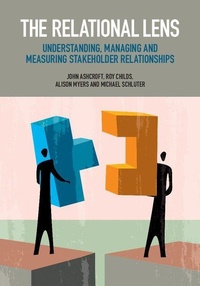
The Relational Lens
Understanding, Managing and Measuring Stakeholder Relationships
Published on 19. October 2016
Book
Hardback
248 pages
978-1-107-15576-3 (ISBN)
Description
Drawing on the authors' combined years of experience in both private and public-sector organisations, this practical book highlights the importance of relationship building between individuals, groups and organisations in diverse contexts. It will make a valuable read for business professionals and graduate students in fields as varied as change management, leadership, organisational psychology, and organisational behaviour. Employing the Relational Proximity (R) framework, it provides tools for informing assessment of the relational impact of policy and management decisions, enabling evaluation of organisational relationships, providing a language for constructive discussion of strained relationships, and integrating a range of models and perspectives within one process. Using real-world case studies and models, the conditions within which people are more likely to form and conduct effective relationships are also examined. This combined approach provides the language and concepts to enable constructive discussion and actionable solutions in building trust and sustainable value.
Reviews / Votes
'What the authors do quite successfully in this volume ... is to explain how components of their relational proximity framework fit together with more ephemeral concepts such as trust, empathy, commitment and respect. This book has been many years in the making but arrives at just the right time.' Vincent Neate, Social Value and Intangibles Review 'The Relational Lens is a well-written book. It will appeal primarily to an applied and lay audience, but it references a good deal of psychological research. Its main contribution might be that it adds fuel to the burgeoning fire around the focus on interpersonal relationships in the organization. For this reason, it should be taken seriously by anyone who wants to understand the complexities of organizational life, relational life in particular.' Richard D. Harvey and Andrew Bleckman, PsycCRITIQUESMore details
Language
English
Place of publication
Cambridge
United Kingdom
Target group
Professional and scholarly
Illustrations
18 Line drawings, black and white
Dimensions
Height: 250 mm
Width: 175 mm
Thickness: 18 mm
Weight
620 gr
ISBN-13
978-1-107-15576-3 (9781107155763)
Copyright in bibliographic data and cover images is held by Nielsen Book Services Limited or by the publishers or by their respective licensors: all rights reserved.
Schweitzer Classification
Other editions
Additional editions
E-Book
10/2016
Cambridge University Press
€39.49
Available for download

John Ashcroft | Roy Childs | Alison Myers
The Relational Lens
Understanding, Managing and Measuring Stakeholder Relationships
E-Book
10/2016
Cambridge University Press
€45.99
Available for download
Persons
John Ashcroft is Research Director at the Relationships Foundation and co-author of Relationships in the NHS (with Geoffrey Meads, 1999) and The Case for Interprofessional Collaboration in Health and Social Care (with Geoffrey Meads, 2005). Roy Childs has worked in organisations at senior levels for more than twenty years focusing on developing capability and building relationships. He is an Associate Fellow of the British Psychological Society and a Chartered Occupational Psychologist. Alison Myers is an experienced consultant, facilitator and trainer. She has been a senior managing consultant with Accenture's Change Management and Human Performance practice and is now an ordained Anglican minister. Michael Schluter is an economist and social entrepreneur who has launched ten not-for-profit organisations and was awarded a CBE in the Queen's New Year's honours in 2009. He co-authored The R Factor (with David John Lee, 1993) and The Relational Manager (with David John Lee, 2009).
Content
Introduction. The dark matter of organisations; 1. The value and importance of relationships; 2. Why organisations should think relationally; 3. How to measure relationships; 4. Directness - high touch organisation; 5. Continuity - connection across time; 6. Multiplexity - context for breadth; 7. Parity - power, balance, fairness; 8. Commonality - overlap of purpose; 9. What relational proximity builds; 10. Relationships between stakeholders; 11. Managing, measuring, reporting, regulating; Epilogue.