

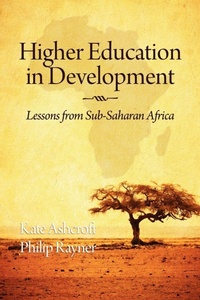
Higher Education in Development
Lessons from Sub Saharan Africa
Will be published approx. on 27. July 2011
Book
Paperback/Softback
302 pages
978-1-61735-541-7 (ISBN)
Description
This book will interest readers learning about or developing strategies for improving higher education systems and institutions in developing countries.
It provides an insight into sub-Saharan African higher education systems and sets out the ways that they are developing and changing. It explores the dilemmas inherent in a context of scarce resources with increasing and urgent demands for a more professionalized workforce and expert services. It examines the factors inhibiting development such as HIV/AIDS, gender issues, historical conflicts, cultural attitudes inimical to innovation, the challenges created by poor infrastructure, and the history of colonialism and authoritarianism and their legacy of centralized control and lack of autonomy and democracy.
The book explores lessons from research into sub-Saharan African higher education that may be applied to other contexts. The authors have lived and worked in sub-Saharan Africa and the book draws on the authors' personal experience of higher education in Zambia, Ethiopia, The Yemen and their links in Mozambique and South Africa as well as extensive senior management experience and at the highest level within sub-Saharan higher education systems. It uses actual examples and a reflective 'case study' approach to describe reforms, and from these, develops ideas as to how to improve the effectiveness of higher education as a means to fight poverty.
The book explores lessons from research into sub-Saharan African higher education that may be applied to other contexts. The authors have lived and worked in sub-Saharan Africa and the book draws on their personal experience of higher education in Zambia, Ethiopia, The Yemen and their links in Mozambique and South Africa. The authors also use their extensive management experience at the highest level within sub-Saharan higher education systems. The book includes actual examples and a reflective 'case study' approach to describe reforms, and from these, develops ideas as to how to improve the effectiveness of higher education as a means to fight poverty.
It provides an insight into sub-Saharan African higher education systems and sets out the ways that they are developing and changing. It explores the dilemmas inherent in a context of scarce resources with increasing and urgent demands for a more professionalized workforce and expert services. It examines the factors inhibiting development such as HIV/AIDS, gender issues, historical conflicts, cultural attitudes inimical to innovation, the challenges created by poor infrastructure, and the history of colonialism and authoritarianism and their legacy of centralized control and lack of autonomy and democracy.
The book explores lessons from research into sub-Saharan African higher education that may be applied to other contexts. The authors have lived and worked in sub-Saharan Africa and the book draws on the authors' personal experience of higher education in Zambia, Ethiopia, The Yemen and their links in Mozambique and South Africa as well as extensive senior management experience and at the highest level within sub-Saharan higher education systems. It uses actual examples and a reflective 'case study' approach to describe reforms, and from these, develops ideas as to how to improve the effectiveness of higher education as a means to fight poverty.
The book explores lessons from research into sub-Saharan African higher education that may be applied to other contexts. The authors have lived and worked in sub-Saharan Africa and the book draws on their personal experience of higher education in Zambia, Ethiopia, The Yemen and their links in Mozambique and South Africa. The authors also use their extensive management experience at the highest level within sub-Saharan higher education systems. The book includes actual examples and a reflective 'case study' approach to describe reforms, and from these, develops ideas as to how to improve the effectiveness of higher education as a means to fight poverty.
More details
Language
English
Place of publication
Charlotte
United States
Publishing group
Emerald Publishing Inc
Target group
Professional and scholarly
Dimensions
Height: 234 mm
Width: 156 mm
Thickness: 17 mm
Weight
462 gr
ISBN-13
978-1-61735-541-7 (9781617355417)
Copyright in bibliographic data and cover images is held by Nielsen Book Services Limited or by the publishers or by their respective licensors: all rights reserved.
Schweitzer Classification
Other editions
Additional editions
E-Book
09/2011
1st Edition
Information Age Publishing
from
€62.33
Available for download
Content
List of Acronyms
Chapter 1. Introduction
Chapter 2. The Context for Higher Education in Sub-Saharan Africa
Chapter 3. Managing Expansion
Chapter 4. Structures and Systems
Chapter 5. Leadership and Governance
Chapter 6. Higher Education Management
Chapter 7. Quality and Standards
Chapter 8. Developing a Curriculum
Chapter 9. Teaching, Learning, and Student Experience
Chapter 10. Research and Community Service
Chapter 11. Administrative Support Structures
Chapter 12. Conclusions
Resources
Chapter 1. Introduction
Chapter 2. The Context for Higher Education in Sub-Saharan Africa
Chapter 3. Managing Expansion
Chapter 4. Structures and Systems
Chapter 5. Leadership and Governance
Chapter 6. Higher Education Management
Chapter 7. Quality and Standards
Chapter 8. Developing a Curriculum
Chapter 9. Teaching, Learning, and Student Experience
Chapter 10. Research and Community Service
Chapter 11. Administrative Support Structures
Chapter 12. Conclusions
Resources