

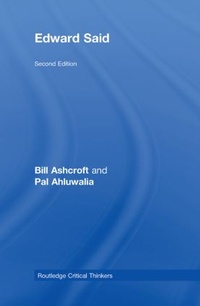
Edward Said
2nd Edition
Published on 16. October 2008
Book
Hardback
200 pages
978-0-415-47687-4 (ISBN)
Description
Edward Said is perhaps best known as the author of the landmark study Orientalism, a book which changed the face of critical theory and shaped the emerging field of post-colonial studies, and for his controversial journalism on the Palestinian political situation.
Looking at the context and the impact of Said's scholarship and journalism, this book examines Said's key ideas, including:
the significance of 'worldliness', 'amateurism', 'secular criticism', 'affiliation' and 'contrapuntal reading'
the place of text and critic in 'the world'
knowledge, power and the construction of the 'Other'
links between culture and imperialism
exile, identity and the plight of Palestine
a new chapter looking at Said's later work and style
This popular guide has been fully updated and revised in a new edition, suitable for readers approaching Said's work for the first time as well as those already familiar with the work of this important theorist. The result is the ideal guide to one of the twentieth century's most engaging critical thinkers.
Looking at the context and the impact of Said's scholarship and journalism, this book examines Said's key ideas, including:
the significance of 'worldliness', 'amateurism', 'secular criticism', 'affiliation' and 'contrapuntal reading'
the place of text and critic in 'the world'
knowledge, power and the construction of the 'Other'
links between culture and imperialism
exile, identity and the plight of Palestine
a new chapter looking at Said's later work and style
This popular guide has been fully updated and revised in a new edition, suitable for readers approaching Said's work for the first time as well as those already familiar with the work of this important theorist. The result is the ideal guide to one of the twentieth century's most engaging critical thinkers.
Reviews / Votes
'A book that at one and the same time can both introduce and challenge, a commendable combination.' - African Studies Association of Australasia and the Pacific, Review and NewsletterMore details
Series
Edition
2nd edition
Language
English
Place of publication
London
United Kingdom
Publishing group
Taylor & Francis Ltd
Target group
College/higher education
Dimensions
Height: 198 mm
Width: 129 mm
Weight
318 gr
ISBN-13
978-0-415-47687-4 (9780415476874)
Copyright in bibliographic data and cover images is held by Nielsen Book Services Limited or by the publishers or by their respective licensors: all rights reserved.
Schweitzer Classification
Other editions
Additional editions
Bill Ashcroft | Pal Ahluwalia
Edward Said
Book
10/2008
2nd Edition
Routledge
€57.19
Shipment within 15-20 days
Bill Ashcroft | Pal Ahluwalia
Edward Said
E-Book
10/2008
2nd Edition
Routledge
€39.49
Available for download
Bill Ashcroft | Pal Ahluwalia
Edward Said
E-Book
10/2008
2nd Edition
Routledge
€39.49
Available for download
Previous edition
Book
12/2000
1st Edition
Routledge
€104.31
Article exhausted; check for reprint
Persons
Bill Ashcroft is a founding exponent of post-colonial theory, co-author of The Empire Writes Back, the first text to examine systematically the field of post-colonial studies. He is Chair of the School of English at the University of Hong Kong, on leave from the University of New South Wales.
Pal Ahluwalia is Pro Vice Chancellor of the Division of Education, Arts and Social Sciences and the Director for the Centre for Post-Colonial Studies, University of Southern Australia. He is the editor of three Routledge journals, Social Identities, African Identities and Sikh Formations.
Pal Ahluwalia is Pro Vice Chancellor of the Division of Education, Arts and Social Sciences and the Director for the Centre for Post-Colonial Studies, University of Southern Australia. He is the editor of three Routledge journals, Social Identities, African Identities and Sikh Formations.
Content
Why Said? Key Ideas 1. Worldliness: the text 2. Worldliness: the critic 3. Orientalism 4. Culture as imperialism 5. Palestine 6. Said's Late Style After Said Further Reading