

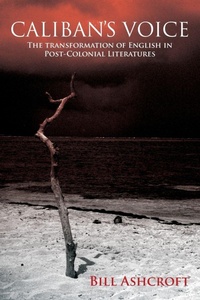
Caliban's Voice
The Transformation of English in Post-Colonial Literatures
1st Edition
Published on 5. December 2008
Book
Paperback/Softback
208 pages
978-0-415-47044-5 (ISBN)
Description
In Shakespeare's Tempest, Caliban says to Miranda and Prospero:
"...you taught me language, and my profit on't
Is, I know how to curse. "
With this statement, he gives voice to an issue that lies at the centre of post-colonial studies. Can Caliban own Prospero's language? Can he use it to do more than curse?
Caliban's Voice examines the ways in which post-colonial literatures have transformed English to redefine what we understand to be 'English Literature'. It investigates the importance of language learning in the imperial mission, the function of language in ideas of race and place, the link between language and identity, the move from orature to literature and the significance of translation. By demonstrating the dialogue that occurs between writers and readers in literature, Bill Ashcroft argues that cultural identity is not locked up in language, but that language, even a dominant colonial language, can be transformed to convey the realities of many different cultures.
Using the figure of Caliban, Ashcroft weaves a consistent and resonant thread through his discussion of the post-colonial experience of life in the English language, and the power of its transformation into new and creative forms.
"...you taught me language, and my profit on't
Is, I know how to curse. "
With this statement, he gives voice to an issue that lies at the centre of post-colonial studies. Can Caliban own Prospero's language? Can he use it to do more than curse?
Caliban's Voice examines the ways in which post-colonial literatures have transformed English to redefine what we understand to be 'English Literature'. It investigates the importance of language learning in the imperial mission, the function of language in ideas of race and place, the link between language and identity, the move from orature to literature and the significance of translation. By demonstrating the dialogue that occurs between writers and readers in literature, Bill Ashcroft argues that cultural identity is not locked up in language, but that language, even a dominant colonial language, can be transformed to convey the realities of many different cultures.
Using the figure of Caliban, Ashcroft weaves a consistent and resonant thread through his discussion of the post-colonial experience of life in the English language, and the power of its transformation into new and creative forms.
More details
Language
English
Place of publication
London
United Kingdom
Publishing group
Taylor & Francis Ltd
Target group
College/higher education
Dimensions
Height: 234 mm
Width: 156 mm
Thickness: 11 mm
Weight
324 gr
ISBN-13
978-0-415-47044-5 (9780415470445)
Copyright in bibliographic data and cover images is held by Nielsen Book Services Limited or by the publishers or by their respective licensors: all rights reserved.
Schweitzer Classification
Other editions
Additional editions
E-Book
01/2009
1st Edition
Routledge
€45.89
Available for download
E-Book
01/2009
Routledge
€55.49
Available for download
E-Book
01/2009
Routledge
€55.49
Available for download
Book
12/2008
1st Edition
Routledge
€206.10
Shipment within 15-20 days
Person
Bill Ashcroft is a founding exponent of post-colonial theory, co-author of The Empire Writes Back, the first text to examine systematically the field of post-colonial studies. He is author and co-author of twelve books including Post-Colonial Transformation and On Post-Colonial Futures. He is Chair of the School of English at the University of Hong Kong, on leave from the University of New South Wales.
Content
Introduction 1. Prospero's Language, Caliban's Voice 2. Language, Learning and Power 3. Language and Race 4. Language and Place 5. Language and Identity 6. Language, Culture and Meaning: the Caribbean 7. Caliban's Books - Orality and Writing 8. How Books Talk 9. Translation and Transformation Bibliography