

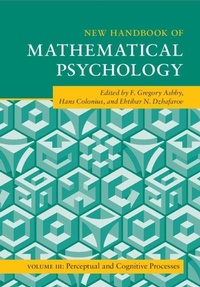
New Handbook of Mathematical Psychology: Volume 3, Perceptual and Cognitive Processes
Published on 23. January 2025
Book
Paperback/Softback
494 pages
978-1-108-82122-3 (ISBN)
Description
The field of mathematical psychology began in the 1950s and includes both psychological theorizing, in which mathematics plays a key role, and applied mathematics motivated by substantive problems in psychology. Central to its success was the publication of the first Handbook of Mathematical Psychology in the 1960s. The psychological sciences have since expanded to include new areas of research, and significant advances have been made both in traditional psychological domains and in the applications of the computational sciences to psychology. Upholding the rigor of the original Handbook, the New Handbook of Mathematical Psychology reflects the current state of the field by exploring the mathematical and computational foundations of new developments over the last half-century. The third volume provides up-to-date, foundational chapters on early vision, psychophysics and scaling, multisensory integration, learning and memory, cognitive control, approximate Bayesian computation, and encoding models in neuroimaging.
Reviews / Votes
'This is the third volume of the New Handbook of Mathematical Psychology. Here, the editors, leaders in their fields, focus on 'Perceptual and Cognitive Processes'. Mathematical psychology has come a long way since its inception in the 1950s. This volume signifies its evolution into a vital linchpin of modern scientific psychology.' James T. Townsend, Distinguished Professor and Rudy Professor of Psychological and Brain Sciences, Emeritus, Indiana UniversityMore details
Series
Language
English
Place of publication
Cambridge
United Kingdom
Target group
College/higher education
Product notice
Paperback (trade)
Illustrations
Worked examples or Exercises
Dimensions
Height: 244 mm
Width: 170 mm
Thickness: 25 mm
Weight
780 gr
ISBN-13
978-1-108-82122-3 (9781108821223)
Copyright in bibliographic data and cover images is held by Nielsen Book Services Limited or by the publishers or by their respective licensors: all rights reserved.
Schweitzer Classification
Other editions
Additional editions
F. Gregory Ashby | Hans Colonius | Ehtibar N. Dzhafarov
New Handbook of Mathematical Psychology: Volume 3, Perceptual and Cognitive Processes
E-Book
05/2023
Cambridge University Press
€179.99
Available for download
F. Gregory Ashby | Hans Colonius | Ehtibar N. Dzhafarov
New Handbook of Mathematical Psychology: Volume 3, Perceptual and Cognitive Processes
Book
04/2023
Cambridge University Press
€210.50
Shipment within 15-20 days
Persons
F. Gregory Ashby is Distinguished Professor Emeritus of Psychological and Brain Sciences at the University of California, Santa Barbara, USA. He is the author of more than 180 publications, including nine articles in Psychological Review and four books. He is past president of the Society for Mathematical Psychology and past chair of the NIH Cognition and Perception Study Section. His awards include the Howard Crosby Warren Medal in 2017. Hans Colonius is Professor of Psychology at Oldenburg University, Germany. He has published 130 papers and two books. He was editor-in-chief of the Journal of Mathematical Psychology and a visiting professor at various universities across Europe and the USA. His awards include a Heisenberg professorship in 1982, and his work has been supported by numerous grants from the German Science Foundation. Ehtibar N. Dzhafarov is Professor of Psychological Sciences at Purdue University, USA. He has published 170 papers in psychology, mathematics, philosophy, and foundations of quantum mechanics; he has also edited six books and three special journal issues. He served as president of the Society for Mathematical Psychology, and he has received a Humboldt Research Award.
Content
List of figures; List of tables; List of contributors; Preface: mathematical psychology in a quest for conceptual clarity; 1. Principles and consequences of the initial visual en-coding Brian Wandell and David Brainard; 2. Measuring multisensory integration in selected paradigms Adele Diederich and Hans Colonius; 3. Fechnerian scaling: dissimilarity cumulation theory Ehtibar N. Dzhafarov and Hans Colonius; 4. Mathematical models of human learning F. Gregory Ashby, Matthew J. Crossley, and Jeffrey B. Inglis; 5. Formal models of memory based on temporally-varying representations Marc W. Howard; 6. Statistical decision theory F. Gregory Ashby and Michael J. Wenger; 7. Modeling response inhibition in the stop signal task Hans Colonius and Adele Diederich; 8. Approximate bayesian computation Noah Thomas, Brandon M. Turner and Trisha Van Zandt; 9. Cognitive diagnosis models Jimmy de la Torre and Miguel A. Sorrel; 10. Encoding models in neuroimaging Fabian A. Soto and F. Gregory Ashby; Index.