

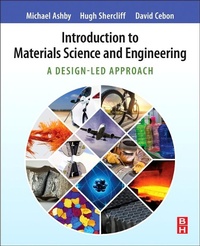
Introduction to Materials Science and Engineering
A Design-Led Approach
Published on 7. August 2023
Book
Paperback/Softback
704 pages
978-0-08-102399-0 (ISBN)
Description
Introduction to Materials Science and Engineering: A Design-Led Approach is ideal for a first course in materials for mechanical, civil, biomedical, aerospace and other engineering disciplines. The authors' systematic method includes first analyzing and selecting properties to match materials to design through the use of real-world case studies and then examining the science behind the material properties to better engage students whose jobs will be centered on design or applied industrial research. As with Ashby's other leading texts, the book emphasizes visual communication through material property charts and numerous schematics better illustrate the origins of properties, their manipulation and fundamental limits.
More details
Language
English
Place of publication
Oxford
United Kingdom
Publishing group
Elsevier Science & Technology
Target group
College/higher education
Undergraduate materials, mechanical, chemical, civil & aeronautical engineering students taking a first course in materials
Dimensions
Height: 229 mm
Width: 189 mm
Thickness: 25 mm
Weight
1080 gr
ISBN-13
978-0-08-102399-0 (9780081023990)
Copyright in bibliographic data and cover images is held by Nielsen Book Services Limited or by the publishers or by their respective licensors: all rights reserved.
Schweitzer Classification
Other editions
Additional editions
Michael F. Ashby | Hugh Shercliff | David Cebon
Introduction to Materials Science and Engineering
A Design-Led Approach
E-Book
08/2023
Butterworth-Heinemann
€55.99
Available for download
Persons
Mike Ashby is one of the world's foremost authorities on materials selection. He is sole or lead author of several of Elsevier's top selling engineering textbooks, including Materials and Design: The Art and Science of Material Selection in Product Design, Materials Selection in Mechanical Design, Materials and the Environment, Materials and Sustainable Development, and Materials: Engineering, Science, Processing and Design. He is also co-author of the books Engineering Materials 1&2, and Nanomaterials, Nanotechnologies and Design. Hugh Shercliff is a Senior Lecturer in Materials in the Department of Engineering at the University of Cambridge. He is a co-author of Michael Ashby's Materials, Third Edition (Butterworth-Heinemann, 2013), and a contributor on aluMATTER, an e-learning website for engineers and researchers sponsored by the European Aluminium Association. David Cebon is Professor of Mechanical Engineering at Cambridge University in the UK.
Author
Royal Society Research Professor Emeritus, University of Cambridge, and Former Visiting Professor of Design at the Royal College of Art, London, UK
Senior Lecturer in Materials, Department of Engineering, University of Cambridge, UK
Professor, Department of Engineering, University of Cambridge, UK
Content
1.Introduction: materials - history, classification, and properties
2. Materials, processes, and design
3. Material properties and microstructure - overview and atom-scale fundamentals
4. Elastic stiffness and stiffness-limited applications
5. Plasticity, yielding and ductility, and strength-limited applications
6. Fracture, fatigue, and fracture-limited applications
7. Materials and heat: thermal properties
8. Materials at high temperatures: diffusion and creep
9. Surfaces: friction, wear, oxidation, corrosion
10. Functional properties: electrical, magnetic, optical
11. Manufacturing processes and microstructure evolution
12. Materials, environment, and sustainability
Guided Learning Unit 1: Simple ideas of crystallography
Guided Learning Unit 2: Material selection in design
Guided Learning Unit 3: Process selection in design
Guided Learning Unit 4: Phase diagrams and phase Transformations
Appendix A: Material property data
2. Materials, processes, and design
3. Material properties and microstructure - overview and atom-scale fundamentals
4. Elastic stiffness and stiffness-limited applications
5. Plasticity, yielding and ductility, and strength-limited applications
6. Fracture, fatigue, and fracture-limited applications
7. Materials and heat: thermal properties
8. Materials at high temperatures: diffusion and creep
9. Surfaces: friction, wear, oxidation, corrosion
10. Functional properties: electrical, magnetic, optical
11. Manufacturing processes and microstructure evolution
12. Materials, environment, and sustainability
Guided Learning Unit 1: Simple ideas of crystallography
Guided Learning Unit 2: Material selection in design
Guided Learning Unit 3: Process selection in design
Guided Learning Unit 4: Phase diagrams and phase Transformations
Appendix A: Material property data