

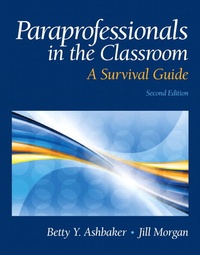
Paraprofessionals in the Classroom: A Survival Guide
Description
This guide explores the roles and duties of K-12 paraprofessionals in both general education and special education settings.
Using a straight-forward presentation, Paraprofessionals in the Classroom: A Survival Guide, 2/e covers topics such as behavior, teaching, assessment, and collaboration and outlines how paraprofessionals can support both students and teachers. Grounded in real classroom situations, it also addresses issues such as learner diversity, confidentiality, professionalism, role definition, and self- evaluation. This edition includes more details on supervision, new tactics for behavior management, and tear-out forms designed to help paraprofessionals manage their daily tasks.
Features a straight-forward presentation that avoids research jargon and emphasizes practical applications. Includes additional activities at the end of each chapter called Extending Your Learning . Case Studies along with descriptions and follow-up questions expose readers to real-life classroom scenarios . Encourages readers to personalize chapter material by offering Reflective Activities in each chapter.
araprofessionals manage their daily tasks.
Reviews / Votes
Does an excellent job of explaining the role of the paraeducator in the curriculum process. Jean Faieta, Professor, School of Education, Edinboro University of Pennsylvania, Edinboro, PA The emphasis on the fact that teaching does not occur if students are not learning is excellent. Karen S. Smucker, Professor of Education, Exceptional Child Program, Northwest Nazarene University, Nampa, ID Current and to the point. Peggy Keaton Woodall, Professor, Advanced Instructional Studies, Henderson State University, Arkadelphia, ARMore details
Other editions
Previous edition
Persons
Dr. Betty Y. Ashbaker is an associate professor in counseling psychology and special education. Trained in elementary, special education, and administration, she has experience as a special education teacher, school district administrator, and professor. She has co-authored several books and articles about her research on training and supervision of paraprofessionals, literacy for minority students, and school safety. At Brigham Young University, she teaches special education law, secondary transition, and introduction to special education courses.
Dr. Jill Morgan , distinguished author and teaching professional, has been training paraprofessional teacher teams for over 15 years throughout the US and UK. She is the co-author of numerous titles including A Teacher's Guide to Working with Paraeducators (ASCD), Supporting and Supervising your Teaching Assistant, The TA's Guide to ASD, How to be a Successful TA, and Behaviour Management all published by Continuum . Her research interests include the role of teaching assistants in the classroom and effective supervision of teaching assistants.
Content
Normal 0 false false false MicrosoftInternetExplorer4
Preface
Section I: Background and Context
Chapter 1: Paraprofessional? What's That?
Chapter 2: Instructional Supervision
Section II: Instruction and the Learning Environment
Chapter 3: Critical Components of Effective Instruction
Chapter 4: Monitoring Instructional Effectiveness
Chapter 5: Organization and Management of the Learning Environment
Chapter 6: Learner Characteristics
Section III: Student Behavior and Classroom Management
Chapter 7: Influencing Behavior
Chapter 8: Recognition, Praise, and Sanctions
Chapter 9: Time as a Behavior Management Tool
Section IV: Professionalism
Chapter 10: Laws and Regulations Affecting Paraprofessionals' Roles
Chapter 11: Professional and Ethical Behavior
Chapter 12: Reflection and Self-Evaluation
Section V: Appendix