

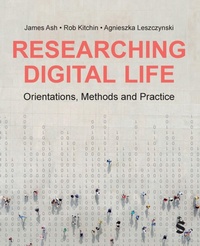
Researching Digital Life
Orientations, Methods and Practice
1st Edition
Published on 22. March 2024
Book
Paperback/Softback
328 pages
978-1-5296-0165-7 (ISBN)
Description
We now live in a world where all aspects of everyday life are thoroughly mediated by digital technologies. Making sense of digital life is accordingly an essential undertaking for social science and humanities scholars.
This multidisciplinary book provides an essential guide to researching digital life:
Orienting readers with respect to methodologies, research design, and research ethics.
Detailing key research methods, including interviews, surveys, ethnographies, walking methodologies, arts-based and participatory approaches, historical analysis, data visualisation, mapping and data analytics.
Demonstrating these methods in action in real-world studies that have investigated apps and interfaces, social and locative media, mobilities, smart cities, and digital labour and work.
The authors provide:
* Non-Eurocentric perspectives and case studies from diverse disciplines
* Annotated further reading to help you situate your research alongside existing research in your field
* An outline of future directions for researching digital life. Accessible in style and richly illustrated, the chapters provide a wealth of key insights and practical information to ensure research projects are successfully planned and implemented.
This multidisciplinary book provides an essential guide to researching digital life:
Orienting readers with respect to methodologies, research design, and research ethics.
Detailing key research methods, including interviews, surveys, ethnographies, walking methodologies, arts-based and participatory approaches, historical analysis, data visualisation, mapping and data analytics.
Demonstrating these methods in action in real-world studies that have investigated apps and interfaces, social and locative media, mobilities, smart cities, and digital labour and work.
The authors provide:
* Non-Eurocentric perspectives and case studies from diverse disciplines
* Annotated further reading to help you situate your research alongside existing research in your field
* An outline of future directions for researching digital life. Accessible in style and richly illustrated, the chapters provide a wealth of key insights and practical information to ensure research projects are successfully planned and implemented.
Reviews / Votes
"The pervasive digital mediation of everyday life presents unique epistemological, methodological, ethical, and practical challenges for social science researchers. This text offers researchers a thorough and greatly-needed critical review of these issues, along with vital guidance for undertaking studies of digital life." -- Sarah Elwood "This book represents a pivotal moment in digital social research. By exploring a comprehensive range of questions, methods and means of data generation and analysis, it captures the present and future of social research. Thoughtful, thorough and reflexive, the text insightfully details how to make sense of our digital lives." -- David Beer "Researching Digital Life is essential reading for anyone interested in investigating and understanding how the digital has become part of our lives. This excellent book offers an incredibly accessible and comprehensive guide to digital methods, and by introducing approaches from the social sciences, arts and computational sciences alongside each other it also delivers the interdisciplinary vision of digital research that all researchers will benefit from." -- Sarah PinkMore details
Language
English
Place of publication
London
United Kingdom
Target group
College/higher education
Dimensions
Height: 235 mm
Width: 191 mm
Thickness: 18 mm
Weight
615 gr
ISBN-13
978-1-5296-0165-7 (9781529601657)
Copyright in bibliographic data and cover images is held by Nielsen Book Services Limited or by the publishers or by their respective licensors: all rights reserved.
Schweitzer Classification
Other editions
Additional editions
James Ash | Rob Kitchin | Agnieszka Leszczynski
Researching Digital Life
Orientations, Methods and Practice
Book
03/2024
1st Edition
SAGE Publications Ltd
€134.30
Shipment within 3-4 weeks
James Ash | Rob Kitchin | Agnieszka Leszczynski
Researching Digital Life
Orientations, Methods and Practice
E-Book
03/2024
1st Edition
SAGE Publications Ltd
€63.49
Available for download
James Ash | Rob Kitchin | Agnieszka Leszczynski
Researching Digital Life
Orientations, Methods and Practice
E-Book
03/2024
1st Edition
SAGE Publications Ltd
€63.49
Available for download
Persons
James Ash is a geographer and Senior Lecturer in Media and Cultural Studies at Newcastle University. His research investigates the cultures, economies and politics of digital interfaces. He is author of Phase Media: Space Time and the Politics of Smart Objects (Bloomsbury, 2017) and The Interface Envelope: Gaming, Technology, Power (Bloomsbury Press, 2015).
Rob Kitchin is a Professor in Maynooth University Social Sciences Institute and Department of Geography. He was a European Research Council Advanced Investigator on the Programmable City project (2013-2018) and a principal investigator on the Building City Dashboards project (2016-2020) and for the Digital Repository of Ireland (2009-2017). He is the (co)author or (co)editor of 31 other academic books, and (co)author of over 200 articles and book chapters. He has been an editor of Dialogues in Human Geography, Progress in Human Geography and Social and Cultural Geography, and was the co-Editor-in-Chief of the International Encyclopedia of Human Geography. He was the 2013 recipient of the Royal Irish Academy's Gold Medal for the Social Sciences. Agnieszka Leszczynski is a Lecturer in the School of Environment at the University of Auckland, New Zealand. Her work is situated at the subdisciplinary interfaces of GIScience and human geography and examines issues around geospatial technologies and critical GIScience. She has published a range of articles in leading Geography journals including Progress in Human Geography and Environment and Planning D: Society and Space.
Rob Kitchin is a Professor in Maynooth University Social Sciences Institute and Department of Geography. He was a European Research Council Advanced Investigator on the Programmable City project (2013-2018) and a principal investigator on the Building City Dashboards project (2016-2020) and for the Digital Repository of Ireland (2009-2017). He is the (co)author or (co)editor of 31 other academic books, and (co)author of over 200 articles and book chapters. He has been an editor of Dialogues in Human Geography, Progress in Human Geography and Social and Cultural Geography, and was the co-Editor-in-Chief of the International Encyclopedia of Human Geography. He was the 2013 recipient of the Royal Irish Academy's Gold Medal for the Social Sciences. Agnieszka Leszczynski is a Lecturer in the School of Environment at the University of Auckland, New Zealand. Her work is situated at the subdisciplinary interfaces of GIScience and human geography and examines issues around geospatial technologies and critical GIScience. She has published a range of articles in leading Geography journals including Progress in Human Geography and Environment and Planning D: Society and Space.
Content
Orientations
Introduction
Methodologies, Ontologies and Epistemologies
Research Design and Implementation
Research Ethics
Methods and Approaches
Interviews, Surveys, Observation and (Auto)Ethnography
Walking Methodologies, Walkthroughs and Audits
Arts-Based Methods
Participatory Methods
Historical Methods
Data Visualisation and Mapping
Data Analytics
Methods in Action
Apps and Interfaces
Social and Locative Media
Mobilities
Smart Cities
Digital Labour
Conclusion
Final thoughts
Introduction
Methodologies, Ontologies and Epistemologies
Research Design and Implementation
Research Ethics
Methods and Approaches
Interviews, Surveys, Observation and (Auto)Ethnography
Walking Methodologies, Walkthroughs and Audits
Arts-Based Methods
Participatory Methods
Historical Methods
Data Visualisation and Mapping
Data Analytics
Methods in Action
Apps and Interfaces
Social and Locative Media
Mobilities
Smart Cities
Digital Labour
Conclusion
Final thoughts