

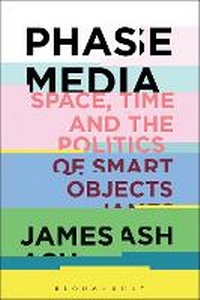
Phase Media
Space, Time and the Politics of Smart Objects
Published on 14. December 2017
Book
Hardback
224 pages
978-1-5013-3560-0 (ISBN)
Description
In Phase Media, James Ash theorizes how smart objects, understood as Internet-connected and sensor-enabled devices, are altering users' experience of their environment. Rather than networks connected by lines of transmission, smart objects generate phases, understood as space-times that modulate the spatio-temporal intelligibility of both humans and non-humans. Examining a range of objects and services from the Apple Watch to Nest Cam to Uber, Ash suggests that the modulation of spatio-temporal intelligibility is partly shaped by the commercial logics of the industries that design and manufacture smart objects, but can also exceed them.
Drawing upon the work of Martin Heidegger, Gilbert Simondon and Bruno Latour, Ash argues that smart objects have their own phase politics, which offer opportunities for new forms of public to emerge. Phase Media develops a conceptual vocabulary to contend that smart objects do more than just enabling a world of increased corporate control and surveillance, as they also provide the tools to expose and re-order the very logics and procedures that created them.
Drawing upon the work of Martin Heidegger, Gilbert Simondon and Bruno Latour, Ash argues that smart objects have their own phase politics, which offer opportunities for new forms of public to emerge. Phase Media develops a conceptual vocabulary to contend that smart objects do more than just enabling a world of increased corporate control and surveillance, as they also provide the tools to expose and re-order the very logics and procedures that created them.
Reviews / Votes
Challenges conventional thinking and offers an interesting framework for evaluating the importance of smart objects with a view towards the future. * European Journal of Communication * James Ash's Phase Media offers a new way to conceptualize how smart objects are becoming part of and active in our lives, environments and the processes of change that characterize the contemporary world. Providing a welcome alternative to network and new materialist approaches, Ash invites us to consider how smart objects themselves are implicated and active in constituting everyday worlds and change processes. In doing so it provokes new theoretical imaginaries of what smart objects are, how they might impact on our lives, and the implications of this for ethical technological futures. This book is essential reading for anyone interested in understanding how smart technologies are emerging as part of our contemporary and near future worlds. * Sarah Pink, Distinguished Professor of Design and Media Ethnography, RMIT University, Australia * With Ash's Phase Media, the fallibility of the autonomous system comes sharply into view. A compelling account of the perturbations of apparently 'smart' devices. * Louise Amoore, Professor of Political Geography, Durham University, UK * Phase Media avoids the common misrecognition of critical academic thinking as an act of judgment or condemnation. It is 'critical' instead in its clarity, patient explanation, examples, helpful signposting and above all, inquisitiveness. * The AAG Review of Books *More details
Language
English
Place of publication
New York
United States
Publishing group
Bloomsbury Publishing Plc
Target group
College/higher education
Dimensions
Height: 229 mm
Width: 152 mm
Weight
472 gr
ISBN-13
978-1-5013-3560-0 (9781501335600)
Copyright in bibliographic data and cover images is held by Nielsen Book Services Limited or by the publishers or by their respective licensors: all rights reserved.
Schweitzer Classification
Other editions
Additional editions
E-Book
12/2017
1st Edition
Bloomsbury Academic USA
€39.49
Available for download
Person
James Ash is a geographer and Senior Lecturer in Media and Cultural Studies at Newcastle University, UK. He works across the disciplines of human geography, cultural studies and media theory. His research focuses on the cultures, economies and politics of digital interfaces and digital technology and how these technologies are transforming everyday life.
Content
Acknowledgements
1: Phase Media
Networks
Smart Objects
Smart Objects, Space and Time
Exploring Phases
2: Objects
Technical Objects
Smart Objects
A Quintuplet model of Smart Objects
3: Spaces
Phase Space
Modulating Phase Spaces
Diffusion, Partition, Envelopment
The Multiple Logics of Modulation
4: Times
Phase Time
Gradation, Dispersion, Dilation
Spatio-Temporal Phases
5: Politics
Smart Politics
Object Politics
Endo and Exo Politics
Phase Politics
6: Involution
Involution
Struction and Dis-struction
Structive Involution
Dis-Structive Involution
Phase Activism
7: Ethics
Ethics and Smart Vehicles
Phases and Accidents
Phase Ethics
Practicing Phase Ethics
Phase Ethic Futures
8: After Networks
Networks and Phases
Closing Remarks
Bibliography
1: Phase Media
Networks
Smart Objects
Smart Objects, Space and Time
Exploring Phases
2: Objects
Technical Objects
Smart Objects
A Quintuplet model of Smart Objects
3: Spaces
Phase Space
Modulating Phase Spaces
Diffusion, Partition, Envelopment
The Multiple Logics of Modulation
4: Times
Phase Time
Gradation, Dispersion, Dilation
Spatio-Temporal Phases
5: Politics
Smart Politics
Object Politics
Endo and Exo Politics
Phase Politics
6: Involution
Involution
Struction and Dis-struction
Structive Involution
Dis-Structive Involution
Phase Activism
7: Ethics
Ethics and Smart Vehicles
Phases and Accidents
Phase Ethics
Practicing Phase Ethics
Phase Ethic Futures
8: After Networks
Networks and Phases
Closing Remarks
Bibliography