

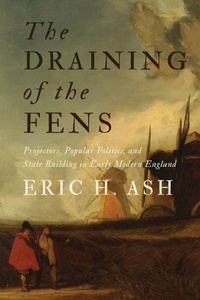
The Draining of the Fens
Projectors, Popular Politics, and State Building in Early Modern England
Published on 29. March 2022
Book
Paperback/Softback
416 pages
978-1-4214-4330-0 (ISBN)
Description
How landowners, drainage projectors, and investors worked with the Crown to transform England's waterlogged Fens.
2017 Choice Outstanding Academic Title
The draining of the Fens in eastern England was one of the largest engineering projects in seventeenth-century Europe. A series of Dutch and English "projectors," working over several decades and with the full support of the Crown, transformed hundreds of thousands of acres of putatively barren wetlands into dry, arable farmland. The drainage project was also supposed to reform the sickly, backward fenlanders into civilized, healthy farmers, to the benefit of the entire commonwealth. As projectors reconstructed entire river systems, these new, artificial channels profoundly altered both the landscape and the lives of those who lived on it.
In this definitive account, historian Eric H. Ash provides a detailed history of this ambitious undertaking. Ash traces the endeavor from the 1570s, when draining the whole of the Fens became an imaginable goal for the Crown, through several failed efforts in the early 1600s. The book closes in the 1650s, when, in spite of the project's enormous difficulty and expense, the draining of the Great Level of the Fens was finally completed. Ash ultimately concludes that the transformation of the Fens into fertile farmland had unintended ecological consequences that created at least as many problems as it solved.
Drawing on painstaking archival research, Ash explores the drainage from the perspectives of political, social, and environmental history. He argues that the efficient management and exploitation of fenland natural resources in the rising nation-state of early modern England was a crucial problem for the Crown, one that provoked violent confrontations with fenland inhabitants, who viewed the drainage (and accompanying land seizure) as a grave threat to their local landscape, economy, and way of life. The drainage also reveals much about the political flash points that roiled England during the mid-seventeenth century, leading up to the violence of the English Civil War. This is compelling reading for British historians, environmental scholars, historians of technology, and anyone interested in state formation in early modern Europe.
2017 Choice Outstanding Academic Title
The draining of the Fens in eastern England was one of the largest engineering projects in seventeenth-century Europe. A series of Dutch and English "projectors," working over several decades and with the full support of the Crown, transformed hundreds of thousands of acres of putatively barren wetlands into dry, arable farmland. The drainage project was also supposed to reform the sickly, backward fenlanders into civilized, healthy farmers, to the benefit of the entire commonwealth. As projectors reconstructed entire river systems, these new, artificial channels profoundly altered both the landscape and the lives of those who lived on it.
In this definitive account, historian Eric H. Ash provides a detailed history of this ambitious undertaking. Ash traces the endeavor from the 1570s, when draining the whole of the Fens became an imaginable goal for the Crown, through several failed efforts in the early 1600s. The book closes in the 1650s, when, in spite of the project's enormous difficulty and expense, the draining of the Great Level of the Fens was finally completed. Ash ultimately concludes that the transformation of the Fens into fertile farmland had unintended ecological consequences that created at least as many problems as it solved.
Drawing on painstaking archival research, Ash explores the drainage from the perspectives of political, social, and environmental history. He argues that the efficient management and exploitation of fenland natural resources in the rising nation-state of early modern England was a crucial problem for the Crown, one that provoked violent confrontations with fenland inhabitants, who viewed the drainage (and accompanying land seizure) as a grave threat to their local landscape, economy, and way of life. The drainage also reveals much about the political flash points that roiled England during the mid-seventeenth century, leading up to the violence of the English Civil War. This is compelling reading for British historians, environmental scholars, historians of technology, and anyone interested in state formation in early modern Europe.
Reviews / Votes
Stunningly relevant and beautifully written . . . This remarkable book is about nation building, economics, and environmental and social history. It is thoroughly researched, and historian Ash tells his story in a compelling way that is accessible to any reader. Essential. All levels/libraries.-Choice Ash's book is a sound study of the drainage of one part of the southern fens over a period of less than a century that was without doubt the most formative era in its taming. It is well-written, informative, assiduously referenced with copious endnotes, and an excellent testimony to the wealth of documentation that survives in the archives.
-Environment and History An excellent contribution to the history of engineering projects, particularly from an environmental and political point of view.
-Metascience This comprehensive account is likely to become the standard textbook for the history of the Fens. It is thoroughly researched, drawing on a wide range of printed material in addition to archival sources including court records, petitions, correspondence, and state papers.
-Renaissance Quarterly The book is certainly the account for our generation.
-American Historical Review Ash's work will long remain an essential account of these important events.
-Journal of British Studies Ash supplies a rousing narrative of 'improvement' schemes in the wetlands of eastern England, written in an engaging Whiggish style that imbues the early Stuart dynastic state.
-Journal of Modern History
More details
Series
Language
English
Place of publication
Baltimore, MD
United States
Target group
Professional and scholarly
Product notice
Paperback (trade)
Illustrations
8 Karten, 17 s/w Photographien bzw. Rasterbilder
8 Maps; 17 Halftones, black and white
Dimensions
Height: 229 mm
Width: 152 mm
Thickness: 25 mm
Weight
675 gr
ISBN-13
978-1-4214-4330-0 (9781421443300)
DOI
10.1353/book.51998
Copyright in bibliographic data and cover images is held by Nielsen Book Services Limited or by the publishers or by their respective licensors: all rights reserved.
Schweitzer Classification
Other editions
Additional editions
Eric H. Ash
The Draining of the Fens
Projectors, Popular Politics, and State Building in Early Modern England
Book
07/2017
Johns Hopkins University Press
€62.20
Shipment within 10-20 days
Person
Eric H. Ash is a professor of history at Wayne State University. He is the author of Power, Knowledge, and Expertise in Elizabethan England.
Content
Dedication
Table of Contents
Abbreviations
Acknowledgements
Introduction. The Unrecovered Country: Draining the Land, Building the State
Part I: Popular Politics, Crown Authority, and the Rise of the Projector
Chapter 1: Land and Life in the Pre-Drainage Fens
Chapter 2: State Building in the Fens, 1570-1607
Chapter 3: The Crisis of Local Governance, 1609-1616
Chapter 4: The Struggle to Forge Consensus, 1617-1621
Part II: Drainage Projects, Violent Resistance, and State Building
Chapter 5: Draining the Hatfield Level, 1625-1636
Chapter 6: The First Great Level Drainage, 1630-1642
Chapter 7: Riot, Civil War, and Popular Politics in the Hatfield Level, 1640-1656
Chapter 8: The Second Great Level drainage, 1649-1656
Epilogue. The Once and Future Fens: Unintended Consequences in an Artificial Landscape
Glossary
Bibliography
Index
Table of Contents
Abbreviations
Acknowledgements
Introduction. The Unrecovered Country: Draining the Land, Building the State
Part I: Popular Politics, Crown Authority, and the Rise of the Projector
Chapter 1: Land and Life in the Pre-Drainage Fens
Chapter 2: State Building in the Fens, 1570-1607
Chapter 3: The Crisis of Local Governance, 1609-1616
Chapter 4: The Struggle to Forge Consensus, 1617-1621
Part II: Drainage Projects, Violent Resistance, and State Building
Chapter 5: Draining the Hatfield Level, 1625-1636
Chapter 6: The First Great Level Drainage, 1630-1642
Chapter 7: Riot, Civil War, and Popular Politics in the Hatfield Level, 1640-1656
Chapter 8: The Second Great Level drainage, 1649-1656
Epilogue. The Once and Future Fens: Unintended Consequences in an Artificial Landscape
Glossary
Bibliography
Index