

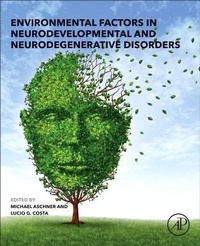
Environmental Factors in Neurodevelopmental and Neurodegenerative Disorders
Published on 29. October 2015
Book
Hardback
450 pages
978-0-12-800228-5 (ISBN)
Description
Environmental Factors in Neurodevelopmental and Neurodegenerative Disorders presents a state-of-the-art review of the effects of environmental contaminants on the development and degeneration of the human nervous system, brought together by world-leading experts in the field.
Part One describes the adverse effects that the environment can have on neurological development, and how these effects may exhibit. Specific contaminants and their possible consequences of exposure are addressed (lead, methylmercury, alcohol), as well as specific disorders and the environmental factors associated with them, such as the effect of diet on attention deficit and hyperactivity disorders. Part Two tackles neurodegenerative disorders, specifically addressing their potential neurotoxic origins, and discussing the increasing interest in the effects that early exposure may have in later life.
Environmental Factors in Neurodevelopmental and Neurodegenerative Disorders is an invaluable reference for those professionals working in the fields of toxicology, environmental health and neuroscience.
Part One describes the adverse effects that the environment can have on neurological development, and how these effects may exhibit. Specific contaminants and their possible consequences of exposure are addressed (lead, methylmercury, alcohol), as well as specific disorders and the environmental factors associated with them, such as the effect of diet on attention deficit and hyperactivity disorders. Part Two tackles neurodegenerative disorders, specifically addressing their potential neurotoxic origins, and discussing the increasing interest in the effects that early exposure may have in later life.
Environmental Factors in Neurodevelopmental and Neurodegenerative Disorders is an invaluable reference for those professionals working in the fields of toxicology, environmental health and neuroscience.
More details
Language
English
Place of publication
San Diego
United States
Publishing group
Elsevier Science Publishing Co Inc
Target group
Professional and scholarly
Professional toxicologists, environmental health scientists, neuroscientists, professors, postgraduate students and legislative professionals who work with neurotoxicology
Product notice
sewn/stitched
Cloth over boards
Illustrations
Approx. 100 illustrations (100 in full color)
Dimensions
Height: 236 mm
Width: 196 mm
Thickness: 28 mm
Weight
1111 gr
ISBN-13
978-0-12-800228-5 (9780128002285)
Copyright in bibliographic data and cover images is held by Nielsen Book Services Limited or by the publishers or by their respective licensors: all rights reserved.
Schweitzer Classification
Other editions
Additional editions
Michael Aschner | Lucio G. Costa
Environmental Factors in Neurodevelopmental and Neurodegenerative Disorders
E-Book
06/2015
Academic Press
€129.00
Available for download
Persons
Dr. Aschner serves as the Harold and Muriel Block Chair in Molecular Pharmacology at Albert Einstein College of Medicine. He served on numerous toxicology panels (Institute of Medicine, US Environmental Protection Agency, Center for Disease Control), and is a member of the Neurotoxicology and Alcohol study section (NIH). Research in our lab focuses on the following topics: (1) Modulation of C. elegans genes (aat, skn-1, daf-16) that are homologous to mammalian regulators of MeHg uptake and cellular resistance will modify dopaminergic neurodegeneration in response to MeHg exposure. (2) Under conditions of MeHg-induced oxidative stress, Nrf2 (a master regulator of antioxidant responses) coordinates the upregulation of cytoprotective genes that combat MeHg-induced oxidative injury, and that genetic and biochemical changes that negatively impact upon Nrf2 function increase MeHg's neurotoxicity. (3) PARK2, a strong PD genetic risk factor, alters neuronal vulnerability to modifiers of cellular Mn status, particularly at the level of mitochondrial dysfunction and oxidative stress. Our studies are designed to (1) shed novel mechanistic insight into metal-induced neurodegeneration; (2) identify targets for genetic or pharmacologic modulation of neurodegenerative disorders; (3) increase knowledge of the pathway involved in oxidative stress; (4) develop improved research models for human disease using knowledge of environmental sciences. Dr. Lucio G. Costa is Professor of Toxicology at the University of Washington in Seattle, and of Pharmacology/Toxicology at the University of Parma Medical School. He received a doctorate in Pharmacology from the University of Milano in 1977, and was a postdoctoral fellow at the University of Texas at Houston. He is a member of several national and international professional organizations, a Fellow of the Academy of Toxicological Sciences, and a European Certified Toxicologist. He received various award for his scientific accomplishments, including the Achievement Award from the Society of Toxicology. He serves in various editorial capacities for several toxicology journals, and is an active manuscript and grant reviewer. Dr. Costa has been the member of dozens of panels and committees at the national and international level dealing with toxicology and risk assessment issues. He has chaired and/or organized symposia at scientific meetings in the United States and internationally. He has been teaching classes in the area of toxicology, neurotoxicology and pharmacology to graduate and medical students for 30 years. He keeps an active research program in the area of neurotoxicology.
Content
Preface
Foreword by Annette Kirshner
Section I: Neurodevelopmental Disorders
1. Overview of the Role of Environmental Factors in Neurodevelopmental Disorders
2. Genetic Factors in Environmentally-Induced Disease
3. Fetal Alcohol Spectrum Disorders
4. Prenatal Infection
5. Attention Deficit-Hyperactivity Disorders
6. Organic Mercury Compounds
7. Lead
8. Endocrine Disruptors
9. Summary and Perspectives
10. Overview of Environmental Factors in Neurodegenerative Disorder
Part II: Neurodegenerative Disorders
11. Western Pacific ALS-PDC: a Prototypical Long-Latency Environment Neurodegenerative Disorder
12. Parkinson's Disease Epidemiology
13. Parkinson's Disease: Mechanisms and Biological Plausibility
14. Genetics of Parkinson's Disease
15. Environmental Risk Factors in Alzheimer Disease
16. Amyotrophic Lateral Sclerosis: Environmental Factors
17. Gene-Environment Interactions in Huntington's Disease
18. Infection, Neuroinflammation and Neurodegenerative Diseases
19. Late Effects of Early Exposures
20. Summary and Perspectives
Foreword by Annette Kirshner
Section I: Neurodevelopmental Disorders
1. Overview of the Role of Environmental Factors in Neurodevelopmental Disorders
2. Genetic Factors in Environmentally-Induced Disease
3. Fetal Alcohol Spectrum Disorders
4. Prenatal Infection
5. Attention Deficit-Hyperactivity Disorders
6. Organic Mercury Compounds
7. Lead
8. Endocrine Disruptors
9. Summary and Perspectives
10. Overview of Environmental Factors in Neurodegenerative Disorder
Part II: Neurodegenerative Disorders
11. Western Pacific ALS-PDC: a Prototypical Long-Latency Environment Neurodegenerative Disorder
12. Parkinson's Disease Epidemiology
13. Parkinson's Disease: Mechanisms and Biological Plausibility
14. Genetics of Parkinson's Disease
15. Environmental Risk Factors in Alzheimer Disease
16. Amyotrophic Lateral Sclerosis: Environmental Factors
17. Gene-Environment Interactions in Huntington's Disease
18. Infection, Neuroinflammation and Neurodegenerative Diseases
19. Late Effects of Early Exposures
20. Summary and Perspectives