

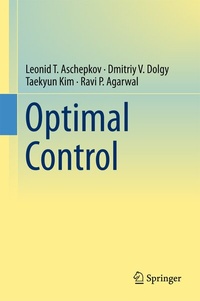
Optimal Control
Published on 18. January 2017
Book
Hardback
XV, 209 pages
978-3-319-49780-8 (ISBN)
Description
This book is based on lectures from a one-year course at the Far Eastern Federal University (Vladivostok, Russia) as well as on workshops on optimal control offered to students at various mathematical departments at the university level. The main themes of the theory of linear and nonlinear systems are considered, including the basic problem of establishing the necessary and sufficient conditions of optimal processes.
In the first part of the course, the theory of linear control systems is constructed on the basis of the separation theorem and the concept of a reachability set. The authors prove the closure of a reachability set in the class of piecewise continuous controls, and the problems of controllability, observability, identification, performance and terminal control are also considered. The second part of the course is devoted to nonlinear control systems. Using the method of variations and the Lagrange multipliers rule of nonlinear problems, the authors prove the Pontryagin maximum principle for problems with mobile ends of trajectories. Further exercises and a large number of additional tasks are provided for use as practical training in order for the reader to consolidate the theoretical material.
In the first part of the course, the theory of linear control systems is constructed on the basis of the separation theorem and the concept of a reachability set. The authors prove the closure of a reachability set in the class of piecewise continuous controls, and the problems of controllability, observability, identification, performance and terminal control are also considered. The second part of the course is devoted to nonlinear control systems. Using the method of variations and the Lagrange multipliers rule of nonlinear problems, the authors prove the Pontryagin maximum principle for problems with mobile ends of trajectories. Further exercises and a large number of additional tasks are provided for use as practical training in order for the reader to consolidate the theoretical material.
More details
Edition
1st ed. 2016
Language
English
Place of publication
Cham
Switzerland
Publishing group
Springer International Publishing
Target group
Professional and scholarly
Illustrations
55 s/w Abbildungen
55 Illustrations, black and white; XV, 209 p. 55 illus.
Dimensions
Height: 23.5 cm
Width: 15.5 cm
Weight
4675 gr
ISBN-13
978-3-319-49780-8 (9783319497808)
DOI
10.1007/978-3-319-49781-5
Schweitzer Classification
Other editions
New editions
Leonid T. Ashchepkov | Dmitriy V. Dolgy | Taekyun Kim
Optimal Control
Book
01/2022
2nd Edition
Springer
€80.24
Shipment within 7-9 days
Additional editions
Leonid T. Aschepkov | Dmitriy V. Dolgy | Taekyun Kim
Optimal Control
Book
04/2018
Springer
€53.49
Shipment within 10-15 days
Leonid T. Aschepkov | Dmitriy V. Dolgy | Taekyun Kim
Optimal Control
E-Book
01/2017
Springer
€53.49
Available for download
Persons
Leonid Aschepkov is a professor in the Department of Mathematical Methods of Economy at Far Eastern Federal University.
Dmitriy V. Dolgy is a professor at the Institute of Natural Sciences at Far Eastern Federal University in Vladivolstok, Russia and at Hanrimwon, Kwangwoon University in Seoul, Republic of Korea.
Taekyun Kim is a professor in the Department of Mathematics at the College of Natural Science at Kwangwoon University.
Ravi P. Agarwal is a professor and the chair of the Department of Mathematics at Texas A&M University.
Dmitriy V. Dolgy is a professor at the Institute of Natural Sciences at Far Eastern Federal University in Vladivolstok, Russia and at Hanrimwon, Kwangwoon University in Seoul, Republic of Korea.
Taekyun Kim is a professor in the Department of Mathematics at the College of Natural Science at Kwangwoon University.
Ravi P. Agarwal is a professor and the chair of the Department of Mathematics at Texas A&M University.
Content
NOTATIONS.- PREFACE.- INTRODUCTION.- 1. Subject of optimal control.- 2. Mathematical model of controlled object.- 3. Reachability set.- 4. Controllability of linear systems.- 5. Minimum time problem.- 6. Synthesis of optimal system performance.- 7. The observability problem.- 8. Identification problem.- 9. Types of optimal control problems.- 10. Small increments of a trajectory.- 11. The simplest problem of optimal control.- 12. General optimal control problem.- 13. Sufficient optimality conditions.- CONCLUSION.- APPENDIX.- EXAMPLES OF TASKS AND SOLUTIONS.- LITERATURE.