

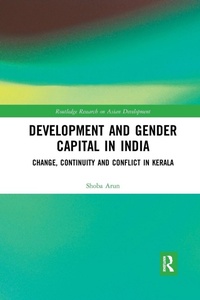
Development and Gender Capital in India
Change, Continuity and Conflict in Kerala
1st Edition
Published on 17. January 2019
Book
Paperback/Softback
186 pages
978-0-367-20923-0 (ISBN)
Description
The Indian state of Kerala has invoked much attention within development and gender debates, specifically in relation to its female capital- an outcome of interrelated historical, cultural and social practices. On the one hand, Kerala has been romanticised, with its citizenry, particularly women, being free of social divisions and uplifted through educational well-being. On the other hand, its realism is stark, particularly in the light of recent social changes.
Using a Bourdieusian frame of analysis, Development and Gender Capital in India explores the forces of globalisation and how they are embedded within power structures. Through narratives of women's lived experiences in the private and public domains, it highlights the 'anomie of gender' through complexities and contradictions vis-a-vis processes of modernity, development and globalisation. By demonstrating the limits placed upon gender capital by structures of patriarchy and domination, it argues that discussions about the empowered Malayalee women should move from a mere 'politics of rhetoric and representation' to a more embedded 'politics of transformation', meaningfully taking into account women's changing roles and identities.
This book will be of interest to scholars and students of Development Studies, Gender Studies, Anthropology and Sociology.
Using a Bourdieusian frame of analysis, Development and Gender Capital in India explores the forces of globalisation and how they are embedded within power structures. Through narratives of women's lived experiences in the private and public domains, it highlights the 'anomie of gender' through complexities and contradictions vis-a-vis processes of modernity, development and globalisation. By demonstrating the limits placed upon gender capital by structures of patriarchy and domination, it argues that discussions about the empowered Malayalee women should move from a mere 'politics of rhetoric and representation' to a more embedded 'politics of transformation', meaningfully taking into account women's changing roles and identities.
This book will be of interest to scholars and students of Development Studies, Gender Studies, Anthropology and Sociology.
Reviews / Votes
Kerala has long been viewed as a model of development and particularly for its achievements in gender equality and women's empowerment. In this important new book Shoba Arun challenges this simplistic narrative. By applying a Bourdieusian gender capital framework she reveals ways in which patriarchical social structures constrain women's social and economic roles. Arun's deep scholarship makes this essential reading for anyone seeking to understand how Kerala really works."David Hulme, Global Development Institute, The University of Manchester
An extraordinary account about the interaction of development policy and the role of women. By constructing that role in terms of "gender capital," Shoba Arun gives us a different type of analysis. From all the negatives in women's situation she succeeds in extracting a significant positive. This move brings women's talents and hard work to the fore and should lead to changed policies.
Saskia Sassen, Columbia University
This is an important book on the welfare of women in India, in particular Kerala, with particular reference to how global and social processes value and devalue forms of gender capital (such as migration, work, neoliberal practices) in local contexts. The rising levels of violence against women in Kerala lead Dr. Arun to reassess the structure of gender relations in a state which is often upheld as a model of social development. The readership of this thoughtful and provocative book would extend beyond feminist sociology into the areas of development and global studies.
Vani Borooah, Emeritus Professor of Applied Economics, University of Ulster
More details
Series
Language
English
Place of publication
London
United Kingdom
Publishing group
Taylor & Francis Ltd
Target group
College/higher education
Illustrations
10 s/w Tabellen
10 Tables, black and white
Dimensions
Height: 234 mm
Width: 156 mm
Thickness: 10 mm
Weight
295 gr
ISBN-13
978-0-367-20923-0 (9780367209230)
Copyright in bibliographic data and cover images is held by Nielsen Book Services Limited or by the publishers or by their respective licensors: all rights reserved.
Schweitzer Classification
Other editions
Additional editions
Book
10/2017
1st Edition
Routledge
€206.00
Shipment within 10-20 days
E-Book
09/2017
Routledge
€64.49
Available for download
E-Book
09/2017
Routledge
€64.49
Available for download
Person
Shoba Arun is a Senior Lecturer in the Department of Sociology at Manchester Metropolitan University, UK.
Content
1. Introduction 2. Gender and Development: A Bourdieusian Framework 3. Situating Gender Capital in Kerala 4. Matriliny and Kinship: Transforming Gendered Habitus 5. ICTs and Gender Capital at Work 6. Migrating Gendered Capital 7. Victimization, Symbolic Violence and Complicity 8. Legitimate Capital and the Adivasi Deficit 9. Conclusion