

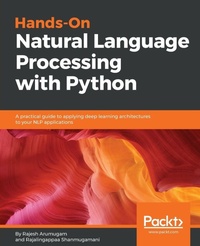
Hands-On Natural Language Processing with Python
A practical guide to applying deep learning architectures to your NLP applications
Published on 18. July 2018
Book
Paperback/Softback
312 pages
978-1-78913-949-5 (ISBN)
Description
Foster your NLP applications with the help of deep learning, NLTK, and TensorFlow
Key Features
Weave neural networks into linguistic applications across various platforms
Perform NLP tasks and train its models using NLTK and TensorFlow
Boost your NLP models with strong deep learning architectures such as CNNs and RNNs
Book DescriptionNatural language processing (NLP) has found its application in various domains, such as web search, advertisements, and customer services, and with the help of deep learning, we can enhance its performances in these areas. Hands-On Natural Language Processing with Python teaches you how to leverage deep learning models for performing various NLP tasks, along with best practices in dealing with today's NLP challenges.
To begin with, you will understand the core concepts of NLP and deep learning, such as Convolutional Neural Networks (CNNs), recurrent neural networks (RNNs), semantic embedding, Word2vec, and more. You will learn how to perform each and every task of NLP using neural networks, in which you will train and deploy neural networks in your NLP applications. You will get accustomed to using RNNs and CNNs in various application areas, such as text classification and sequence labeling, which are essential in the application of sentiment analysis, customer service chatbots, and anomaly detection. You will be equipped with practical knowledge in order to implement deep learning in your linguistic applications using Python's popular deep learning library, TensorFlow.
By the end of this book, you will be well versed in building deep learning-backed NLP applications, along with overcoming NLP challenges with best practices developed by domain experts.What you will learn
Implement semantic embedding of words to classify and find entities
Convert words to vectors by training in order to perform arithmetic operations
Train a deep learning model to detect classification of tweets and news
Implement a question-answer model with search and RNN models
Train models for various text classification datasets using CNN
Implement WaveNet a deep generative model for producing a natural-sounding voice
Convert voice-to-text and text-to-voice
Train a model to convert speech-to-text using DeepSpeech
Who this book is forHands-on Natural Language Processing with Python is for you if you are a developer, machine learning or an NLP engineer who wants to build a deep learning application that leverages NLP techniques. This comprehensive guide is also useful for deep learning users who want to extend their deep learning skills in building NLP applications. All you need is the basics of machine learning and Python to enjoy the book.
Key Features
Weave neural networks into linguistic applications across various platforms
Perform NLP tasks and train its models using NLTK and TensorFlow
Boost your NLP models with strong deep learning architectures such as CNNs and RNNs
Book DescriptionNatural language processing (NLP) has found its application in various domains, such as web search, advertisements, and customer services, and with the help of deep learning, we can enhance its performances in these areas. Hands-On Natural Language Processing with Python teaches you how to leverage deep learning models for performing various NLP tasks, along with best practices in dealing with today's NLP challenges.
To begin with, you will understand the core concepts of NLP and deep learning, such as Convolutional Neural Networks (CNNs), recurrent neural networks (RNNs), semantic embedding, Word2vec, and more. You will learn how to perform each and every task of NLP using neural networks, in which you will train and deploy neural networks in your NLP applications. You will get accustomed to using RNNs and CNNs in various application areas, such as text classification and sequence labeling, which are essential in the application of sentiment analysis, customer service chatbots, and anomaly detection. You will be equipped with practical knowledge in order to implement deep learning in your linguistic applications using Python's popular deep learning library, TensorFlow.
By the end of this book, you will be well versed in building deep learning-backed NLP applications, along with overcoming NLP challenges with best practices developed by domain experts.What you will learn
Implement semantic embedding of words to classify and find entities
Convert words to vectors by training in order to perform arithmetic operations
Train a deep learning model to detect classification of tweets and news
Implement a question-answer model with search and RNN models
Train models for various text classification datasets using CNN
Implement WaveNet a deep generative model for producing a natural-sounding voice
Convert voice-to-text and text-to-voice
Train a model to convert speech-to-text using DeepSpeech
Who this book is forHands-on Natural Language Processing with Python is for you if you are a developer, machine learning or an NLP engineer who wants to build a deep learning application that leverages NLP techniques. This comprehensive guide is also useful for deep learning users who want to extend their deep learning skills in building NLP applications. All you need is the basics of machine learning and Python to enjoy the book.
More details
Language
English
Place of publication
Birmingham
United Kingdom
Target group
Professional and scholarly
US School Grade: College Graduate Student
Dimensions
Height: 235 mm
Width: 191 mm
Thickness: 17 mm
Weight
586 gr
ISBN-13
978-1-78913-949-5 (9781789139495)
Copyright in bibliographic data and cover images is held by Nielsen Book Services Limited or by the publishers or by their respective licensors: all rights reserved.
Schweitzer Classification
Other editions
Additional editions
Rajesh Arumugam | Rajalingappaa Shanmugamani | Auguste Byiringiro
Hands-On Natural Language Processing with Python
A practical guide to applying deep learning architectures to your NLP applications
E-Book
09/2024
Packt Publishing
€27.99
Available for download
Persons
Rajesh Arumugam is an ML developer at SAP, Singapore. Previously, he developed ML solutions for smart city development in areas such as passenger flow analysis in public transit systems and optimization of energy consumption in buildings when working with Centre for Social Innovation at Hitachi Asia, Singapore. He has published papers in conferences and has pending patents in storage and ML. He holds a PhD in computer engineering from Nanyang Technological University, Singapore. Rajalingappaa Shanmugamani is currently working as an Engineering Manager for a Deep learning team at Kairos. Previously, he worked as a Senior Machine Learning Developer at SAP, Singapore and worked at various startups in developing machine learning products. He has a Masters from Indian Institute of TechnologyMadras. He has published articles in peer-reviewed journals and conferences and submitted applications for several patents in the area of machine learning. In his spare time, he coaches programming and machine learning to school students and engineers.
Content
Table of Contents
Getting Started
Text Classification and POS Tagging Using NLTK
Deep Learning and TensorFlow
Semantic Embedding Using Shallow Models
Text Classification Using LSTM
Searching and DeDuplicating Using CNNs
Named Entity Recognition Using Character LSTM
Text Generation and Summarization Using GRUs
Question-Answering and Chatbots Using Memory Networks
Machine Translation Using the Attention-Based Model
Speech Recognition Using DeepSpeech
Text-to-Speech Using Tacotron
Deploying Trained Models
Getting Started
Text Classification and POS Tagging Using NLTK
Deep Learning and TensorFlow
Semantic Embedding Using Shallow Models
Text Classification Using LSTM
Searching and DeDuplicating Using CNNs
Named Entity Recognition Using Character LSTM
Text Generation and Summarization Using GRUs
Question-Answering and Chatbots Using Memory Networks
Machine Translation Using the Attention-Based Model
Speech Recognition Using DeepSpeech
Text-to-Speech Using Tacotron
Deploying Trained Models