

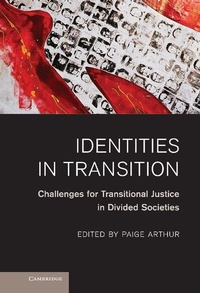
Identities in Transition
Challenges for Transitional Justice in Divided Societies
Published on 13. December 2010
Book
Hardback
392 pages
978-1-107-00369-9 (ISBN)
Description
In many societies, histories of exclusion, racism and nationalist violence often create divisions so deep that finding a way to deal with the atrocities of the past seems nearly impossible. These societies face difficult practical questions about how to devise new state and civil society institutions that will respond to massive or systematic violations of human rights, recognize victims and prevent the recurrence of abuse. Identities in Transition: Challenges for Transitional Justice in Divided Societies brings together a rich group of international researchers and practitioners who, for the first time, examine transitional justice through an 'identity' lens. They tackle ways that transitional justice can act as a means of political learning across communities; foster citizenship, trust and recognition; and break down harmful myths and stereotypes, as steps toward meeting the difficult challenges for transitional justice in divided societies.
Reviews / Votes
'Arthur's edited volume provides an extremely useful tool for the practitioner. Taking a multidimensional approach that understands identities as multiple and complex, the book offers both an indepth and a broad view of the difficult terrain that transitional processes have to traverse, and via country cases studies sets out the different strategies that could be adopted in achieving political reconciliation in postconflict societies.' Ambika Satkunanathan, International Journal of Transitional JusticeMore details
Language
English
Place of publication
Cambridge
United Kingdom
Target group
Professional and scholarly
Dimensions
Height: 235 mm
Width: 157 mm
Thickness: 26 mm
Weight
717 gr
ISBN-13
978-1-107-00369-9 (9781107003699)
Copyright in bibliographic data and cover images is held by Nielsen Book Services Limited or by the publishers or by their respective licensors: all rights reserved.
Schweitzer Classification
Other editions
Additional editions
Book
01/2014
Cambridge University Press
€55.50
Shipment within 15-20 days
E-Book
01/2011
1st Edition
Cambridge University Press
€33.99
Available for download
E-Book
12/2010
1st Edition
Cambridge University Press
€29.49
Available for download
Person
Paige Arthur is Deputy Director of Institutional Learning at the International Center for Transitional Justice, where she leads ICTJ's initiatives in evaluating its impact, improving the effectiveness of its work, and knowledge management. Arthur was formerly ICTJ's Deputy Director of Research. Before coming to ICTJ, she was an editor of the journal Ethics and International Affairs. Arthur was also the Senior Program Officer for the Ethics in a Violent World initiative at the Carnegie Council. She is the author of Unfinished Projects: Decolonization and the Philosophy of Jean-Paul Sartre (2010).
Content
Introduction Paige Arthur; Part I. Identity in Transitional Justice Measures: 1. Indigenous groups and claims for reparation: tentative steps in Peru and Guatemala Ruth Rubio-Marin, Claudia Paz y Paz Bailey and Julie Guillerot; 2. Truth-telling, identities, and power in South Africa and Guatemala Madeleine Fullard and Nicky Rousseau; 3. Security sector reform and identity in Northern Ireland Mary O'Rawe; 4. Staging violence, staging identities: identity politics in domestic prosecutions Christiane Wilke; 5. International and hybrid criminal jurisdictions: stigmatizing or reconciling? Cecile Aptel; 6. Silence, visibility and agency: ethnicity, class and gender in public memorialization in Argentina and Peru Elizabeth Jelin; Part II. Identities, Transition, and Transformation: 7. Transitional justice for indigenous peoples Courtney Jung; 8. Leveraging the rights of minorities and indigenous peoples for transitional justice Chris Chapman; 9. 'Fear of the future, lived through the past': pursuing transitional justice in the wake of ethnic conflict Paige Arthur; 10. Transitional justice, federalism, and the accommodation of minority nationalism Will Kymlicka; 11. History education reform, transitional justice, and the transformation of identities Elizabeth A. Cole and Karen Murphy.